
Medicines
Update of 15/01/2026
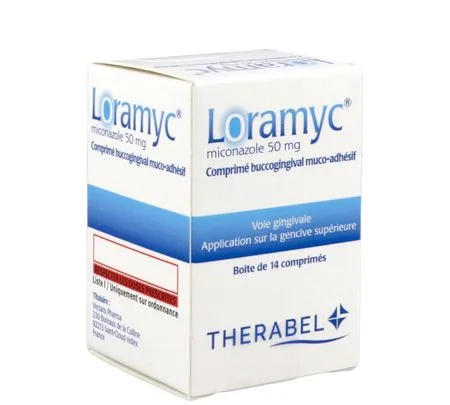
LORAMYC®
miconazole
Forms and presentations
Buccogingival muco-adhesive tablet at 50 mg (with one convex face and one flat face engraved "L"; white to slightly yellow): Bottle of 14, with child-resistant cap.Composition
| per tablet | |
| Miconazole
|
50 mg |
Excipients with known effect: lactose monohydrate, milk protein concentrate, sodium lauryl sulfate.
Indications
Loramyc is indicated for the treatment of oropharyngeal candidiasis in immunocompromised patients (see Pharmacodynamics).Dosage and administration
DosageGingival route.
Reserved for adults.
Application of one muco-adhesive buccal tablet once a day, for 7 to 14 days depending on clinical response. It is preferable to apply the tablet in the morning, after brushing the teeth, as salivary flow is lower at night. Loramyc may be administered with food and drinks.
In case of clinical cure (i.e. complete disappearance of signs and symptoms of the disease) after 7 days of treatment, Loramyc may be discontinued.
When the lesions of oropharyngeal candidiasis are extensive or confluent, treatment must be continued until clinical cure or for up to 14 days.
Method of administration:
Loramyc must be applied to the upper gum, just above the incisor:
- Once the tablet has been removed from the bottle, it must be used immediately. Note that the tablet has one convex face and one flat face.
- The convex face of the tablet must be applied to the upper gum above an incisor. Hold the tablet in place for 30 seconds by applying light finger pressure on the outside of the upper lip.
- If the tablet does not stick, it must be repositioned.
- If the tablet falls off but is not swallowed within the first 6 hours, it must be replaced immediately.
- If Loramyc is accidentally swallowed, it is recommended to drink a glass of water. If it is swallowed within the first 6 hours after application, the tablet should be replaced only once.
- At each new application of Loramyc, the tablet must be applied to the opposite side of the upper gum relative to the previous application.
- Elderly patients:
- Loramyc may be administered to elderly people.
- Paediatric population:
- There is no experience in children.
Contraindications
This medicine must not be used in the following cases:- Hypersensitivity to the active substance, to other imidazole derivatives, or to any of the excipients mentioned in the section Composition.
- Hypersensitivity to milk or milk derivatives.
- Hepatic impairment.
- In combination with vitamin K antagonists, sulfonylurea hypoglycaemic agents, cisapride, pimozide and ergot alkaloids: ergotamine, dihydroergotamine (see Interactions).
Warnings and precautions
The combination of Loramyc with halofantrine is not recommended (see Interactions).
The combination of Loramyc with phenytoin or fosphenytoin requires particular precautions.
This medicinal product is contraindicated in patients with galactose intolerance, total lactase deficiency or glucose-galactose malabsorption syndrome (rare hereditary diseases).
Local irritation has rarely been observed after application of Loramyc.
This medicinal product contains 5,18 mg of sodium lauryl sulfate in a mucoadhesive buccogingival tablet.
Sodium lauryl sulfate may cause local skin reactions (such as a stinging or burning sensation) or increase skin reactions caused by other products when applied to the same area.
Severe hypersensitivity reactions, including anaphylaxis and angioedema, have been reported during treatment with miconazole-based formulations. If a reaction suggestive of hypersensitivity or irritation occurs, treatment must be discontinued.
Loramyc must be applied to the upper gum, just above the incisor:- All situations that could disrupt the adhesion of the tablet should be avoided, such as touching or pressing the place where the tablet is placed. Chewing gum should also be avoided.
- The tablet must not be sucked, chewed or swallowed.
- If teeth are brushed during the day, care should be taken not to touch the tablet and to rinse the mouth carefully.
- If the mouth becomes dry, moisten the gum before applying the mucoadhesive buccogingival tablet.
- If the tablet falls out or is accidentally swallowed within the first 6 hours, it must be replaced immediately.
- Accidental ingestion of Loramyc may occur. If Loramyc is accidentally swallowed, it is recommended to drink a glass of water.
The clinical cure rate is lower in patients with extensive or confluent oropharyngeal candidiasis.
Interactions
Drug interactionsMiconazole is an inhibitor of cytochromes CYP2C9 and CYP3A4. No interaction study has been performed with Loramyc.
Although the systemic absorption of Loramyc has been insufficiently evaluated, the administration of medicinal products with a narrow therapeutic margin that are metabolised by CYP2C9 and CYP3A4 is contraindicated due to increased exposure (see Contraindications).
Contraindicated:
- Vitamin K antagonists: unpredictable haemorrhage, possibly serious.
- Cisapride: increased risk of ventricular arrhythmias, in particular torsades de pointes.
- Pimozide: increased risk of ventricular arrhythmias, in particular torsades de pointes.
- Ergot alkaloids (ergotamine and dihydroergotamine): risk of ergotism with necrosis of the extremities.
- Sulfonylurea hypoglycaemic agents: increased hypoglycaemic effect with possible occurrence of hypoglycaemic manifestations, even coma.
Not recommended:
- Halofantrine: increased risk of ventricular arrhythmias, particularly torsades de pointes.
Requiring precautions for use:
- Phenytoin (and, by extrapolation, fosphenytoin): increase in plasma concentrations of phenytoin, which may reach toxic values. Proposed mechanism: inhibition of hepatic metabolism of phenytoin. Close clinical monitoring, measurement of plasma phenytoin and possible dose adjustment of phenytoin during treatment with miconazole and after its discontinuation.
Fertility, pregnancy and breastfeeding
Pregnancy:There are no sufficiently relevant data on the use of miconazole in pregnant women. Animal studies have not shown a teratogenic effect, but other effects on reproduction have been observed (see Preclinical safety). The risk in humans is unknown. Miconazole should be used during pregnancy only if necessary.
Breastfeeding:
There are no data on the excretion of miconazole into breast milk. Consequently, caution is required when prescribing to a woman who is breastfeeding.
In case of cisapride intake in the newborn or breastfed infant, administration of miconazole to the mother is contraindicated as a precaution, due to the potential risk of interaction in the child (torsades de pointes).
Fertility:There are no available data concerning the effect of miconazole on fertility.
Driving and using machines
There is no study establishing whether Loramyc does or does not impair the ability to drive vehicles or use machines. Nevertheless, miconazole is known to have no effect on alertness or the ability to drive.Adverse effects
The safety of Loramyc was evaluated in 740 patients included in five clinical studies. The most frequently observed serious adverse effects included gastrointestinal disorders.
Table of undesirable effects:
The following adverse effects were reported from 5 clinical studies conducted at the recommended dose of 50 mg per day for 7 or 14 days, with frequencies corresponding to: very common (≥ 1/10); common (≥ 1/100, < 1/10); uncommon (≥ 1/1000, < 1/100); rare (≥ 1/10 000, < 1/1000); very rare (< 1/10 000); frequency not known (cannot be estimated from the available data).
| System organ class | Common | Uncommon | Not known |
| Infections and infestations | Upper respiratory tract infections | ||
| Metabolism and nutrition disorders | Decreased appetite | ||
| Nervous system disorders | Headache
Dysgeusia Ageusia |
||
| Vascular disorders | Hot flushes | ||
| Gastrointestinal disorders | Diarrhoea
Vomiting Nausea Abdominal pain Glossodynia Dry mouth Discomfort in the mouth |
Oral ulceration
Gingival pain Gingival pruritus |
|
| Skin and subcutaneous tissue disorders | Skin rash
Pruritus |
Acute generalised exanthematous pustulosis
Severe skin reactions* Fixed pigmented erythema |
|
| General disorders and administration site conditions | Pain at the application site
Irritation at the application site, which may progress to ulceration or erosion Fatigue |
Reporting of suspected adverse reactions:
Reporting suspected adverse reactions after authorisation of the medicinal product is important. It allows continuous monitoring of the benefit/risk balance of the medicinal product. Healthcare professionals should report any suspected adverse reaction via the national reporting system: National Agency for the Safety of Medicines and Health Products (ANSM) and the network of Regional Pharmacovigilance Centres. Website: https://signalement.social-sante.gouv.fr.
Overdose
- Symptoms:
- In case of accidental overdose, vomiting and diarrhoea may occur.
- Treatment:
- There is no known antidote for miconazole. Overdose must be treated symptomatically.
- In case of accidental ingestion of a large quantity of Loramyc, an appropriate gastric lavage method may be used if necessary.
- No cases of overdose have been reported with Loramyc.
Pharmacodynamics
Pharmacotherapeutic class: Anti-infective for local oral treatment (ATC code: A01AB09).
- Mechanism of action:
- Miconazole exerts its antifungal activity by inhibiting ergosterol biosynthesis in the cell membrane of the pathogenic organism. At low concentration, it interacts with fungal cytochrome P450, which results in inhibition of 14-α-demethylation, a step in ergosterol biosynthesis. Depletion of ergosterol and concomitant accumulation of lanosterol lead to alterations of a number of membrane functions. Miconazole has a fungistatic effect through inhibition of membrane sterol synthesis and a fungicidal effect through alteration of the barrier function of the fungal membrane.
- Microbiology:
- Miconazole has a broad spectrum of antifungal activity. It is active against species of Candida, including Candida albicans, and also non-albicans species such as Candida glabrata, Candida krusei, Candida parapsilosis, Candida tropicalis and Candida pseudotropicalis.
- Miconazole also has antibacterial activity against Gram-positive bacteria (including Streptococcus pyogenes, Staphylococcus aureus and Erysipelothrix insidiosa).
- The Candida species most frequently encountered in oral candidiasis (Candida albicans, Candida glabrata, Candida krusei and Candida tropicalis) are susceptible to miconazole.
- In most recent studies, the minimum inhibitory concentration (MIC) of miconazole ranges from 0,03 to 1 µg/ml for Candida albicans and from 0,03 to 4 µg/ml for Candida no albicans, including Candida glabrata and Candida krusei which are intrinsically resistant to fluconazole.
- In clinical trials in HIV-positive patients, Candida albicans is the most prevalent species (87,5 %). In patients with head and neck cancer, among the 321 isolates identified at inclusion, Candida albicans represents 62,6 % of isolates and Candida no albicans 37,4 % [including Candida tropicalis (30,8 %), Candida krusei (22,5 %), and Candida glabrata (10,8 %)].
- The MIC90 of miconazole for clinical isolates of Candida (Candida albicans 87,5 %, Candida tropicalis 8 % and Candida parapsilosis 2,1 %) measured during a clinical trial in 577 HIV-positive patients was 0,25 µg/ml before treatment. After 14 days of treatment, no resistance to miconazole was detected.
- Drug resistance:
- Clinical resistance to systemically administered triazole agents may occur in species of Candida. Resistance is determined by multiple mechanisms, mainly changes in amino acids and/or in the regulation of the target enzyme and efflux pumps. Several mechanisms frequently coexist in the same isolate. Cross-resistance among azoles is not complete, even within the triazole subclass. Cross-resistance depends on a number of factors, including the species evaluated, clinical history, the azole compound chosen as comparator, and the type of susceptibility test performed.
- Resistance breakpoints, correlating activity in vitro with clinical efficacy, have not been established for miconazole.
- No primary resistance of species of Candida to miconazole, an azole belonging to the imidazole class, has been described in the literature, and acquired resistance to miconazole has rarely been described, even in patients treated repeatedly. In experiments in vitro with 150 recent clinical isolates, repeated exposure to miconazole does not induce resistance among species of Candida susceptible or resistant to triazoles.
- However, a significant increase in the miconazole MIC was observed in 2 strains out of 6 of Candida even though the MICs remained below 0,5 µg/ml.
- Therefore, the emergence of miconazole-resistant strains cannot be excluded after repeated exposure to antifungal treatments.
- Clinical experience:
- In a randomised, comparative, investigator-blinded study conducted in patients with head and neck cancer who had been treated with radiotherapy (all patients had mucositis, oral inflammation or erythema and 96 % had reduced salivary flow), the response rate on day 14 and the relapse rate on day 60 in patients with a complete clinical response (no oral lesions) were:
-
Loramyc 50 mg Miconazole gel ITT population: N = 141 N = 141 Complete clinical response rate 52,48 % 45,39 % - Treatment difference (CI 95 %) + 7,09 (- 19,0 ; 4,8) Relapse rate on day 60
(CI 95 %)21,62 %
(13,79 ; 32,31)17,19 %
(9,92 ; 28,27)Population PP: N = 107 N = 106 Complete clinical response rate 53,27 % 51,89 % - Treatment difference (CI 95 %) + 1,38 (- 15,1 ; 12,3) Relapse rate on day 60
(CI 95 %)24,56 %
(15,26 ; 37,17)14,55 %
(7,62 ; 26,22) - In a comparative, randomised, double-blind study conducted in HIV-positive patients, the clinical cure rate (no signs and no symptoms of oropharyngeal candidiasis) after treatment of 14 days (between day 17 and day 22) and the relapse rate at day 35 were as follows:
-
Loramyc 50 mg Clotrimazole lozenges 10 mg ITT population: N = 290 N = 287 Clinical cure rate 60,7 % 65,2 % - Treatment difference (CI 95 %) - 4,5 (- 12,4 ; 3,4) Relapse rate at day 35
(CI 95 %)27,9 %
(21,3 ; 35,2)28,1 %
(21,8 ; 35,2)Population PP: N = 240 N = 236 Clinical cure rate 68,3 % 74,2 % - Treatment difference (CI 95 %) - 5,9 (- 14,0 ; 2,2) Relapse rate at day 35
(CI 95 %)26,9 %
(20,2 ; 34,4)27,6 %
(21,1 ; 34,9) - In an open-label, non-comparative study including 25 HIV-positive patients treated with Loramyc, the response rate at day 14 was 84 % (CI 95 %: 63,9; 95,5) and the relapse rate at day 45 was 38,5 % (CI 95: 13,8; 68,4) in patients with clinical cure (no signs, no symptoms of oropharyngeal candidiasis).
- The HIV-positive patients included in the clinical studies were severely immunocompromised. More than 50 % had a CD4+ < 250/mm3, and 5 % had a CD4+ < 50/mm3, the viral load was high (117 000 copies/ml).
- Overall, in clinical trials, 94,3 % of Loramyc tablets adhere to the gum for more than 6 hours.
Pharmacokinetics
The oral bioavailability of miconazole is low (25-30 %) because miconazole is poorly absorbed from the gastrointestinal tract. Most of the absorbed miconazole is metabolised by the liver. A proportion of less than 1 % of the administered dose is recovered unchanged in the urine.
In cases of renal impairment, the pharmacokinetics of miconazole are not significantly altered. There are no active metabolites and the elimination half-life is of the order of 20 hours.
A single administration of Loramyc containing 50 mg of miconazole to healthy subjects leads to a mean maximum salivary concentration of 15 µg/ml, reached 7 hours after tablet administration, with an area under the curve (AUC0-24 h) of 55,23 µg.h/ml.
After application of a single Loramyc 50 mg tablet, salivary miconazole concentrations above 1 µg/ml (upper limit of the MIC value for Candida albicans strains Candida albicans) were reached within 1 hour and lasted on average 13 hours.
Plasma miconazole concentrations were undetectable as they were below the limit of quantification (0,4 µg/ml) in the majority of healthy subjects, confirming the low absorption of miconazole through the buccal mucosa and from the gastrointestinal tract after swallowing saliva.
After 7 days of treatment in patients, plasma miconazole concentrations were undetectable (limit of quantification: 0,2 ng/ml) in 21,5 % of patients and were negligible (below 10 ng/ml) in more than 90 % of patients.
Preclinical safety
In single and repeated dose toxicity studies and pre- and postnatal development studies, toxic effects were observed in animals (mouse, rat, rabbit, dog) only at doses higher (approximately 30 to > 900 times) the maximum recommended dose in humans (0,7 mg/kg).
Embryotoxic but not teratogenic effects of miconazole were observed in reproduction studies.
The standard battery of genotoxicity tests (Ames, chromosomal aberration, micronucleus) did not reveal any genotoxic potential.
Local tolerance studies (hamster cheek pouch and LLNA sensitisation test in mice) did not reveal any particular toxicity.
No carcinogenicity study has been conducted with miconazole.
Storage conditions
- Shelf life
- 3 years.
This medicinal product does not require any special precautions for storage regarding temperature.
Store the bottle tightly closed, protected from moisture.
HANDLING/DISPOSAL INSTRUCTIONS
No special requirements for disposal.
Prescription, supply and reimbursement
LIST I| Marketing authorisation (AMM) | 3400937723640 (2006, SmPC rev 01.12.2025). |
| Price: | 64,69 euros (14 tablets). |
| Reimbursed by Social Security at 65 %. Collective. | |
| Marketing authorisation holder: Vectans Pharma, 230, bureaux de la Colline, 92213 Saint-Cloud Cedex. | |
CSP
76-78, avenue du Midi. CS 30077
63808 Cournon d'Auvergne cdx
Tel: 04 73 69 28 28. Fax: 04 73 69 93 15
Medical information and pharmacovigilance: Tel: 01 47 04 80 46
Source: VIDAL · Updated on 11/11/2026. This information does not replace advice from a healthcare professional.