
Medicines
SmPC of the 28/04/2022
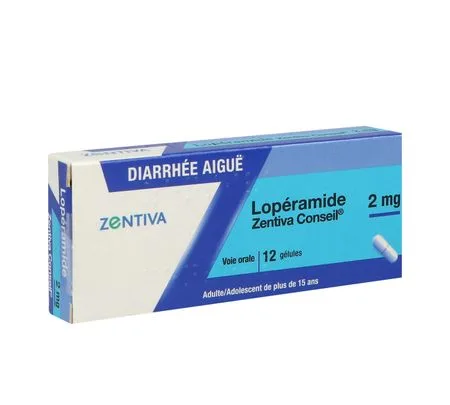
LOPERAMIDE ZENTIVA CONSEIL 2 mg, capsule
Composition
Loperamide hydrochloride.................................................................................................................................2 mg
For one capsule.
Excipient with known effect: lactose.
Rice starch, lactose monohydrate, magnesium stearate, talc.
Composition of the capsule shell : gelatin, titanium dioxide (E171).
Indications
Short-term treatment of acute transient diarrhoea in adults (from 15 years of age).
This treatment is a complement to dietary measures.
Dosage and administration
Dosage
Reserved for adults (from 15 years of age).
Initial dose: 2 capsules, then 1 additional capsule, to be taken after each unformed stool, but:
- never exceed 6 capsules per day,
- never exceed 2 days of treatment.
Method of administration
Oral use.
Contraindications
- Hypersensitivity to the active substance or to any of the excipients listed in section Composition.
- Acute flare-ups of haemorrhagic rectocolitis (risk of colectasia).
Warnings and precautions
Special warnings
- This medicine is not suitable for children (under 15 years).
- If diarrhoea persists after 2 days of treatment, the course of action should be reassessed and the need for rehydration with oral rehydration solution or by intravenous route should be considered.
This medicinal product contains lactose. Its use is not recommended in patients with galactose intolerance, Lapp lactase deficiency or glucose-galactose malabsorption syndrome (rare hereditary disorders).
Cardiac effects including prolongation of the QT interval, widening of the QRS complex and torsades de pointes have been reported in cases of overdose. In some cases the outcome was fatal (see section Overdose). Overdose may unmask an existing Brugada syndrome. Patients must not exceed the recommended dose and/or duration of treatment.
Precautions for use
- Loperamide should not be used as first-line treatment in acute dysentery with blood in the stools and high fever.
- Loperamide must not be used in cases of diarrhoea occurring during broad-spectrum antibiotic treatment. Indeed, pseudomembranous colitis with toxi-infection must then be feared. In this case, any treatment causing faecal stasis must be avoided.
- As a general rule, loperamide should not be used when inhibition of peristalsis must be avoided, and its administration should be interrupted if constipation or abdominal distension occurs.
- Patients with hepatic insufficiency must be under particular monitoring due to the significant effect of 1 passage.er passage.
Fertility, pregnancy and breastfeeding
Pregnancy
Animal studies have not shown any teratogenic effect. In the absence of a teratogenic effect in animals, a malformative effect in humans is not expected. Indeed, to date, substances responsible for malformations in humans have been shown to be teratogenic in animals in well-conducted studies in two species.
In clinical practice, use of loperamide during a limited number of pregnancies has so far apparently revealed no particular malformative or foetotoxic effect.
However, additional studies are needed to assess the consequences of exposure during pregnancy.
Consequently, use of loperamide should be considered during pregnancy only if necessary.
In case of prolonged treatment, take into account its opioid properties, which may in particular affect the digestive functions of the newborn.
Breast-feeding
Loperamide passes into breast milk to a very small extent; consequently, breastfeeding is possible in case of occasional treatment with this medicine.
In case of prolonged treatment, take into account its opioid properties.
Driving and using machines
This medicine sometimes causes slight and transient drowsiness. Attention is drawn, particularly for drivers of vehicles and users of certain machines, to the possible risks of drowsiness associated with the use of this medicine.
Adverse effects
- Constipation and/or abdominal distension, associated in very rare cases with ileus, the risk of which may be increased if the information concerning use has not been respected (see section Dosage and administration and section Contraindications).
- Abdominal pain, bloating, nausea, vomiting, dry mouth.
- Asthenia, drowsiness, dizziness.
- Rarely hypersensitivity reactions (including skin rash, urticaria and angio-oedema) and extremely rarely anaphylactic shock.
- Acute pancreatitis (frequency not determined).
Reporting of suspected adverse reactions
Reporting suspected adverse reactions after marketing authorisation of the medicinal product is important. It allows continued monitoring of the benefit/risk balance of the medicinal product. Healthcare professionals are asked to report any suspected adverse reactions via the national reporting system: National Agency for the Safety of Medicines and Health Products (ANSM) and the network of Regional Pharmacovigilance Centres - Website: www.signalement-sante.gouv.fr.
Overdose
Symptoms :
In case of overdose (including overdose related to hepatic insufficiency), depression of the central nervous system (decreased alertness, drowsiness, miosis, hypertonia, respiratory depression, motor incoordination) and ileus may be observed. Children may be more sensitive to effects on the central nervous system.
Cardiac effects, such as prolongation of the QT interval and widening of the QRS complex, torsades de pointes, other serious ventricular arrhythmias, cardiac arrest and syncope, have been observed in individuals who ingested excessive doses of loperamide (see section Warnings and precautions). Fatal cases have also been reported. Overdose may unmask an existing Brugada syndrome.
Emergency procedure, antidote :
Naloxone may be used as an antidote. As the duration of action of the specialty is longer than that of naloxone (1 to 3 hours), it may be necessary to repeat administration of the latter. Consequently, the patient must be kept under medical supervision for at least 48 hours to detect any depression of the central nervous system.
Pharmacodynamics
Pharmacotherapeutic class: Antidiarrhoeal, ATC code: A07DA03
(A: alimentary tract and metabolism)
- Antidiarrhoeal, structural analogue of opioids.
- Antisecretory activity by increasing the hydro-electrolytic flow from the intestinal lumen towards the plasma pole of the enterocyte and reducing the reverse flow.
- Slowing of colonic transit with increased segmental contractions.
- Rapid and lasting effects.
- Respects the bacteriological and parasitological characteristics of the stools.
Pharmacokinetics
Loperamide is poorly absorbed by the digestive route. It undergoes a significant first-pass hepatic effect.
Plasma concentrations are low (2 ng/ml after administration of approximately 8 mg of loperamide per day).
In humans, the peak plasma concentration occurs between 2 and 4 hours.
Loperamide is mainly metabolised by the liver, and its elimination half-life is 10 to 15 hours. It is eliminated essentially in the faeces.
Preclinical safety
Non-clinical in vitro and in vivo studies with loperamide hydrochloride show no significant effect on cardiac electrophysiology at concentrations corresponding to the therapeutic margin and for large multiples of this margin (up to 47 times). However, at extremely high concentrations associated with overdose (see section Warnings and precautions), loperamide acts on cardiac electrophysiology by inhibiting potassium (hERG) and sodium channels, and causes arrhythmias.
Prescription, supply and reimbursement
| Marketing authorisation (AMM) |
|
35 RUE DU VAL DE MARNE CS 91439
75214 PARIS CEDEX 13
Tel: 0 800 089 219 https://www.zentiva.com/
Source: VIDAL · Updated on 11/11/2026. This information does not replace advice from a healthcare professional.