Medicines
SmPC of 28/07/2022
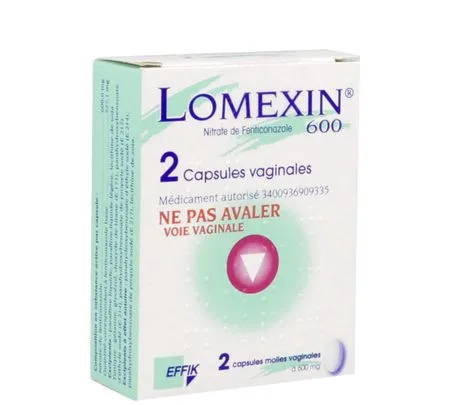
LOMEXIN 600 mg, vaginal soft capsule
Composition
For one vaginal soft capsule:
Fenticonazole nitrate: 600,0 mg
Quantity corresponding to fenticonazole base: 527,1 mg
Excipients with known effect : sodium ethyl parahydroxybenzoate, sodium propyl parahydroxybenzoate (E 217), soya lecithin.
Liquid paraffin, light liquid paraffin, soya lecithin.
Composition of the capsule shell :
Gelatin, glycerol, titanium dioxide (E171), sodium ethyl parahydroxybenzoate, sodium propyl parahydroxybenzoate (E 217).
Indications
Genital candidiasis (vulvovaginitis, cervicitis) superinfected or not by Gram-positive bacteria.
Dosage and administration
One capsule of 600 mg, at bedtime, as a single administration. The capsule must be inserted deeply into the vagina, preferably in a lying position at bedtime.
In case of recurrent or resistant mycosis, administration may be renewed after three days.
Treatment of the partner (foreskin and glans) will be discussed on a case-by-case basis.
Practical advice
- washing with a pH-neutral or alkaline soap,
- treatment will be accompanied by hygiene advice (wearing cotton underwear, avoiding vaginal douching ...) and, where possible, removal of predisposing factors,
- to treat vulvar or perianal extensions of the mycosis, it is recommended to combine the gynaecological ovules with an antifungal lotion or cream applied locally,
- do not interrupt treatment during menstruation.
Paediatric population
The safety and efficacy of LOMEXIN in children under 16 years have not been established. No data are available. The recommended dose for children over 16 years is identical to that for adults.
Contraindications
- Hypersensitivity to the active substance or to any of the excipients listed in section Composition.
- Due to the presence of soya lecithin, this medicine must not be used in patients allergic to peanut or soya.
Warnings and precautions
Certain excipients of the vaginal capsules (parahydroxybenzoates) may cause allergic reactions (possibly delayed). In case of hypersensitivity or allergic reaction, treatment must be discontinued.
Patients are advised to consult their doctor in case of:
- no improvement of symptoms within one week
- recurrent symptoms (more than 2 infections during the past 6 months)
- history of sexually transmitted disease or exposure to a partner with a sexually transmitted disease
- age over 60 years
- known hypersensitivity to imidazoles or other vaginal antifungal products
- any abnormal or irregular vaginal bleeding
- any vaginal discharge with traces of blood
- any vulvar or vaginal wound, ulcer or blister
- any lower abdominal pain or dysuria
- any adverse effect such as erythema, pruritus or rash associated with the treatment.
Vaginal capsules must not be used in combination with barrier contraceptives, spermicides, intravaginal douches or other vaginal products (see section Interactions). Appropriate treatment is indicated when the partner is also infected.
Fenticonazole should be used during pregnancy and breastfeeding only under medical supervision (see section Fertility, pregnancy and breastfeeding).
Interactions
No interaction studies have been performed.
The fatty excipients and oils contained in the vaginal capsules may damage latex contraceptives. Patients should be advised to use alternative contraceptive methods/precautions while using this product.
Combinations not recommended
+ Spermicides:
Any local vaginal treatment may inactivate a local spermicidal contraceptive.
Fertility, pregnancy and breastfeeding
Pregnancy
Data on the use of fenticonazole in pregnant women are limited. Animal studies have shown no teratogenic effect. Embryotoxic and foetotoxic effects were observed only at very high doses administered orally. Low systemic exposure to fenticonazole is expected after vaginal treatment (see section Pharmacokinetics). Fenticonazole should be used during pregnancy under the supervision of a physician.
Breast-feeding
Oral animal studies have shown that fenticonazole and/or its metabolites may be excreted in milk. After vaginal administration, the negligible amount of fenticonazole absorbed does not pass significantly into breast milk (see section Pharmacokinetics). Even though no data available in women show that vaginally administered fenticonazole is excreted (and/or its metabolites) in milk, a risk to the baby cannot be excluded. Fenticonazole should be used during breastfeeding only under the supervision of a physician.
Fertility
No human study on the effects of fenticonazole on fertility has been conducted, but animal studies have shown no effect of the medicine on fertility.
Driving and using machines
Lomexin has negligible or no effect on the ability to drive vehicles and use machines.
Adverse effects
When used as recommended, Lomexin is only weakly absorbed and no systemic adverse reactions are expected. A slight transient burning sensation may occur after application. Prolonged use of topical products may lead to sensitisation (see section Warnings and precautions).
In the table below, adverse effects are reported and listed by MedDRA system organ class and by frequency: very common (≥ 1/10); common (≥ 1/100 to < 1/10); uncommon (≥ 1/1 000 to < 1/100); rare (≥ 1/10 000 to < 1/1 000); very rare (< 1/10 000); unknown (frequency cannot be estimated from available data).
|
System organ class |
Frequency |
MedDRA terminology |
|
Disorders of the reproductive system and breast |
Very rare |
Vulvovaginal burning sensation |
|
Skin and subcutaneous tissue disorders |
Very rare |
Erythema
|
|
General disorders and administration site conditions |
Unknown |
Hypersensitivity at the application site |
Reporting of suspected adverse reactions
Reporting suspected adverse reactions after authorisation of the medicinal product is important. It allows continued monitoring of the benefit/risk balance of the medicinal product. Healthcare professionals are asked to report any suspected adverse reactions via the national reporting system: National Agency for the Safety of Medicines and Health Products (ANSM) and the network of Regional Pharmacovigilance Centres - Website: https://signalement.social-sante.gouv.fr.
Overdose
No cases of overdose have been reported. LOMEXIN is intended for local application and not for oral use. In the event of accidental ingestion, abdominal pain and vomiting may occur.
Pharmacodynamics
Pharmacotherapeutic class: LOCAL ANTIFUNGALS, ATC code: G01AF12.
Fenticonazole nitrate is an imidazole derivative with antifungal and antibacterial activity.
The antifungal activity has been demonstrated in vitro and acts on the agents responsible for mucocutaneous mycoses:
- dermatophytes (Trichophyton, Epidermophyton, Microsporum),
- Candida and other yeasts.
An inhibitory activity on acid proteinase secretion by Candida albicans has also been demonstrated in vitro, but it is not confirmed in vivo, in the absence of a study.
In vivo: eradication of vaginal Candida mycoses in mice after 5 days of treatment.
The antibacterial activity has been demonstrated in vitro against Gram-positive bacteria. Its mechanism of action, which differs from that of antibiotics, operates at several levels: membrane (increased permeability), cytoplasmic (inhibition of oxidative processes at the level of the mitochondria), and nuclear (inhibition of RNA synthesis).
Pharmacokinetics
Pharmacokinetic studies have shown that there was no transcutaneous absorption, whether in women or in animals, and that vaginal absorption was very low.
Preclinical safety
Non-clinical data from conventional repeated-dose oral toxicology studies and genotoxicity studies did not reveal any particular risk for humans.
Reproductive toxicity studies conducted by the oral route did not reveal any impairment of fertility or teratogenicity, but embryofetotoxicity was observed in rats from 40 mg/kg and in rabbits at all doses tested.
SPECIAL PRECAUTIONS FOR DISPOSAL AND OTHER HANDLING
Insert a capsule deep into the vagina, preferably in the lying position.
Source: VIDAL · Updated on 11/11/2026. This information does not replace advice from a healthcare professional.