
Medicines
SmPC of 20/04/2026
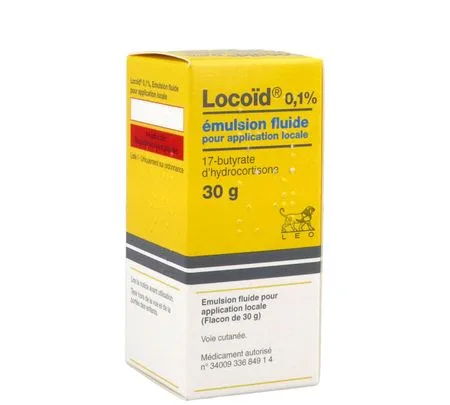
LOCOID 0,1 %, fluid emulsion for topical application
Composition
For 100 g of fluid emulsion:
17-hydrocortisone butyrate: 0,100 g
Excipients with known effect: butylhydroxytoluene (E321) and parahydroxybenzoates (propyl E216 and butyl).
Macrogol 100 monocetyl ether, cetylstearyl alcohol, petrolatum, solid paraffin, borage oil, butylhydroxytoluene (E321), propylene glycol, anhydrous sodium citrate, anhydrous citric acid, propyl parahydroxybenzoate, butyl parahydroxybenzoate, purified water.
Indications
LOCOID is indicated for the treatment of inflammatory, allergic and pruritic dermatoses not caused by microorganisms.
1. Preferred indications where topical corticosteroid therapy is considered the best treatment
- Contact eczema.
- Atopic dermatitis.
2. Indications where topical corticosteroid therapy is one of the usual treatments
- Stasis dermatitis.
- Maintenance treatment of psoriasis, in skin folds or in children.
- Seborrheic dermatitis except on the face.
3. Indications of circumstance for a short duration
- Insect bites and parasitic prurigo after etiological treatment.
The emulsion form is more particularly suited to the treatment of dermatoses localized to hairy regions or areas of heavy sweating.
LOCOID is indicated in adults, children and infants older than 3 months.
Dosage and administration
Dosage
1 to 2 application(s) per day in a thin, uniform layer on the affected area of skin.
An increase in the number of daily applications would risk worsening adverse effects without improving therapeutic effects.
Treatment of large surface areas requires monitoring of the number of bottles used.
Method of administration
For rational use, it is advised to apply the product in spaced dabs and then spread it until it is completely absorbed.
Wash hands after each application, unless LOCOID is used to treat the hands.
Certain dermatoses (psoriasis, atopic dermatitis...) make a gradual discontinuation desirable. It may be achieved by reducing the frequency of applications and/or by using a less potent or less concentrated corticosteroid.
Paediatric population
The safety and efficacy of this medicine in children aged under 3 months have not been established. In children and infants, the use of large quantities and treatments under occlusive dressing or prolonged treatments should be avoided. In infants, treatment should normally not exceed 7 days in general.
Elderly
No special precautions and no dosage adjustment are necessary in elderly patients.
Contraindications
- Hypersensitivity to the active substance or to any of the excipients listed in section Composition.
- Skin conditions caused by infections due to bacteria, viruses, fungi, yeasts or parasites.
- Ulcerated lesions.
- Acne and rosacea.
- Perioral dermatitis.
Warnings and precautions
Special warnings
Manifestations of hypercortisolism (Cushing's syndrome) and reversible inhibition of the hypothalamic-pituitary-adrenal axis leading to adrenocortical insufficiency may occur in some subjects due to an increase in the systemic absorption of topical corticosteroids. In either case, the medicine should be gradually discontinued by reducing the frequency of application, or by substituting a corticosteroid of lower potency. Abrupt cessation of treatment may lead to adrenocortical insufficiency (see section Adverse effects).
The factors likely to increase systemic effects are the following
- Activity and formulation of the topical corticosteroid,
- Duration of exposure,
- Application over a large area,
- Occlusive application to the skin: for example, to intertriginous areas or under an occlusive dressing or under nappies
- Increased hydration of the stratum corneum of the skin,
- Application on thin skin surfaces such as the face,
- Application to skin lesions or other situations involving an impairment of the skin barrier.
Visual disorders
Visual disturbances may occur with systemic or local corticosteroid therapy. In case of blurred vision or the appearance of any other visual symptom during corticosteroid therapy, an ophthalmological examination is required to look for cataract, glaucoma, or rarer lesions such as central serous chorioretinopathy, as described with systemic or local administration of corticosteroids.
Precautions for use
Use in psoriasis
Topical corticosteroids should be used with caution in psoriasis, as rebound effects, development of tolerance, a risk of generalised pustular psoriasis and local or systemic toxicity due to impaired skin barrier have been reported in some cases. Use in the treatment of psoriasis requires careful medical supervision.
Application to the eyelids
LOCOID must not be applied to the eyelids because of the risks of glaucoma or cataract.
LOCOID must not be applied to mucous membranes (inside the nose, mouth, ears).
Application on the face
Prolonged use on the face of corticosteroids of moderate or high potency exposes to the occurrence of corticosteroid-induced dermatitis, paradoxically corticosteroid-sensitive, with rebound after each discontinuation. Gradual weaning, which is particularly difficult, is then necessary.
The skin of the face and genital organs is more sensitive to corticosteroids than other skin sites. LOCOID should therefore be used with caution on these areas.
The risk of systemic undesirable effects is increased when treating intertriginous areas, extensive skin surfaces or under occlusive dressing, as well as in cases of frequent administration or prolonged treatment.
If local intolerance appears, treatment must be discontinued and the cause must be investigated.
A rebound effect may be observed upon abrupt discontinuation after long-term treatment. This can be avoided by gradual tapering. Long-term use of topical steroids may lead to a rebound effect after treatment is stopped (local corticosteroid withdrawal reaction). This rebound phenomenon can be severe and develop in the form of dermatitis associated with intense redness, painful tingling and burning sensations that may spread beyond the initial treatment area. These reactions are more likely to occur when delicate skin areas, such as the face and flexural folds, are treated. If the condition reappears within days or weeks following successful treatment, a withdrawal reaction should be suspected. Re-treatment must be carried out with caution, and in this case, consultation with a specialist is recommended, or other treatment options should be considered.
Excipients:
This medicine contains butylhydroxytoluene (E321) which may cause local skin reactions (for example contact dermatitis), or irritation of the eyes and mucous membranes.
This medicine contains parahydroxybenzoates (propyl E216 and butyl), which may cause allergic reactions (possibly delayed).
Paediatric population:
Clinical studies have not shown specific problems in the paediatric population that would limit the use of topical hydrocortisone 17-butyrate in children. However, compared with adults, children's skin, particularly that of infants and young children, may absorb proportionally greater amounts of topical corticosteroids and is therefore more exposed to systemic adverse effects (Cushingoid syndrome and growth retardation). This is because children have an immature skin barrier and a greater body surface area to weight ratio compared with adults. These effects disappear when treatment is stopped, but abrupt discontinuation may be followed by acute adrenal insufficiency.
In infants, it is preferable to avoid corticosteroids of strong activity.
Particular caution should be exercised regarding spontaneous occlusion phenomena that may occur in skin folds or under nappies.
Particular caution is required for dermatoses in early childhood, including napkin erythema in infants.
Interactions
Metabolic disorders such as decreased glucose tolerance are observed with concomitant use of topical corticosteroids and antidiabetic agents. Inform the patient and reinforce blood and urine glucose self-monitoring, especially at the start of treatment.
Fertility, pregnancy and breastfeeding
Pregnancy
Clinical data collected from a large number of pregnancies exposed to mild or moderate topical corticosteroids have not revealed a significant increase in foetal developmental abnormalities. Although animal studies have revealed teratogenic effects such as intrauterine growth retardation and the occurrence of cleft palate, clinical relevance in humans has not been established.
In a limited number of case-control studies, a significant association between the use of topical corticosteroids and cleft palate has been noted. However, this association has not been observed in several other case-control studies, retrospective cohort studies or registry analyses.
The use of LOCOID may be considered during pregnancy, regardless of the stage, only if the benefit outweighs the potential risk. As a precaution, pregnant women should not use LOCOID for a prolonged period or over a large area.
Breast-feeding
Corticosteroids pass into breast milk after systemic administration. Given the topical use, this medicine may be used during breastfeeding.
Do not apply to the breasts during breastfeeding.
Fertility
There are no animal or human data on the effect of LOCOID on fertility.
Driving and using machines
LOCOID has no or negligible influence on the ability to drive vehicles and use machines.
Adverse effects
Cases of skin irritation and hypersensitivity have been reported during clinical studies.
The adverse effects most frequently reported after marketing are hypersensitivity and skin effects such as erythema, pruritus and skin infections.
Adverse effects are presented by MedDRA system organ class:
- Very common (≥ 1/10).
- Frequent (≥ 1/100 and < 1/10).
- Uncommon (≥ 1/1 000 and < 1/100).
- Rare (≥ 1/10 000 and < 1/1 000).
- Very rare (< 1/10 000).
- Frequency not determinable (cannot be estimated from the available data).
Within each frequency group, adverse effects are presented in decreasing order of severity.
|
Infections and infestations |
|
|
Frequency not known |
Skin infection |
|
Immune system disorders |
|
|
Frequency not known |
Hypersensitivity |
|
Endocrine disorders |
|
|
Very rare (< 1/10 000) |
Adrenal suppression |
|
Eye disorders |
|
|
Frequency not known |
Blurred vision* |
|
Skin and subcutaneous tissue disorders |
|
|
Rare ≥ 1/10 000 and < 1/1 000 |
Skin atrophy**
|
|
Frequency not known |
Pruritus
|
|
General disorders and administration site conditions |
|
|
Rare ≥ 1/10 000 and < 1/1 000 |
Rebound effect |
|
Frequency not known |
Pain at the application site |
* See section Warnings and precautions.
** Often irreversible and accompanied by thinning of the epidermis.
*** Cases of dermatitis and eczema, including contact dermatitis, have been reported.
Reporting of suspected adverse reactions
Reporting suspected adverse reactions after authorisation of the medicinal product is important. It allows continued monitoring of the benefit/risk balance of the medicinal product. Healthcare professionals are asked to report any suspected adverse reactions via the national reporting system: National Agency for the Safety of Medicines and Health Products (ANSM) and the network of Regional Pharmacovigilance Centres - Website: https://signalement.social-sante.gouv.fr/.
Overdose
There is no data on overdose.
However, in case of excessive or prolonged use of topical corticosteroids, there is a risk of exacerbation of adverse effects, and the possibility of systemic effects should not be ruled out.
In case of systemic overdose, appropriate symptomatic treatment is indicated.
Pharmacodynamics
Pharmacotherapeutic class: MODERATE-POTENCY CORTICOSTEROIDS (GROUP II), ATC code: D07AB02.
Topical corticosteroids are classified into 4 levels of activity according to skin vasoconstriction tests: very strong, strong, moderate, weak activity.
The 17-hydrocortisone butyrate, active substance of LOCOID, is of moderate activity.
Mechanism of action
Active on certain inflammatory processes (contact hypersensitivity...) and the pruritic effect associated with them, vasoconstrictor, inhibitor of cell multiplication.
Topical corticosteroids have anti-inflammatory properties based on multiple mechanisms; they inhibit the late phase of allergic reactions, notably reduce mast cell density, chemotaxis and eosinophil activation, reduce cytokine production by lymphocytes, monocytes, mast cells and eosinophils, and inhibit arachidonic acid metabolism.
Pharmacodynamic effects:
Topical corticosteroids have anti-inflammatory, antipruritic and vasoconstrictive properties.
Pharmacokinetics
Absorption
The extent of transdermal passage and systemic effects depends on the size of the treated surface area, the degree of epidermal damage and the duration of treatment. These effects are all the more to be feared the longer the treatment is prolonged.
Topical corticosteroids may be absorbed through healthy skin and reach the general circulation. The extent of percutaneous absorption of topical corticosteroids depends on various factors, such as the vehicle and the integrity of the epidermal barrier. Occlusive application, inflammation and/or other cutaneous pathological processes may also increase percutaneous absorption. Certain factors are likely to increase systemic effects (see section Warnings and precautions).
Metabolism
Once absorbed through the skin, topical corticosteroids follow the same pharmacokinetic pathways as corticosteroids administered systemically. They are metabolised mainly by the liver.
Biotransformation
Topical corticosteroids are excreted by the kidneys.
Preclinical safety
Non-clinical data from conventional studies of safety pharmacology, repeated-dose toxicity, genotoxicity, carcinogenesis, and reproduction and developmental functions revealed no particular risk for humans.
SPECIAL PRECAUTIONS FOR DISPOSAL AND OTHER HANDLING
Any unused medicinal product or waste material should be disposed of in accordance with local requirements.
Prescription, supply and reimbursement
| Marketing authorisation (AMM) |
|
| Price: |
|
Social Security reimbursement at 65 %. Collect.
CHEPLAPHARM France
68, rue Marjolin. 92300 Levallois-Perret
Tel: 08 09 54 20 23
https://www.cheplapharm.fr
Source: VIDAL · Updated on 11/11/2026. This information does not replace advice from a healthcare professional.