
Medicines
Update of 10/07/2025
*LIPOSIC®
carbomer
Forms and presentations
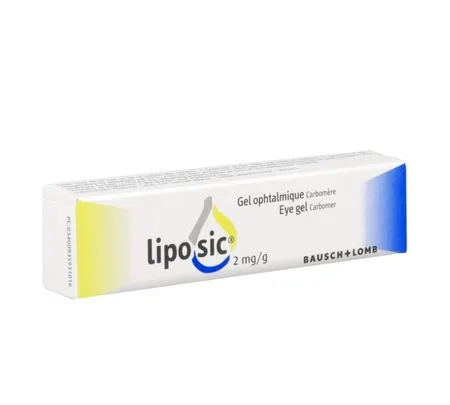
Ophthalmic gel at 2 mg/g (white, opalescent, high viscosity): Tube of 10 g, single-unit carton.Composition
| tube | |
| Carbomer
|
20 mg |
Each gram of ophthalmic gel contains 2 mg of carbomer.
Indications
Symptomatic treatment of dry eye syndrome.Dosage and administration
DosageTreatment of dry eye requires that the dosage be individually adapted.
Depending on the severity and intensity of symptoms, instil 1 drop into the conjunctival sac 3 to 5 times a day, approximately 30 minutes before bedtime (to avoid the risk of eyelids sticking together).
- Paediatric population:
- The safety and efficacy of Liposic 2 mg/g ophthalmic gel in children and adolescents (up to 18 years), at the recommended adult dosage, has been established through clinical experience, but no clinical trial data are available.
Method of administration:
Ophthalmic use.
In general, an ophthalmologist should be consulted to treat keratoconjunctivitis sicca, which normally requires long-term or permanent treatment.
A drop of appropriate size is obtained by holding the tube vertically above the eye during instillation.
Contraindications
Hypersensitivity to the active substance or to any of the excipients listed in section Composition.Warnings and precautions
Contact lenses must be removed before administration and may be reinserted 30 minutes after Liposic 2 mg/g ophthalmic gel has been instilled.
Liposic 2 mg/g ophthalmic gel may prolong the contact time of topical ophthalmic medicinal products. In case of concomitant ocular treatment, the latter should be administered 15 minutes before instillation of Liposic 2 mg/g ophthalmic gel (see Interactions).
If symptoms of dry eye persist or worsen, treatment must be discontinued and an ophthalmologist must be consulted.
Interactions
Drug interactionsNo interaction studies have been performed.
Fertility, pregnancy and breastfeeding
No studies have been carried out.
Pregnancy:There are no data on the use of carbomer in pregnant women.
Animal studies do not indicate a direct reproductive toxicity effect (see Preclinical safety). As a precaution, it is preferable to avoid the use of Liposic 2 mg/g, ophthalmic gel during pregnancy.
Breastfeeding:
No information is available on the excretion of carbomer and its metabolites in breast milk. A risk to the newborn or infant cannot be excluded. The decision to stop breastfeeding or to stop/avoid treatment with Liposic 2 mg/g, ophthalmic gel must be made taking into account the benefit of breastfeeding for the child and the benefit of treatment for the mother.
Fertility:No studies have been carried out.
Driving and using machines
Liposic 2 mg/g, ophthalmic gel has a moderate influence on the ability to drive vehicles and use machines.Even when the conditions of use are respected, this medicinal product may reduce visual acuity for approximately 5 minutes due to the formation of filaments after application of the gel. Therefore, patients must remain cautious when driving vehicles or using machines.
Adverse effects
Undesirable effects are categorised by frequency according to the following convention: very common (≥ 1/10), common (between ≥ 1/100 and < 1/10), uncommon (between ≥ 1/1 000 and < 1/100), rare (between ≥ 1/10 000 and < 1/1 000), very rare (< 1/10 000), or frequency not known (the frequency cannot be estimated from the available data).
| Eye disorders | |
| Very rare
(< 1/10 000) |
Ocular burning sensation, eye redness, eyelid eczema, foreign body sensation in the eye, giant papillary conjunctivitis, pruritus, sensation of sticky eyes, superficial punctate keratitis, watery eyes, blurred vision |
These reactions may occur due to the preservative present (cetrimide) or as a reaction to intolerance to one of the other components.
Blurred vision may occur after instillation of Liposic 2 mg/g, ophthalmic gel, due to the high viscosity of the product. During clinical trials with Liposic 2 mg/g, ophthalmic gel, only one non-serious topical adverse effect was observed (ocular burning sensation).
- Paediatric population:
- No specific information has been reported.
Reporting suspected adverse reactions after authorisation of the medicinal product is important. It allows continuous monitoring of the benefit/risk balance of the medicinal product. Healthcare professionals should report any suspected adverse reaction via the national reporting system: National Agency for the Safety of Medicines and Health Products (ANSM) and the network of Regional Pharmacovigilance Centres. Website: https://signalement.social-sante.gouv.fr.
Overdose
No cases of overdose have been reported.
- Paediatric population:
- No special information has been reported concerning the paediatric population.
Pharmacodynamics
Pharmacotherapeutic class: Artificial tears, ATC code: S01XA20.
Liposic 2 mg/g, ophthalmic gel is based on a high molecular weight hydrophilic polymer. Its pH and osmolality are similar to those of the normal tear film. Due to its physical properties, the ophthalmic gel captures water and forms a transparent, lubricating and wetting film on the surface of the eye.
The structure of the gel is broken down by the salts contained in tears, thus hydrating and lubricating. A study conducted in 54 patients with dry keratoconjunctivitis showed that treatment with Liposic 2 mg/g, ophthalmic gel prolongs the tear film break-up time by an average of 5,3 seconds to 11,2 seconds after 6 weeks. Schirmer test values were increased on average from 4,8 mm to 10,7 mm after 6 weeks.
Pharmacokinetics
No controlled pharmacokinetic studies in animals or humans have been performed with this product. However, absorption or accumulation in ocular tissues can likely be excluded due to the high molecular weight of carbomer. Studies performed with an essentially similar product have shown that the ocular residence time is estimated to be approximately 90 minutes.
- Paediatric population:
- No data available.
Preclinical safety
Non-clinical data from conventional studies of safety pharmacology, repeated-dose toxicity, genotoxicity, carcinogenesis, and reproduction and developmental functions revealed no particular risk for humans.
Storage conditions
- Shelf life
- 3 years.
Store at a temperature not exceeding 25 °C.
- After opening the tube:
- 28 days.
HANDLING/DISPOSAL INSTRUCTIONS
No special requirements.
Prescription, supply and reimbursement
| Marketing authorisation (AMM) | 3400935931016 (2002, SmPC rev 12.01.2024). |
| Price: | 2,37 euros (tube of 10 g). |
| Reimbursed by Social Security at 65 %. Collective. | |
CHAUVIN Laboratory
416, rue Samuel-Morse. CS 99535. 34961 Montpellier
Tel: 04 67 12 30 30
Source: VIDAL · Updated on 11/11/2026. This information does not replace advice from a healthcare professional.