
Medicines
SmPC of the 16/04/2026
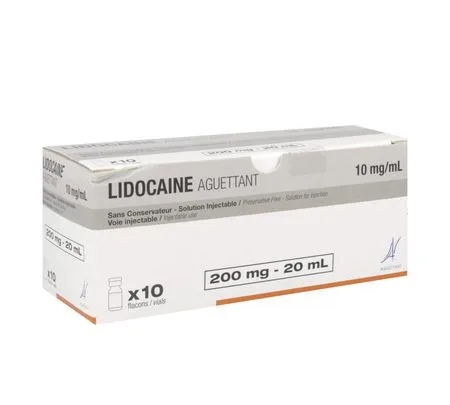
LIDOCAINE AGUETTANT 10 mg/ml WITHOUT PRESERVATIVE, injectable solution
Composition
Lidocaine hydrochloride monohydrate..............................................................................................10,61 mg
Quantity corresponding to anhydrous lidocaine hydrochloride..........................................................10,00 mg
For 1 mL of solution.
One vial of 20 ml contains 212,2 mg of lidocaine hydrochloride monohydrate (quantity corresponding to 200 mg of anhydrous lidocaine hydrochloride).
One ampoule of 10 ml contains 106,1 mg of lidocaine hydrochloride monohydrate (quantity corresponding to 100 mg of anhydrous lidocaine hydrochloride).
Excipient with known effect: sodium.
Each ml of injectable solution contains 2,4 mg of sodium.
Each vial of 20 ml contains 48 mg of sodium.
Each ampoule of 10 ml contains 24 mg of sodium.
Sodium chloride, officinal sodium hydroxide solution or concentrated hydrochloric acid, water for injectable preparations.
Indications
LIDOCAINE AGUETTANT 10 mg/ml WITHOUT PRESERVATIVE, injectable solution is used:
- in adults and in children over 1 year:
o in loco-regional anesthesia,
o for the prevention of pain related to intravenous injection of propofol.
- in adults by intravenous route:
for the prevention of postoperative pain, in particular to accelerate the resumption of intestinal transit after abdominal surgery.
Dosage and administration
Dosage
A- Loco-regional anesthesia :
Apart from local anesthesia by infiltration, lidocaine should only be used by or under the responsibility of physicians experienced in loco-regional anesthesia techniques.
The form and concentration used vary according to the indication and the objective to be achieved, the age and the pathological condition of the patient. The level of anesthesia obtained is usually a function of the total dose administered. The dose to be injected depends on the anesthesia technique for which the product is used.
Elderly or frail patients may be more sensitive to standard dosages, with an increased risk and severity of toxic reactions on the central nervous system and the cardiovascular system. Nevertheless, it is not recommended to reduce the dose of lidocaine because this could result in insufficient anesthesia.
In adults and adolescents over 12 years
Local anesthesia by infiltration: the maximum dose must not exceed 200 mg. For higher doses, it is recommended to use the adrenaline-containing forms.
Regional anesthesia (caudal, epidural, plexus, nerve trunk): the maximum dose must not exceed 400 mg. For higher doses, it is recommended to use the adrenaline-containing forms. The more concentrated forms increase the intensity of the motor block. In obstetrics, for epidural anesthesia, it is recommended to reduce the dose by half.
Obstetric analgesia: a solution with a concentration less than or equal to 10 mg/ml should be used; on the other hand, for anesthesia for cesarean section, a concentration greater than 10 mg/ml should be used.
Peri- and intra-articular infiltrations and sympathetic infiltrations: the maximum dose must not exceed 200 mg.
The recommended doses of lidocaine at 10 mg/ml and 20 mg/ml in adults are indicated in table 1.
TABLE 1
Recommended dosages in adults
|
Technique |
Lidocaine hydrochloride |
||
|
Concentration (mg/mL) |
Volume (ml) |
Total dose (mg) |
|
|
Infiltration anesthesia |
10 20 |
0,5 - 20 0,25 - 10 |
5 – 200 5 – 200 |
|
Anesthesia by peripheral nerve blocks, e.g.: |
|
|
|
|
• intercostal block – per segment |
10 |
3 – 5 (max. 40) |
30 – 50 (max. 400 for all segments) |
|
|
20 |
1,5 – 2,5 (max 20) |
30 – 50 (max. 400 for all segments) |
|
• Paracervical anesthesia – on each side |
10 20 |
10 5 |
100 100 |
|
• Paravertebral anesthesia |
10 20 |
20 10 |
200 in total 200 in total |
|
• Cervical block |
10 20 |
20 - 40 10 - 20 |
200 - 400 200 - 400 |
|
• Lumbar block |
10 20 |
20 - 40 10 - 20 |
200 - 400 200 - 400 |
|
Epidural anesthesia/analgesia, e.g.: |
|
|
|
|
• Epidural block |
|
|
|
|
10 20 |
20 - 40* 10 - 20 |
200 - 400 200 - 400 |
|
• Obstetrics |
|
|
|
|
20 10 |
10 - 20 20 |
200 - 400 200 |
|
• Caudal block |
10 20 |
20 - 40* 10 - 20 |
200 - 400 200 - 400 |
*Volume not recommended for epidural injection (increased intracranial pressure for volumes greater than 30 ml).
Paediatric population
Child aged 1 to 12 years
To avoid any systemic toxicity, the lowest effective concentration and the lowest effective dose should always be used.
• Local infiltration and regional anaesthesia (epidural, caudal, plexus, nerve trunk): the maximum recommended dose is between 2 and 7 mg/kg of body weight, depending on the technique used.
Child under 1 year
Safety in children under 1 year has not been established. This medicine must not be used in this population.
B- By intravenous route :
Lidocaine hydrochloride should only be used by or under the responsibility of physicians experienced in anaesthesia and analgesia techniques.
o For prevention of pain associated with propofol injection :
In adults and adolescents over 12 years
10 to 40 mg of lidocaine hydrochloride as an IV bolus: either mixed with propofol just before anaesthesia or immediately before the propofol injection (with or without venous occlusion (tourniquet)).
Paediatric population
Child aged 1 year to 12 years
0,5 to 1 mg/kg of lidocaine hydrochloride as an IV bolus, mixed with propofol, prepared extemporaneously just before anaesthesia.
Child under 1 year
As safety has not been established, this medicine must not be used in children under 1 year.
o For prevention of post-operative pain in particular in order to accelerate the resumption of intestinal transit
In adults
Lidocaine hydrochloride is administered as an initial IV bolus of 1 to 2 mg/kg followed by a continuous infusion of 2 mg/kg/h for the entire duration of the operation.
The infusion should be stopped at the end of the surgical procedure. However, if the infusion must continue post-operatively, the patient must be monitored in the post-interventional recovery room.
The use of an electric syringe is recommended for continuous infusion.
Paediatric population
As safety of use has not been established, this medicine must not be used in children and adolescents to prevent post-operative pain and/or to accelerate the resumption of intestinal transit.
Method of administration
The method of administration of lidocaine varies depending on the type of procedure.
LIDOCAINE AGUETTANT 10 mg/ml WITHOUT PRESERVATIVE, injectable solution may be administered by intravenous, intramuscular, subcutaneous or epidural route.
Contraindications
• Known hypersensitivity to lidocaine hydrochloride, to amide-type local anaesthetics or to any of the excipients listed in section Composition ;
• Patients with recurrent porphyrias.
Warnings and precautions
Concomitant administration of IV lidocaine and local anaesthetics should be avoided.
If the use of a local anaesthetic is necessary, the total dose administered will take into account the quantity of lidocaine administered intravenously.
As with other loco-regional anaesthetics, lidocaine should be used with caution in patients suffering from the following conditions: epilepsy, hypovolaemia, atrioventricular block or conduction disorders, bradycardia or respiratory insufficiency.
Likewise, lidocaine should be used with caution in patients with porphyria in remission as well as in asymptomatic carriers of mutant genes responsible for porphyrias.
Lidocaine is metabolised by the liver and should be administered with caution in patients suffering from hepatic insufficiency. The plasma half-life of lidocaine may be prolonged in the event of reduced hepatic blood flow during cardiac and circulatory insufficiency.
Lidocaine metabolites may accumulate in cases of renal insufficiency.
A complete resuscitation kit must always be available when administering local anesthetics. Cases of chondrolysis have been reported in patients receiving a continuous intra-articular infusion of local anesthetics postoperatively. The majority of reported cases of chondrolysis involved the shoulder joint. The exact mechanism of this injury remains unknown but is probably multifactorial.
Epidural anesthesia may lead to hypotension and bradycardia. Hypotension should be promptly treated by intravenous injection of a vasopressor and appropriate fluid replacement.
This medicine contains 24 mg of sodium per ampoule, which is equivalent to 1,2 % of the maximum recommended daily dietary intake of 2 g of sodium per adult set by the WHO.
This medicine contains 48 mg of sodium per vial, which is equivalent to 2,4 % of the maximum recommended daily dietary intake of 2 g of sodium per adult set by the WHO.
Paediatric population
In the absence of sufficient safety data, this medicine is not recommended in children under 1 year.
Interactions
Many antiarrhythmics depress cardiac automaticity, conduction and contractility.
The association of antiarrhythmics of different classes can provide a beneficial therapeutic effect, but it proves most often very delicate, requiring close clinical monitoring and ECG control. The association of antiarrhythmics causing torsades de pointes (amiodarone, disopyramide, quinidine-type agents, sotalol…) is contraindicated.
Combining antiarrhythmics of the same class is not recommended, except in exceptional cases, due to the increased risk of cardiac adverse effects.
Combination with medicines that have negative inotropic properties, that cause bradycardia and/or slow atrioventricular conduction, is delicate and requires clinical monitoring and ECG control.
Associations requiring precautions for use
+ Amiodarone
Risk of increased plasma concentrations of lidocaine, with possible neurological and cardiac adverse effects, due to decreased hepatic metabolism of lidocaine by amiodarone. Clinical monitoring, ECG and possibly monitoring of plasma lidocaine concentrations. If necessary, adjust the lidocaine dosage during amiodarone treatment and after its discontinuation.
+ Cimetidine
With cimetidine used at doses greater than or equal to 800 mg/day: increased plasma concentrations of lidocaine with risk of neurological and cardiac adverse effects (inhibition of hepatic metabolism of lidocaine). Clinical monitoring, ECG and possibly monitoring of plasma lidocaine concentrations; if applicable, adjust the lidocaine dosage during treatment with cimetidine and after its discontinuation.
+ Fluvoxamine
Increased plasma concentrations of lidocaine with possible neurological and cardiac adverse effects (decreased hepatic clearance of lidocaine). Clinical monitoring, ECG and possibly monitoring of plasma lidocaine concentrations during and after discontinuation of the combination. Adjust the lidocaine dosage if necessary.
Associations to be taken into account
+ Beta-blockers in heart failure
Negative inotropic effect with risk of cardiac decompensation.
Fertility, pregnancy and breastfeeding
Pregnancy
Data on the administration of lidocaine to pregnant women are insufficient. Lidocaine crosses the placental barrier (see section Pharmacokinetics).
Animal studies have not shown a teratogenic effect (see section Preclinical safety). Lidocaine may be used if necessary during pregnancy.
Do not use in a paracervical block in obstetric anesthesia, due to the risk of uterine hypertonia with neonatal consequences (hypoxia).
Breast-feeding
Lidocaine is excreted in breast milk. It is unlikely to have an effect on the infant when used at the recommended doses. Breastfeeding is possible following locoregional anesthesia with lidocaine.
Fertility
No fertility data are available.
Driving and using machines
Depending on the dose administered, locoregional anesthetics may have a very mild effect on mental functions and may temporarily impair mobility and movement coordination. Affected patients must not drive vehicles or operate machinery.
Adverse effects
Adverse effects due to lidocaine must be differentiated from physiological effects due to the block itself (hypotension, bradycardia) as well as direct (neurological injury) or indirect (epidural abscess) effects due to needle insertion.
The occurrence of an adverse effect should raise suspicion of an overdose. Toxic reactions, indicating local anesthetic overdose, may occur under two conditions: either immediately due to a relative overdose from accidental intravascular injection, or later due to a true overdose from using too large a quantity of anesthetic. These toxic reactions are of two types, cardiovascular and neurological.
The cardiovascular reactions are of the depressant type and may be characterised by hypotension, myocardial depression, bradycardia or even cardiac arrest.
Central nervous system (CNS) reactions are of the excitatory and/or depressant type. The first symptoms of toxicity are feelings of dizziness, numbness of the lips and tongue, tinnitus, hearing dysfunction and dysarthria. Other subjective CNS symptoms include disorientation and feelings of drowsiness. Objective signs of CNS toxicity are generally excitatory and include shivering, muscle twitching and tremors initially involving the facial muscles and the distal parts of the extremities.
Finally, generalised "grand mal" convulsions appear. If a very large dose is administered, the initial signs of CNS excitation (epileptoid activity) are rapidly followed by generalised CNS depression (respiratory depression then respiratory arrest).
Allergic reactions are extremely rare. They may be characterised by skin lesions, urticaria, oedema or anaphylactoid reactions. Detection of sensitivity by skin testing remains non-predictive.
The relative frequency of reports of these undesirable effects is as follows:
Undesirable effects have been classified according to their incidence using the following classification:
Very common (≥ 1/10); common (≥ 1/100, < 1/10); uncommon (≥ 1/1 000, < 1/100); rare (≥ 1/10 000, < 1/1 000); very rare (< 1/10 000); frequency not known (cannot be estimated from the available data).
|
Frequency |
System |
Effects |
|
Common (> 1/100 to < 1/10) |
Circulatory |
Hypotension, bradycardia (mainly during epidural anaesthesia) |
|
Rare (> 1/10 000 to < 1/1000) |
Circulatory |
Myocardial depression or cardiac arrest (caused by an absolute or relative overdose). |
|
|
CNS |
Loss of consciousness or generalised convulsions (overdose) |
|
|
General |
Allergic reactions, and in the most severe cases, anaphylactic shock. |
|
Not known (cannot be estimated from the available data) |
Blood and lymphatic system |
Methaemoglobinaemia |
Reporting of suspected adverse reactions
Reporting suspected adverse reactions after authorisation of the medicinal product is important. It allows continued monitoring of the benefit/risk balance of the medicinal product. Healthcare professionals are asked to report any suspected adverse reaction via the national reporting system: National Agency for the Safety of Medicines and Health Products (ANSM) and the network of Regional Centres of Pharmacovigilance - Website: https://signalement.social-sante.gouv.fr.
Overdose
Treatment of a patient showing signs of systemic toxicity consists of treating the convulsions and ensuring adequate ventilation with oxygen, if necessary by assisted or controlled ventilation (breathing). In adults, when convulsions occur, they should be promptly treated by intravenous injection of thiopental (2 to 4 mg/kg) or short-acting benzodiazepines (diazepam 0,1 mg/kg or midazolam 0,05 mg/kg). Intravenous succinylcholine (50 to 100 mg) may be used to provide muscle relaxation provided that the clinician is able to perform endotracheal intubation and manage a fully paralysed patient.
After the convulsions have stopped and when adequate pulmonary ventilation is ensured, no further treatment is usually required. However, in case of hypotension, a vasopressor should be administered intravenously.
Pharmacodynamics
Pharmacotherapeutic class: Local anaesthetics, amides, ATC code: N01BB02.
N: Central Nervous System
Lidocaine causes a reversible loss of sensation by preventing or reducing the conduction of sensory nerve signals near their site of action; the primary site of action being the cell membrane. Lidocaine blocks conduction by reducing or preventing the large, transient increase in sodium permeability of excitable membranes, a permeability normally produced by slight depolarisation of the membranes.
This action is due to its direct interaction with voltage-dependent sodium channels, the main mechanism of action probably involving an interaction with one or more more specific binding sites within the sodium channel.
In general, small nerve fibres, particularly unmyelinated fibres, are more readily blocked by a local anaesthetic because the critical length beyond which a signal can be transmitted is shorter than in large fibres. For the same reason, recovery is faster in small fibres. Lidocaine has an intermediate duration of action, of 60 to 120 minutes after local infiltration and nerve block anaesthesia.
In addition to their local anaesthetic activity, lidocaine and analogous substances may act on the functioning of certain organs in which nerve signals are conducted or transmitted (such as the central nervous system or the cardiovascular system).
Several clinical studies and meta-analyses also highlight the effects of perioperative intravenous infusion of lidocaine on postoperative pain, rapid return of bowel function, and reduction of opioid consumption.
In the meta-analysis by McCarthy of 2010 (395 patients receiving intravenous lidocaine versus 369 in the control group), 16 studies showed that in open and laparoscopic abdominal surgery, opioid consumption was reduced by more than 85% in the group treated with intravenous lidocaine.
In the meta-analysis by Sun of 2012 (21 studies with 1108 adult patients), 548 patients received intravenous lidocaine, and the results showed a reduction of 7,04 mg (95% CI; [-10,4; -3,68]; I²=0,46) in opioid consumption 48 hours after surgery.
The results of the Cochrane meta-analysis conducted in 2015, concerning the benefits of lidocaine in abdominal surgery, confirmed the results of the Sun meta-analysis 2012.
These meta-analyses highlight a reduction in intraoperative and postoperative opioid consumption for patients treated with intravenous lidocaine compared with untreated patients or those who received a placebo.
Pharmacokinetics
Absorption and distribution
Lidocaine is readily absorbed from injection sites, including muscle, and from the gastrointestinal tract, mucous membranes and damaged skin; it is poorly absorbed through intact skin. After an intravenous dose, plasma concentrations fall rapidly, with an initial half-life of less than 30 minutes and an elimination half-life of one to two hours.
The binding of lidocaine to plasma proteins is of the order of 66%.
Lidocaine crosses the blood-brain barrier and is excreted in breast milk.
Lidocaine crosses the placenta by diffusion and reaches the fetus within minutes. The fetal/maternal serum concentration ratio is approximately 0,5-0,7 after epidural administration. After perineal infiltration or paracervical anaesthesia, higher concentrations have been measured in the umbilical vein.
Biotransformation and elimination
Lidocaine is eliminated mainly by hepatic metabolism. This consists essentially of dealkylation involving the cytochrome P450 isoenzymes CYP1A2 and CYP3A4.
The main metabolites formed are MEGX (monoethylglycinexylidide) and GX (glycinexylidide). These metabolites also have local anaesthetic activity.
In humans, approximately 75% of xylidine is excreted in the urine as 4-hydroxy-2,6-dimethylaniline. Only 3% of unchanged lidocaine is found in the urine.
After maternal epidural anaesthesia, the elimination half-life of lidocaine in the newborn is approximately 3 hours; after perineal infiltration or paracervical anaesthesia, lidocaine is detectable in the newborn's urine for at least 48 hours.
Preclinical safety
Single-dose and repeated-dose toxicity studies have been conducted in various animal species and have shown effects on the central nervous system and the cardiovascular system.
Lidocaine did not show genotoxic potential in genotoxicity assays in vitro and in vivo. However, studies in vitro have shown that 2,6-xylidine, a metabolite of lidocaine, may cause mutagenic effects.
No carcinogenicity study has been conducted with lidocaine. The metabolite 2,6-xylidine was found to have carcinogenic potential in a 2-year toxicology study in rats. The clinical significance of these results has not been determined.
Reproductive toxicity studies conducted in rats did not show any teratogenic effect. Behavioural effects have been reported in the offspring of female rats that received, during gestation, a dose close to the maximum recommended dose in humans. The clinical significance of these results has not been determined.
INCOMPATIBILITIES
In the absence of compatibility studies, this medicinal product must not be mixed with other medicinal products.
Prescription, supply and reimbursement
| Marketing authorisation (AMM) |
|
Hospital model(s) (10Amp/10ml).
Collection.
1 ALEXANDER FLEMING STREET
69007 LYON
Tel: 04 78 61 51 41 standard.gerland@aguettant.fr
https://www.aguettant.fr/
Source: VIDAL · Updated on 11/11/2026. This information does not replace advice from a healthcare professional.