
Medicines
SmPC of the 15/04/2025
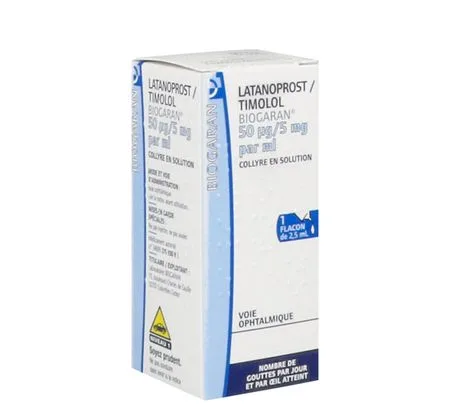
LATANOPROST/TIMOLOL BIOGARAN 50 micrograms/5 mg per ml, eye drops in solution
Forms and presentations
Eye drops in solution.
Clear, colourless solution with a pH between 5,5 and 6,5 and an osmolality between 270 and 330 mOsmol/kg.
Composition
Latanoprost................................................................................................................................50 micrograms
Timolol...............................................................................................................................................................5 mg
As timolol maleate...........................................................................................................6,80 mg
For 1 ml.
Excipients with known effect: benzalkonium chloride (200 micrograms/ml), phosphates.
Sodium chloride, benzalkonium chloride, sodium dihydrogen phosphate dihydrate, disodium hydrogen phosphate dodecahydrate, purified water, sodium hydroxide (for pH adjustment), hydrochloric acid (for pH adjustment).
Indications
LATANOPROST/TIMOLOL BIOGARAN is indicated in adults (including elderly people) for the reduction of intraocular pressure (IOP) in patients with open-angle glaucoma or ocular hypertension who show an insufficient response to locally administered beta-blockers or prostaglandin analogues.
Dosage and administration
Dosage
Adults (including elderly people)
The recommended dose is one drop in the affected eye(s) once daily.
If a dose is missed, treatment should continue as normal with the next instillation. The dose should not exceed one drop per day in the affected eye(s).
Paediatric population
The efficacy and tolerability of LATANOPROST/TIMOLOL BIOGARAN have not been established in children and adolescents.
Method of administration
Contact lenses must be removed before instillation of the eye drops and may be reinserted 15 minutes after (see section Warnings and precautions).
In case of concomitant use of several topical ophthalmic products, the instillations of the different products must be separated by at least five minutes.
Nasolacrimal occlusion or eyelid closure for 2 minutes reduces systemic absorption. This results in a reduction of systemic undesirable effects and an increase in local activity.
Contraindications
LATANOPROST/TIMOLOL BIOGARAN is contraindicated in patients with:
• conditions associated with bronchial hyperreactivity, including asthma or a history of asthma, and severe chronic obstructive pulmonary disease;
• sinus bradycardia, coronary sinus disease, sino-atrial block, second- or third-degree atrioventricular block not controlled by a pacemaker, confirmed heart failure, cardiogenic shock;
• hypersensitivity to the active substances or to any of the excipients listed in section Composition.
Warnings and precautions
Systemic effects
Like all topically applied ophthalmic agents, LATANOPROST/TIMOLOL BIOGARAN has systemic absorption. Due to the presence of timolol, a beta-adrenergic component, cardiovascular and pulmonary adverse reactions, and other adverse reactions identical to those seen with systemically administered beta-adrenergic blocking agents, may occur.
The frequency of systemic adverse reactions after topical ophthalmic administration is lower than after systemic administration. To reduce systemic absorption, see section Dosage and administration.
Cardiac disorders
In patients with cardiovascular disease (coronary artery disease, Prinzmetal's angina, and heart failure), and hypotension, treatment with beta-blockers must be carefully evaluated and treatment with other medicinal products should be considered. In these patients, monitoring must be carried out to look for signs of worsening of these conditions or adverse reactions.
Due to their negative dromotropic effect, beta-blockers should only be prescribed with caution to patients with first-degree heart block.
After administration of timolol, cardiac effects and, rarely, deaths in association with heart failure have been reported.
Vascular disorders
Patients suffering from severe disorders of peripheral circulation (i.e. the severe form of the disease or Raynaud's syndrome) should be treated with caution.
Respiratory disorders
In asthmatic patients, respiratory manifestations, including death due to bronchospasm, have been reported following administration of some ophthalmic beta-blockers. LATANOPROST/TIMOLOL BIOGARAN must be administered with caution in patients with moderate to severe chronic obstructive pulmonary disease (COPD) and only if the potential benefit appears to outweigh the potential risk.
Hypoglycaemia/Diabetes
Beta-blockers should be administered with caution in patients prone to spontaneous hypoglycaemia or in patients with unstable diabetes, as beta-blockers may mask the signs of acute hypoglycaemia.
Beta-blockers may also mask the signs of hyperthyroidism.
Corneal diseases
Ophthalmic beta-blockers may cause ocular dryness. Patients suffering from corneal diseases must be treated with caution.
Other beta-blocking agents
The effect on intraocular pressure or the known effects of systemic beta-blockers may be potentiated when timolol is administered to patients already receiving an oral beta-blocker. The response of these patients should be closely monitored. The concomitant use of two beta-adrenergic blocking agents is not recommended (see section Interactions).
Anaphylactic reactions
Patients treated with beta-blockers who have a history of atopy or of severe anaphylactic reaction to various allergens may be more reactive to repeated administration of such allergens and may not respond to the doses of adrenaline usually used to treat anaphylactic reactions.
Choroidal detachment
Choroidal detachments have been observed after glaucoma filtration surgery with the administration of treatments that reduce aqueous humor secretion (e.g., timolol, acetazolamide).
Surgical anesthesia
Beta-blockers used in ophthalmology may block the effects of systemic beta-agonists such as adrenaline. The anesthetist should be informed when the patient is receiving timolol.
Concomitant treatment
Interactions of timolol with other medicinal products have been described (see section Interactions).
Other prostaglandin analogues
The concomitant use of two or more prostaglandins, prostaglandin analogues, or prostaglandin derivatives is not recommended (see section Interactions).
Changes in iris pigmentation
Latanoprost may gradually change eye colour by increasing the amount of brown pigment in the iris. This pigmentation was also observed (with photographic control) in 16 to 20 % of patients treated for one year with latanoprost/timolol; in particular in patients with multicoloured irises: green-brown, yellow-brown or blue/grey-brown. It is due to an increase in the melanin content of melanocytes in the iris stroma. Generally, in the affected eyes, the brown pigmentation surrounding the pupil spreads concentrically towards the periphery, and the iris may become partially or totally browner. Clinical studies show that after two years of treatment, these colour changes were only rarely observed in patients with uniformly coloured eyes, blue, grey, green or brown.
Changes in iris colour develop slowly and may go unnoticed for months or even years. This effect has not been associated with any symptoms or pathological changes.
After treatment discontinuation, no further progression of brown iris pigmentation was observed, but the colour change may be permanent.
Neither the nevi nor the ephelides of the iris were affected by the treatment.
No accumulation of pigment in the trabecular meshwork or at other points of the anterior chamber has been observed. However, patients should be examined regularly and, depending on the patient's clinical context, treatment may be discontinued in case of increased iris pigmentation.
Before starting treatment, patients should be informed of the risk of eye colour change. Unilateral treatment may result in permanent heterochromia.
Changes in eyelids and eyelashes
A darker coloration of the eyelid skin, which may be reversible, has been reported in association with the use of latanoprost.
Latanoprost may gradually change the eyelashes and vellus hair of the treated eye; these changes include increased length, thickness, pigmentation and number of eyelashes or hairs, and misdirected growth of the eyelashes. Eyelash changes are reversible upon discontinuation of treatment.
Glaucoma
There is currently no documented experience on the efficacy of latanoprost in inflammatory, neovascular glaucoma or in chronic angle-closure glaucoma, in open-angle glaucoma in pseudophakic patients and in pigmentary glaucoma.
Latanoprost has little or no effect on the pupil. However, there is currently no documented experience in acute angle-closure glaucoma attacks. Therefore, in the absence of additional data, it is recommended to use LATANOPROST/TIMOLOL BIOGARAN with caution in these situations.
Herpetic keratitis
Latanoprost should be used with caution in patients with a history of herpetic keratitis and its use should be avoided in cases of Herpes simplex active keratitis and in patients with a history of recurrent herpetic keratitis specifically associated with prostaglandin analogues.
Macular oedema
Cases of macular edema, including cystoid macular edema, have been reported during treatment with latanoprost. These occurred mainly in aphakic or pseudophakic patients with posterior capsule rupture or in patients with known risk factors for macular edema. Therefore, LATANOPROST/TIMOLOL BIOGARAN should be used with caution in these patients.
Excipients
This medicine contains 0,20 mg of benzalkonium chloride (a preservative) per ml of eye drops.
Benzalkonium chloride may be absorbed by soft contact lenses and change their colour. Remove contact lenses before application and wait at least 15 minutes before reinserting them (see section Dosage and administration).
Benzalkonium chloride is known to cause eye irritation, dry eye syndrome symptoms, and may affect the tear film and corneal surface. It should be used with caution in patients with dry eye and those at risk of corneal damage. Patients should be monitored during prolonged use. This medicine contains 6,31 mg of phosphates per ml of eye drops.
If you have severe corneal damage (the transparent layer at the front of the eye), phosphates may, in very rare cases, cause visual disturbances due to calcium deposition during treatment (clouding).
Interactions
No specific drug interaction study has been conducted with latanoprost/timolol.
Paradoxical increases in intraocular pressure have been reported following concomitant ophthalmic administration of two prostaglandin analogues. Therefore, the use of two or more prostaglandins, prostaglandin analogues, or prostaglandin derivatives is not recommended.
An additive effect, resulting in hypotension and/or bradycardia, may be observed when ophthalmic beta-blocker solution is administered concomitantly with calcium channel blockers, beta-adrenergic blocking agents, antiarrhythmics (notably amiodarone), digitalis glycosides, parasympathomimetics, and systemically administered guanethidine.
Potentiation of systemic beta-blocking effects (for example: decreased heart rate, depression) has been reported when CYP2D6 inhibitor treatments (for example: quinidine, fluoxetine and paroxetine) are combined with timolol.
The effect on intraocular pressure or the known effects of systemic beta-blockers may be potentiated when latanoprost/timolol is administered to patients already receiving an oral beta-blocker, and the use of two or more topical beta-blocking agents is not recommended.
Mydriasis has occasionally been reported when ophthalmic beta-blockers and adrenaline (epinephrine) have been used concomitantly.
The rebound hypertensive surge occurring on abrupt withdrawal of clonidine may be increased when beta-blockers are administered.
Beta-blockers may increase the hypoglycaemic effect of antidiabetic agents. They may mask the signs and symptoms of hypoglycaemia (see section Warnings and precautions).
Fertility, pregnancy and breastfeeding
Pregnancy
Latanoprost
There are no data on the use of latanoprost in pregnant women. In animals, studies have shown toxicity on reproductive functions (see section Preclinical safety). The potential risk in humans is not known.
Timolol
There are no adequate data on the use of timolol in pregnant women. Timolol should not be used during pregnancy unless clearly necessary. To reduce systemic absorption, see section Dosage and administration.
Epidemiological studies have not revealed a malformative effect but demonstrate a risk of intrauterine growth retardation when beta-blockers are administered orally. In addition, signs and symptoms of a beta-blocker effect (for example: bradycardia, hypotension, respiratory distress and hypoglycaemia) have been observed in the newborn when beta-blockers were administered until delivery. If latanoprost/timolol is administered until delivery, the newborn should be closely monitored during the first days of life.
Therefore, LATANOPROST/TIMOLOL BIOGARAN must not be used during pregnancy (see section Preclinical safety).
Breast-feeding
Beta-blockers are excreted in breast milk. However, at therapeutic doses of timolol contained in eye drops, the amount passing into breast milk is unlikely to be sufficient to produce clinical symptoms of beta-blockade in the infant. To reduce systemic absorption see section Dosage and administration.
Latanoprost and its metabolites may pass into breast milk. Therefore, LATANOPROST/TIMOLOL BIOGARAN must not be used in breast-feeding women.
Fertility
Neither latanoprost nor timolol has been shown to have an impact on male or female fertility in animal studies.
Driving and using machines
LATANOPROST/TIMOLOL BIOGARAN has a minor influence on the ability to drive and use machines. As with other eye preparations, instillation of eye drops may be followed by transient visual disturbances. Until these are resolved, patients must not drive or use machines.
Adverse effects
For latanoprost, the majority of adverse reactions relate to the ocular system. During the extension phase of the pivotal latanoprost/timolol studies, 16 to 20 % of patients developed an increase in iris pigmentation, which may be permanent. In an open-label clinical trial studying the tolerability of latanoprost over 5 years, 33 % of patients developed an increase in iris pigmentation (see section Warnings and precautions).
Other ocular adverse reactions are generally transient and occur at the time of dosing. For timolol, the most serious adverse reactions are of a systemic nature, including bradycardia, arrhythmia, congestive heart failure, bronchospasm and allergic reactions.
As with other topically applied ophthalmic medicinal products, timolol is absorbed into the systemic circulation. This may result in adverse reactions similar to those seen with systemic beta-blockers. The incidence of systemic adverse reactions after ophthalmic administration is lower compared with systemic administration. Expected adverse reactions include those observed with the class of ophthalmic beta-blockers.
Treatment-related adverse reactions observed in clinical trials with latanoprost/timolol are listed below.
Adverse reactions are classified according to frequency of occurrence, as follows: very common (≥ 1/10), common (≥ 1/100 to < 1/10), uncommon (≥ 1/1000 to < 1/100), rare (≥ 1/10 000 to < 1/1000), very rare (< 1/10 000) and not known (cannot be estimated from the available data).
Table 1: Adverse reactions observed during trials with latanoprost/timolol
|
System organ class |
Very common (≥ 1/10) |
Common ≥ 1/100 to < 1/10 |
Uncommon ≥ 1/1000 to < 1/100 |
|
Nervous system disorders |
|
|
Headache |
|
Eye disorders |
Iris hyperpigmentation |
Eye pain, eye irritation (including tingling, burning sensation, itching, foreign body sensation) |
Corneal damage, conjunctivitis, blepharitis, ocular hyperaemia, blurred vision, increased lacrimation |
|
Skin and subcutaneous tissue disorders |
|
|
Skin rash, pruritus |
Other adverse reactions related to the use of either component of latanoprost/timolol have been reported in clinical studies, spontaneous notifications or from the literature.
For latanoprost :
Table 2: Adverse reactions of latanoprost
|
System organ class |
Adverse effects |
|
Infections and infestations |
Herpetic keratitis |
|
Nervous system disorders |
Dizziness |
|
Eye disorders |
Changes to eyelashes and periorbital vellus hair (increased length, thickness, pigmentation and number of eyelashes); punctate keratitis, periorbital oedema, iritis; uveitis; macular oedema, including cystoid macular oedema; dry eye; keratitis; corneal oedema; corneal erosion; trichiasis; iris cyst; photophobia; periorbital and eyelid changes following deepening of the eyelid sulcus; eyelid oedema; localised skin reaction at the eyelids; pseudopemphigoid of the ocular conjunctiva+ ; darker pigmentation of the eyelid skin |
|
Cardiac disorders |
Angina; unstable angina; palpitations |
|
Respiratory, thoracic and mediastinal disorders |
Asthma; worsening of asthma; dyspnoea |
|
Gastrointestinal disorders* |
Nausea*; vomiting* |
|
Musculoskeletal and connective tissue disorders |
Myalgia; arthralgia |
|
General disorders and administration site conditions |
Chest pain |
|
* Identified after marketing with an estimated uncommon frequency + Potentially attributable to the preservative, benzalkonium chloride |
|
For timolol :
Table 3: Adverse effects of timolol maleate (ocular instillation)
|
System organ class |
Adverse effects |
|
Immune system disorders |
Systemic allergic reactions including anaphylactic reaction, angioedema, urticaria, localised or generalised rash, pruritus |
|
Metabolism and nutrition disorders |
Hypoglycaemia |
|
Psychiatric disorders |
Memory loss, insomnia, depression, nightmares, hallucinations |
|
Nervous system disorders |
Cerebrovascular accident, cerebral ischaemia, dizziness, increase in signs and symptoms of myasthenia gravis, paraesthesia, headache, syncope |
|
Eye disorders |
Choroidal detachment after filtering surgery (see section Warnings and precautions), corneal erosion, keratitis, diplopia, decreased corneal sensitivity, signs and symptoms of eye irritation (for example: burning, stinging, itching, tearing and redness), dry eye, ptosis, blepharitis, blurred vision |
|
Ear and labyrinth disorders |
Tinnitus |
|
Cardiac disorders |
Cardiac arrest, cardiac failure, atrioventricular block, congestive cardiac failure, chest pain, arrhythmia, bradycardia, oedema, palpitations |
|
Vascular disorders |
Cold extremities, hypotension, Raynaud's phenomenon |
|
Respiratory, thoracic and mediastinal disorders |
Bronchospasm (mainly in patients with pre-existing bronchospastic disease), cough, dyspnoea |
|
Gastrointestinal disorders |
Abdominal pain, vomiting, diarrhoea, dry mouth, dysgeusia, dyspepsia, nausea |
|
Skin and subcutaneous tissue disorders |
Skin rash, psoriasiform rash, exacerbation of psoriasis, alopecia |
|
Musculoskeletal and connective tissue disorders |
Myalgia |
|
Disorders of the reproductive system and breast |
Sexual dysfunction, decreased libido |
|
General disorders and administration site conditions |
Asthenia, fatigue |
A few rare cases of corneal calcification have been reported in association with the use of phosphate-containing drops in certain patients with severely damaged corneas.
Reporting of suspected adverse reactions
Reporting suspected adverse reactions after authorisation of the medicinal product is important. It allows continued monitoring of the benefit/risk balance of the medicinal product. Healthcare professionals are asked to report any suspected adverse reaction via the national reporting system: National Agency for the Safety of Medicines and Health Products (ANSM) and the network of Regional Centres of Pharmacovigilance - Website: https://signalement.social-sante.gouv.fr/.
Overdose
There is no clinical experience of overdose with latanoprost/timolol.
Symptoms
Symptoms of systemic overdose with timolol are: bradycardia, hypotension, bronchospasm and cardiac arrest.
In case of latanoprost overdose, apart from ocular irritation and conjunctival hyperaemia, no other ocular or systemic adverse effects have been reported.
Treatment
If symptoms of overdose occur, treatment should be symptomatic and supportive.
In case of accidental ingestion, the following information may be useful. Studies have shown that timolol is not easily dialysed. Gastric lavage if necessary.
Latanoprost is extensively metabolised during first hepatic passage. An intravenous infusion of 3 micrograms/kg in healthy volunteers caused no symptoms; however, a dose of 5,5-10 micrograms/kg caused nausea, abdominal pain, dizziness, fatigue, hot flushes and sweating. These effects were mild and moderate and disappeared without treatment within 4 hours after the end of the infusion.
Pharmacodynamics
Pharmacotherapeutic class: Ophthalmic beta-blocker - timolol, in combination, ATC code: S01ED51.
Mechanism of action
LATANOPROST/TIMOLOL BIOGARAN combines two components: latanoprost and timolol maleate. These two components lower elevated intraocular pressure (IOP) through different mechanisms of action. The combined effect results in a further reduction of intraocular pressure compared with that obtained when each component is administered alone.
Latanoprost, a prostaglandin F analogue2α, is a selective prostanoid FP receptor agonist that lowers intraocular pressure by increasing aqueous humour outflow. The main mechanism of action is increased outflow via the uveoscleral pathway. In addition, an increase in outflow facility (decrease in outflow resistance via the trabecular pathway) has been noted in humans. Latanoprost has no significant effect on aqueous humour production, on the blood-aqueous barrier or on intraocular blood flow. After chronic treatment with latanoprost in monkeys that had previously undergone extracapsular lens surgery, no damage to retinal blood vessels was detected by fluorescein angiography. Short-term treatment with latanoprost did not induce fluorescein leakage in the posterior segment of the eye of pseudophakic patients.
Timolol is a non-selective beta-1 and beta-2 adrenergic receptor blocking agent, with no significant intrinsic sympathomimetic activity, no direct cardiac depressant effect and no membrane-stabilising effect. Timolol lowers intraocular pressure by reducing aqueous humour formation in the ciliary epithelium. The precise mechanism of action is not clearly established, but inhibition of the increase in cyclic AMP synthesis caused by endogenous beta-adrenergic stimulation is probable. Timolol has not been shown to significantly affect the permeability of the blood-aqueous barrier to plasma proteins. In rabbits, timolol had no effect on local ocular blood flow after chronic treatment.
Clinical efficacy and safety
In dose-finding studies, latanoprost/timolol produced a significantly greater reduction in mean diurnal intraocular pressure compared with latanoprost and timolol administered once daily as monotherapy.
In two controlled, double-blind clinical studies of six months' duration, the effect of latanoprost/timolol on intraocular pressure was compared with that of latanoprost and timolol monotherapy, in patients with an intraocular pressure of at least 25 mm Hg. After a period of 2 to 4 weeks of timolol treatment (resulting in a mean reduction in intraocular pressure of 5 mm Hg compared with baseline), further mean diurnal reductions in intraocular pressure of 3,1, 2,0 and 0,6 mm Hg were observed after 6 months of treatment with the latanoprost/timolol combination, latanoprost and timolol (twice daily), respectively. The effect was maintained during the open-label extension phase of these studies up to 6 months.
Existing data suggest that evening administration may be more effective in lowering IOP than morning administration. However, when deciding between morning or evening administration, the patient's lifestyle and their ability to adhere to treatment should be given sufficient consideration.
It should be borne in mind that, in cases of insufficient efficacy with the fixed combination, study results show that concomitant use of timolol twice daily and latanoprost 1 times daily may still be effective.
The effect of latanoprost/timolol begins within one hour of administration, and maximum effect is observed after 6 to 8 hours. With repeated administration, the reduction in intraocular pressure is maintained for up to 24 hours after instillation.
Pharmacokinetics
Latanoprost
Absorption
Latanoprost is an isopropyl ester prodrug, inactive in itself, which becomes biologically active after hydrolysis by corneal esterases into latanoprost acid. The prodrug is well absorbed by the cornea and all of the substance penetrating into the aqueous humour is hydrolysed during passage through the cornea.
Distribution
Clinical studies in humans show that the maximum concentration in the aqueous humour, approximately 15‑30 ng/ml, is reached about 2 hours after topical administration of latanoprost alone. After topical administration in monkeys, latanoprost is distributed mainly in the anterior segment, the conjunctiva and the eyelids.
Latanoprost acid has a plasma clearance of 0,40 l/h/kg and a low volume of distribution of 0,16 l/kg, resulting in a short plasma half-life of 17 minutes.
After ocular administration, the systemic bioavailability of latanoprost acid is 45 %. Latanoprost acid has a binding to plasma proteins of 87 %.
Biotransformation and elimination
Latanoprost acid is practically not metabolised in the eye. Metabolism is mainly hepatic. Animal studies have shown low or even no activity of the main metabolites, the 1, 2‑dinor and the 1, 2, 3, 4‑tetranor, which are mainly eliminated in the urine.
Timolol
Absorption and distribution
The maximum concentration of timolol in the aqueous humour is reached about 1 hour after topical administration of the eye drops. Part of the dose is absorbed systemically and the maximum plasma concentration of 1 ng/ml is reached 10-20 minutes after daily topical administration of one drop in each eye (300 micrograms/day).
Biotransformation
The plasma half-life of timolol is about 6 hours. It is extensively metabolised in the liver.
Elimination
Metabolites are excreted in the urine together with unchanged timolol.
Latanoprost/Timolol
Pharmacokinetic/pharmacodynamic relationships
No pharmacokinetic interaction between latanoprost and timolol has been observed, despite a concentration of latanoprost acid in the aqueous humour 1-4 hours after administration of latanoprost/timolol that is twice that observed with monotherapy.
Preclinical safety
The ocular and systemic safety profile of each component is well established. No ocular or systemic adverse effects were observed in rabbits treated topically with the fixed combination or with simultaneous administration of latanoprost and timolol eye drops. Pharmacology, genotoxicity and carcinogenicity studies conducted with each of the components revealed no toxic effects in humans. Latanoprost does not impair corneal wound healing in rabbits, whereas this process is inhibited in rabbits and monkeys treated more than once daily with timolol.
For latanoprost, no effect on fertility in male and female rats has been observed. No teratogenic potential has been detected in rats and rabbits. No embryotoxic effect has been observed in rats after intravenous administration of doses up to 250 micrograms/kg/day. However, latanoprost induces embryo-foetal toxicity, characterised by an increased incidence of late resorptions, abortions and a decrease in foetal weight in rabbits at intravenous doses greater than or equal to 5 micrograms/kg/day (approximately 100 times the therapeutic dose). Timolol does not cause any effect on fertility in male or female rats. No teratogenic potential has been observed in mice, rats and rabbits.
INCOMPATIBILITIES
Studies in vitro precipitation has been shown to occur when eye drops containing thiomersal are mixed with latanoprost/timolol. In case of concomitant use of these medicinal products and LATANOPROST/TIMOLOL BIOGARAN, the eye drops should be administered at least 5 minutes apart.
Shelf life
3 years.
After first opening of the bottle : the medicinal product must be stored for a maximum of 28 days at a temperature not exceeding 25°C.
Special storage precautions
Store in a refrigerator (between 2°C and 8°C).
For storage conditions after opening of the bottle, see section Shelf life.
Prescription, supply and reimbursement
| Marketing authorisation (AMM) |
|
| Price: |
|
- Indication(s) listed in the marketing authorisation at the date of publication of this decree (Fl/2,5ml, 3Fl/2,5ml)
Collection.
15 BOULEVARD CHARLES DE GAULLE
92707 COLOMBES CEDEX
Tel: 01 55 72 41 00 contact@biogaran.fr
https://www.biogaran.fr
Source: VIDAL · Updated on 11/11/2026. This information does not replace advice from a healthcare professional.