
Medicines
Update of 04/11/2025
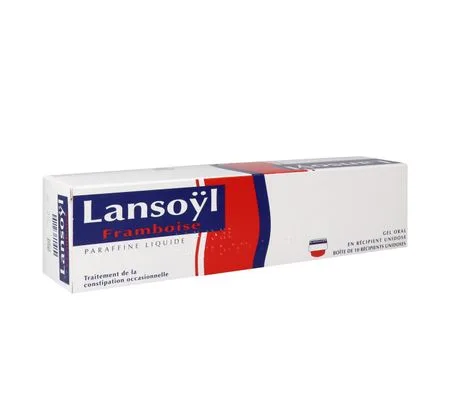
LANSOŸL RASPBERRY® oral gel
liquid paraffin
Forms and presentations
Raspberry oral gel:Pot of 225 g (15 tablespoons).
Single-dose containers of 15 g, boxes of 9 and 10.
Hospital model: Box of 220.
Composition
| for 100 g | per single dose or per tablespoon | |
| Liquid paraffin
|
78,230 g | 11,734 g |
Excipients with known effect: sucrose (2,12 g per tablespoon or 2,3 g per single-dose container), carmine red A (E124) and ethanol contained in the flavouring (11,85 mg per tablespoon or 3,95 mg per teaspoon, and 13,95 mg per single-dose container).
Caloric intake: 9 kcal per tablespoon or single-dose container.
* Raspberry, cassis bud and iris alcoholates, vanilla tincture, plum alcoholature and alcoholate, ethanol, amyl esters (formates, acetates, valerianates), ethylprotocatechuic aldehyde, pelargonic aldehyde.Indications
Symptomatic treatment of occasional constipation.Dosage and administration
Dosage- Pot:
- 1 tablespoon = 15 ml.
- 1 teaspoon = 5 ml.
-
- Adult: 1 to 3 tablespoons per day.
- Child aged 2 to 15 years: 1 to 3 teaspoons per day.
- Use in children under 2 years: only under medical supervision.
- Adult: 1 to 3 tablespoons per day.
- Liquid paraffin may be administered in one or several doses.
- Do not exceed the recommended maximum dosages.
- If the treatment fails, do not increase the doses but seek medical advice.
- The maximum duration of treatment is limited to 15 days.
- Single-dose containers:
- Reserved for adults and children from 12 years of age.
-
- Adults: 1 to 3 single-dose containers per day.
- Children aged 12 years and over: 1 to 2 single-dose containers per day.
- Adults: 1 to 3 single-dose containers per day.
- Do not exceed the recommended maximum dosages.
- If the treatment fails, do not increase the doses but seek medical advice.
- The maximum duration of treatment is limited to 15 days.
Method of administration:
Oral use.
- Preferably take away from meals.
- If taken in the evening, it is recommended not to lie down within two hours after taking it and to take into account the onset of action (6 to 8 hours).
Contraindications
- Hypersensitivity to the active substance or to any of the excipients listed in section Composition.
- Do not use in case of intestinal obstruction and abdominal pain of unknown cause.
- Do not use in people with swallowing difficulties because of the risk of bronchial inhalation and lipid pneumonia.
Warnings and precautions
Warnings:
- Do not use for a prolonged period; prolonged use of liquid paraffin may reduce the absorption of fat-soluble vitamins (A, D, E, K).
- Drug treatment of constipation is only an adjunct to lifestyle and dietary measures, which consist of enriching the diet with vegetable fibres and fluids, engaging in physical activity, and retraining bowel evacuation.
- In children, the administration of laxatives should be exceptional: the risk of interfering with the normal functioning of the defecation reflex must be taken into account.
- Administration of liquid paraffin to children, debilitated or bedridden persons, or in cases of gastro-oesophageal reflux should be done with caution due to the risk of bronchial inhalation and lipid pneumonia (see Undesirable effects).
- If symptoms persist or worsen, or if new symptoms appear, the patient must stop the treatment and consult a doctor.
- This medicine contains 2,12 g of sucrose per tablespoon and 2,3 g of sucrose per single-dose container. This should be taken into account for patients with diabetes mellitus.
- Patients with fructose intolerance, glucose-galactose malabsorption syndrome or sucrase/isomaltase deficiency (rare hereditary diseases) must not take this medicine.
- This medicine contains an azo colouring agent (carmine red A, E124) and may cause allergic reactions.
- This medicine contains 11,85 mg of alcohol (ethanol) per 15 ml tablespoon or 3,95 mg of alcohol (ethanol) per 5 ml teaspoon, and 13,95 mg of alcohol (ethanol) per single-dose container. The small amount of alcohol in this medicine is not likely to cause any noticeable effect.
Interactions
The data available to date do not suggest the existence of clinically significant interactions.
Fertility, pregnancy and breastfeeding
Pregnancy:Clinically, there is no appropriate exposure study during pregnancy or breastfeeding.
No sufficiently relevant data are available to assess a possible malformative or foetotoxic effect of liquid paraffin.
Liquid paraffin shows minimal absorption in the digestive tract but interferes with the resorption of fat-soluble vitamins (A, D, E, K), which could have neonatal consequences (potential bleeding...).
It is not known whether liquid paraffin or its metabolites are excreted in breast milk.
This medicine must not be used during pregnancy or breastfeeding, unless the potential benefit of the treatment for the mother outweighs the potential risk to the developing foetus or the breastfed child. The patient must consult a doctor before using this medicine if she is pregnant or breastfeeding. Any use must be of limited duration.
Driving and using machines
Lansoÿl Framboise has no or negligible effect on the ability to drive vehicles and use machines.Adverse effects
The following table describes the adverse effects reported with liquid paraffin.
The frequency of adverse effects is defined using the following convention: very common (≥ 1/10); common (≥ 1/100, < 1/10); uncommon (≥ 1/1 000, < 1/100); rare (≥ 1/10 000, < 1/1 000); very rare (< 1/10 000), frequency not known (cannot be estimated from the available data).
| System organ class | |
| Frequency | Adverse effects |
| Gastrointestinal disorders | |
| Frequency not known | Diarrhoea, anal seepage, perianal irritation |
| Respiratory, thoracic and mediastinal disorders | |
| Frequency not known | Lipid pneumonia following bronchial inhalation of liquid paraffin (see Warnings and Precautions for Use) |
Reporting suspected adverse reactions after authorisation of the medicinal product is important. It allows continuous monitoring of the benefit/risk balance of the medicinal product. Healthcare professionals should report any suspected adverse reaction via the national reporting system: National Agency for the Safety of Medicines and Health Products (ANSM) and the network of Regional Pharmacovigilance Centres. Website: https://signalement.social-sante.gouv.fr.
Overdose
- Symptoms:
- An overdose of liquid paraffin may be associated with excessive laxative effect and related adverse effects.
- Treatment:
- In case of overdose, stop treatment and apply local symptomatic treatment.
- Keep out of the sight and reach of children. In case of overdose, seek medical advice immediately or contact a poison control centre.
Pharmacodynamics
Pharmacotherapeutic class: Lubricant laxatives (ATC code: A06AA01; A: alimentary tract and metabolism).
Liquid paraffin acts mechanically by lubricating the colonic contents and softening the stools to facilitate their expulsion.
Pharmacokinetics
Absorption of liquid paraffin is minimal.
When taken orally, its action occurs within 6 to 8 hours.
Preclinical safety
Preclinical data derived from literature data on single and repeated dose toxicity, genotoxicity, carcinogenicity, and reproductive and developmental toxicity did not reveal any particular risk for humans.
General toxicology:
Liquid paraffin shows very low acute oral toxicity in rats. In a dietary repeated-dose study of 2 years on chronic toxicity and carcinogenicity in rats receiving liquid paraffin, no adverse effects were reported up to 1 200 mg/kg/day.
Genotoxicity:
No genotoxic potential of liquid paraffin was detected in studies in vitro and in vivo.
Carcinogenicity:
In a dietary repeated-dose study of 2 years, no increase in tumour incidence was observed when rats received 1 200 mg/kg body weight/day of liquid paraffin.
Teratogenicity:
No adverse effects were reported with liquid paraffin in the teratogenicity study in rats.
Fertility:
No adverse effects were observed in male and female rats after administration of liquid paraffin by gavage, and a NOAEL was determined at a dose of 1 000 mg/kg body weight/day.
Storage conditions
- Shelf life
- 3 years.
Store at a temperature not exceeding 25 °C.
HANDLING/DISPOSAL INSTRUCTIONS
Any unused medicinal product or waste material should be disposed of in accordance with local requirements.
Prescription, supply and reimbursement
| Marketing authorisation (AMM) | 3400930570357 (1958/91, SmPC rev 15.09.2022) jar 225 g. |
| 3400935444622 (1991, SmPC rev 15.09.2022) 9 single-dose sachets 15 g. | |
| 3400935444851 (1991, SmPC rev 15.09.2022) 10 single-dose sachets 15 g. | |
| 3400935444790 (1991, SmPC rev 15.09.2022) 220 single-dose sachets 15 g. |
| Not reimbursed by Social Security. | |
| 10 single-dose sachets: Collect. | |
| Hospital pack (220 single-dose sachets): Collect. |
Kenvue France
41, rue Camille-Desmoulins
92130 Issy-les-Moulineaux
Additional information and Pharmacovigilance:
Tel (free green number from a landline in metropolitan France):
00 800 260 26 000
https://www.kenvue.com/fr-fr
Source: VIDAL · Updated on 11/11/2026. This information does not replace advice from a healthcare professional.