
Medicines
SmPC of 05/12/2023
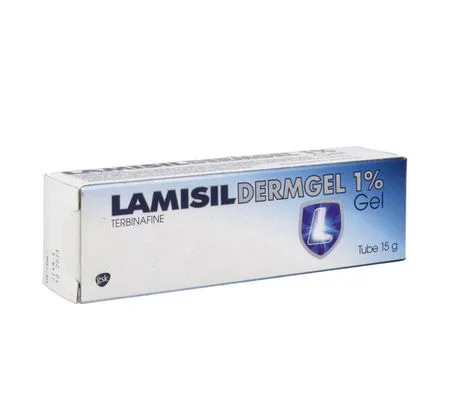
LAMISILDERM GEL 1%, gel
Composition
Active substance:
1 g of gel contains 10 mg of terbinafine base (1% m/m)
Excipients with known effect : butylhydroxytoluene (E321) (0,2 mg/g), ethanol at 96% (100 mg/g), benzyl alcohol (5 mg/g).
Butylhydroxytoluene (E321), sodium hydroxide, benzyl alcohol, sorbitan laurate, carbomer (Carbopol 974P), polysorbate 20, isopropyl myristate, ethanol at 96 percent, purified water.
Indications
LAMISILDERM GEL 1%, gel is indicated for the treatment of cutaneous dermatophytoses and of Pityriasis versicolor in adults (see section Warnings and precautions).
Dosage and administration
CUTANEOUS USE ONLY.
Dosage
This medicine is intended for adults only.
Regardless of the indication, LAMISILDERM GEL 1%, gel is applied once daily.
Duration and frequency of treatment:
- Dermatophytoses of glabrous skin: 1 times/day for 1 week.
- Genitocrural intertrigo: 1 times/day for 1 week.
- Interdigital and plantar intertrigo: 1 times/day for 1 week.
- Pityriasis versicolor : 1 times/day for 1 week.
Clinical symptoms usually begin to improve after a few days. Irregular use or premature discontinuation of treatment may lead to a risk of relapse.
If no sign of improvement appears 1 week after the end of the applications, the patient is advised to ask a pharmacist to check that the product is being applied correctly or a doctor to check the diagnosis.
Method of administration
Before 1year use, the membrane covering the tube must be pierced using the tip inside the cap.
The affected area must be carefully cleaned and dried before application of LAMISILDERM GEL 1%, gel. The gel should be applied as a thin layer and worked into the affected skin and at the periphery of the lesion. In case of infection of skin folds (submammary, interdigital, intergluteal, inguinal), the application may be covered with a compress, particularly at night.
Dosage in special populations
Paediatric population
The use of LAMISILDERM GEL 1 %, gel is not recommended in children, as safety and efficacy data are insufficient.
Elderly
There are no data or experience suggesting that elderly subjects require different dosages of the product or present different adverse effects from those of younger subjects.
Contraindications
Hypersensitivity to the active substance or to any of the excipients listed in section Composition.
Warnings and precautions
LAMISILDERM GEL 1 %, gel should be used with caution on lesions that could be irritated by alcohol. It must not be used on the face.
LAMISILDERM GEL 1 %, gel is limited to external use.
This product may be irritating to the eyes. In case of accidental contact with the eyes, rinse thoroughly with running water.
LAMISILDERM GEL 1 %, gel must be kept out of sight and out of reach of children.
Information on excipients
This medicine contains butylated hydroxytoluene (E321) and may cause local skin reactions (for example: eczema) or irritation of the eyes and mucous membranes.
It also contains 100 mg/g of ethanol at 96 %. Alcohol may cause burning sensations on damaged skin.
This medicine contains 5 mg/g of benzyl alcohol. Benzyl alcohol may cause allergic reactions.
Fertility, pregnancy and breastfeeding
Pregnancy
There are no data available on the use of terbinafine in pregnant women. Studies carried out in animals have not shown any harmful effect on pregnancy or on the health of the foetus (see section Preclinical safety).
The use of LAMISILDERM GEL 1 %, gel should only be considered during pregnancy if necessary.
Breast-feeding
Terbinafine is excreted in breast milk. After topical use only, low systemic exposure is expected.
LAMISILDERM GEL 1 %, gel should be used in breastfeeding women only if the expected benefits justify the risk to the infant. In addition, infants must under no circumstances be brought into contact with treated areas of skin, in particular the breasts.
Fertility
Animal studies have not shown any effect of terbinafine on fertility (see section Preclinical safety).
Driving and using machines
LAMISILDERM GEL 1 %, gel has no or negligible effect on the ability to drive vehicles and use machines.
Adverse effects
Summary of the safety profile
Local symptoms such as pruritus, desquamation, pain, irritation, pigmentation disorders, a burning sensation of the skin, erythema, crusting... may occur at the application site.
These mild symptoms must be differentiated from hypersensitivity reactions including skin rash, reported sporadically and requiring discontinuation of treatment. In case of accidental contact with the eyes, terbinafine may be irritating to the eyes. In rare cases, the underlying fungal infection may be aggravated.
Undesirable effects are listed by system organ class, according to their incidence using the following classification:
- Very common (≥ 1/10).
- Common (≥ 1/100 to < 1/10).
- Uncommon (≥ 1/1 000 to < 1/100).
- Rare (≥ 1/10 000 to < 1/1 000).
- Very rare (< 1/10 000).
- Frequency not determinable (cannot be estimated from the available data).
Within each frequency group, undesirable effects are presented in order of decreasing seriousness.
Undesirable effects identified after marketing are reported voluntarily from a population of uncertain size. The frequency of these undesirable effects is "not known" but may be rare or very rare.
|
System organ class
|
Adverse effects |
|
Immune system disorders: |
|
|
Frequency not known |
Hypersensitivity |
|
Eye disorders: |
|
|
Rare |
Eye irritation |
|
Skin and subcutaneous system disorders: |
|
|
Common |
Desquamation, pruritus |
|
Uncommon |
Skin lesion, crust, skin disorder, pigmentation disorder, erythema, skin burning sensation |
|
Rare |
Dry skin, contact dermatitis, eczema |
|
Frequency not known |
Skin rash |
|
General disorders and administration site conditions: |
|
|
Uncommon |
Pain, pain at application site, irritation at application site. |
|
Rare |
Worsening of symptoms |
Reporting of suspected adverse reactions
Reporting suspected adverse reactions after authorisation of the medicinal product is important. It allows continued monitoring of the benefit/risk balance of the medicinal product. Healthcare professionals are asked to report any suspected adverse reactions via the national reporting system: National Agency for the Safety of Medicines and Health Products (ANSM) and the network of Regional Pharmacovigilance Centres - Website: www.signalement.social-sante.gouv.fr.
Overdose
Due to the low systemic absorption of the LAMISILDERMGEL 1 %, gel emulsion gel, overdose is unlikely. An accidental ingestion of 30 g of LAMISILDERMGEL 1 %, gel, which contains 300 mg of terbinafine, is comparable to that of a 250 mg LAMISIL tablet (daily adult dosage).
In the case of accidental ingestion of LAMISILDERMGEL 1 %, gel in an amount greater than 30 g, adverse effects similar to those observed with an overdose of LAMISIL tablets could occur. These side effects include headache, nausea, gastric pain and dizziness.
In case of accidental ingestion, take into account the presence of ethanol (9,4 % v/v).
Treatment of overdose
In case of accidental ingestion, the recommended treatment of overdose consists essentially of eliminating the absorbed terbinafine by administration of activated charcoal, and implementing symptomatic treatment if necessary.
Pharmacodynamics
Pharmacotherapeutic class: TOPICAL ANTIFUNGALS, ATC code: D01AE15.
Terbinafine is a broad-spectrum antifungal agent belonging to the allylamine class.
Terbinafine is active against cutaneous fungal infections due to dermatophytes such as Trichophyton (e.g.: T. rubrum, T. mentagrophytes, T. verrucosum, T. violaceum), Microsporum canis and Epidermophyton floccosum. At low concentration, terbinafine is fungicidal against dermatophytes and moulds. The fungicidal activity (e.g.: Pityrosporum orbiculare or Malassezia furfur) or fungistatic activity against certain yeasts depends on the species.
Mechanism of action
Terbinafine interferes specifically and early on with the biosynthesis of ergosterol (an essential component of the fungal cell membrane), which results in an ergosterol deficit and intracellular accumulation of squalene responsible for its fungicidal action.
Terbinafine acts by inhibiting squalene epoxidase in the fungal cell membrane; the enzyme squalene epoxidase is not linked to the cytochrome P-450 system.
Terbinafine does not modify the metabolism of hormones and other substances.
Pharmacokinetics
Absorption
Less than 5% of the dose is absorbed after topical application in humans, so systemic exposure is very low.
Preclinical safety
No significant toxic effect was observed in rats and dogs after long-term oral administration (up to one year) of oral doses reaching 100 mg/kg/day.
At high oral doses, the liver and, to a lesser degree, the kidneys were identified as potential target organs.
In a dermal toxicity study of 4 weeks, conducted in rabbits, LAMISILDERMGEL 1 %, gel was well tolerated and free of systemic toxicity. Signs of moderate skin irritation, due to the gel excipient, disappeared when treatment was stopped.
In a two-year carcinogenesis study conducted in mice, no data on the occurrence of neoplasms or other abnormalities attributable to treatment were found after oral administration of doses up to 130 mg/kg/day (males) and 156 mg/kg/day (females).
In a 2th In a carcinogenesis study conducted in rats over 2 years, after oral terbinafine intake, males treated at the highest dose (i.e. 69 mg/kg/day) showed an increased incidence of liver tumours. It was shown that these observations, which could be related to peroxisome proliferation, are specific to this animal species as they were not found in the carcinogenicity study in mice or in other studies conducted in mice, dogs or monkeys.
During high oral dose studies of terbinafine in monkeys, refractive irregularities at the level of the retina were noted at the highest doses (no toxic effect dose: 50 mg/kg). These irregularities, not accompanied by histological changes, were associated with the presence of a metabolite of terbinafine in ocular tissue and disappeared when treatment was stopped.
A standard battery of genotoxicity tests performed in vitro and in vivo revealed no mutagenic or clastogenic potential of the product.
No adverse effects relating to fertility or other reproductive parameters were observed in studies in rats and rabbits.
Prescription, supply and reimbursement
| Marketing authorisation (AMM) |
|
| Price: |
|
ALLOGA FRANCE
ZAC de Chapotin Sud
Rue du Professeur-Dargent. 69970 Chaponnay
Medical Information:
Tel: 01 81 79 38 34
www.alloga.fr
Source: VIDAL · Updated on 11/11/2026. This information does not replace advice from a healthcare professional.