
Medicines
Update of 13/11/2023
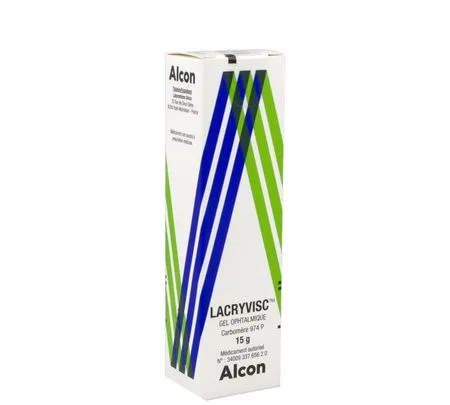
LACRYVISC®
carbomer
Forms and presentations
Ophthalmic gel:Tube of 15 g, with cannula.
Composition
| for 100 g | |
| Carbomer 974 P
|
300 mg |
Excipient with known effect: benzalkonium chloride (0,001 mg of benzalkonium chloride per dose equivalent to 0,05 mg/g).
Indications
Symptomatic treatment of dry eye syndrome.Dosage and administration
DosageTopical use.
For ophthalmic use only, as an eye instillation.
- Adults (including the elderly):
- Instil 1 drop of ophthalmic gel into the lower conjunctival sac, gently pulling the lower eyelid down and looking up, into the affected eye or eyes, 2 to 4 times a day depending on the eye disorder.
- Paediatric population and adolescents up to 18 years:
- The safety and efficacy of Lacryvisc, ophthalmic gel in children and adolescents, at the dose recommended for adults, have been established by clinical experience, but no clinical study data are available.
Method of administration:
The tip of the tube must not come into contact with any surface, including the eye (see also Warnings and precautions).
In case of concomitant treatment with another eye drop, another ophthalmic ointment or another ophthalmic gel, wait at least 5 minutes between the two instillations.
Lacryvisc, ophthalmic gel should always be instilled last, as it may delay the penetration of other ophthalmic medicines.
Contraindications
Hypersensitivity to the active substance or to any of the excipients listed in section Composition.Warnings and precautions
For ophthalmic use only.
If the patient experiences eye pain, changes in vision, eye irritation, eye redness, or if symptoms worsen or persist, treatment must be discontinued and a doctor or ophthalmologist must be consulted.
Avoid touching the eye, or any other surface, with the tip, due to the risk of contaminating the gel and eye injury.
- Close the tube after use of the product.
-
- Benzalkonium chloride:
- This medicine contains 0,001 mg of benzalkonium chloride per dose, equivalent to 0,05 mg/g.
- Benzalkonium chloride may be absorbed by soft contact lenses and change their colour. Remove contact lenses before application and wait at least 15 minutes before reinserting them.
- Benzalkonium chloride may also cause eye irritation, especially if the patient suffers from dry eye syndrome or corneal disorders. If abnormal sensation, tingling or pain in the eyes occurs after using this medicine, a doctor should be consulted.
- Irritation may affect adherence to treatment in children.
- Patients should be monitored in case of prolonged use.
Interactions
No interaction studies have been performed.
No clinically significant interaction has been described with Lacryvisc, eye gel.
If another eye drop, another eye ointment or another eye gel is used, it is recommended to wait at least 5 minutes between each medicine. Eye ointments and eye gels should be administered last.
Fertility, pregnancy and breastfeeding
Pregnancy:There are no data on the use of carbomer in pregnant women. However, no effect during pregnancy is expected because systemic exposure to carbomer is normally negligible. Furthermore, carbomer is an inactive ingredient that only exerts a surface protective effect.
Lacryvisc, eye gel may be used during pregnancy.
Breastfeeding:
It is unknown whether carbomer or any of the components of this medicine is excreted in breast milk.
However, no effect on the breastfed child is expected because systemic exposure to carbomer in the breastfeeding woman is normally negligible. Furthermore, carbomer is an inactive ingredient that only exerts a surface protective effect.
Lacryvisc, eye gel may be used during breastfeeding.
Fertility:There are no data concerning the effects of this medicine on male or female fertility.
Driving and using machines
Lacryvisc, eye gel has no or negligible effect on the ability to drive vehicles and use machines.Vision may be blurred and stinging may be felt for a few minutes after instillation, depending on the viscosity of the product. This may reduce the ability to drive vehicles or use machines. In this case, the patient should be advised not to drive or use machines until normal vision is restored.
Adverse effects
- Summary of the product's safety profile:
- During clinical trials, the most frequently reported adverse reactions were: vision disorders (occurring in 11 % of patients) and crusting on the eyelid margin (occurring in 7,79 % of patients).
- Summary table of adverse effects:
- The adverse reactions reported in clinical trials of Lacryvisc, eye gel are listed in the table below and are classified as follows: very common (≥ 1/10), common (≥ 1/100 to < 1/10), uncommon (≥ 1/1 000 to < 1/100), rare (≥ 1/10 000 to < 1/1 000), very rare (< 1/10 000), or frequency not known (cannot be estimated from the available data). Within each frequency group, adverse reactions are presented in order of decreasing seriousness.
-
System organ class Frequency Adverse effects Eye disorders Very common Blurred vision Common Eye discomfort, crusting on the eyelid margin, eye irritation Uncommon Eyelid oedema, conjunctival oedema, eye pain, ocular pruritus, eye hyperaemia, increased lacrimation Skin and subcutaneous tissue disorders Uncommon Contact dermatitis - Possibility of slight stinging upon instillation, transient blurred vision, after instillation and until the gel spreads evenly over the surface of the eye.
- Due to the presence of benzalkonium chloride, risk of contact eczema and irritation.
- The following adverse effects have been identified during post-marketing surveillance of Lacryvisc, ophthalmic gel. The frequencies of these effects cannot be estimated from the available data.
-
System organ class Adverse effects Immune system disorders Hypersensitivity
Reporting suspected adverse reactions after authorisation of the medicinal product is important. It allows continuous monitoring of the benefit/risk balance of the medicinal product. Healthcare professionals should report any suspected adverse reaction via the national reporting system: National Agency for the Safety of Medicines and Health Products (ANSM) and the network of Regional Pharmacovigilance Centres. Website: https://signalement.social-sante.gouv.fr.
Overdose
Due to the characteristics of this preparation, no toxic effect is to be expected in the event of ocular overdose with this product, nor in the event of accidental ingestion of the contents of a tube.
In case of overdose, rinse with sterile physiological saline.
Pharmacodynamics
Pharmacotherapeutic class: Lacrimal substitute (ATC code: S01XA20).
- Fluid ophthalmic gel based on high molecular weight hydrophilic polymer (carbomer 974 P).
- This gel forms on the surface of the eye a transparent, lubricating and wetting film that temporarily compensates for insufficient tears.
- Its pH and osmolarity are similar to those of the normal tear film.
- Their viscosity is higher than that of an artificial tear, which results in a less frequent administration frequency.
Pharmacokinetics
The residence time on the surface of the eye is on the order of 30 minutes.
Preclinical safety
There are no preclinical data on the mutagenicity, carcinogenicity or teratogenicity of carbomer 974 P. Locally, no ocular irritation or signs of ocular or systemic toxicity have been demonstrated in animals treated with carbomer 974 P.
Storage conditions
- Shelf life
-
- Before opening:
- 2 years.
-
- After opening:
- The medicinal product may be stored for a maximum of 28 days.
Store at a temperature not exceeding 25 °C.
HANDLING/DISPOSAL INSTRUCTIONS
No special requirements.
Prescription, supply and reimbursement
| Marketing authorisation (AMM) | 3400933765620 (1992, RCP rev 20.11.2020) tube. |
| Price: | 4,09 euros (tube of 15 g). |
| Reimbursed by Social Security at 65 %. Collective. | |
Laboratoires ALCON SAS
20, Rue des Deux-Gares. 92500 Rueil-Malmaison
Tel: 01 47 10 47 10. Fax: 01 47 10 27 70
Medical information and materiovigilance: Tel: 01 47 10 47 58
Source: VIDAL · Updated on 10/11/2026. This information does not replace advice from a healthcare professional.