
Medicines
SPC of 05/02/2026
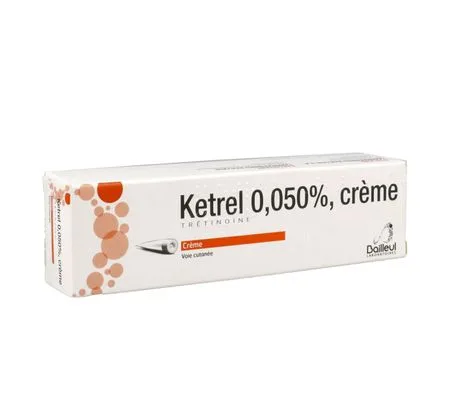
KETREL 0,050 %, cream
Composition
For 100 g of cream:
Tretinoin: 0,0500 g
Excipients with known effect: butylhydroxytoluene, butylhydroxyanisole, methyl parahydroxybenzoate, propyl parahydroxybenzoate, polysorbate 80.
Isopropyl myristate, carbomer (CARBOPOL 974P NF), polysorbate 80, medium-chain triglycerides (MIGLYOL 812), glycerol, light liquid paraffin, butylhydroxytoluene, butylhydroxyanisole, methyl parahydroxybenzoate, propyl parahydroxybenzoate, sodium hydroxide, purified water.
Dosage and administration
Dosage
The starting dosage is one application, in the evening. The frequency of applications will be adjusted according to the reactions obtained.
The application frequency must be prescribed such that it avoids unpleasant irritation reactions; only slight erythema, moderate desquamation, or even a faint burning sensation are acceptable.
In case of significant primary irritation, switch to one application every other day.
In the absence of any local reaction, the frequency of applications may be increased to 2 per day. From the end of the second week until the end of the initial treatment (12th at 14th week), the rhythm of applications is on average once a day or less in case of persistent irritation.
To obtain the best result, the patient must be warned of the normal reactions that mark the beginning of treatment: primary irritation and transient efflorescence; the patient must be seen regularly to adjust the dosage and minimise primary irritation.
He/she should be informed of the delayed nature of the improvement, of the benefit of continuing therapy until the third month to obtain an optimal result, and of the need for maintenance treatment to prevent relapses.
Improvement is clearly visible by week 6th of treatment, it continues to achieve the best possible result by week 12th or week 14th week.
At this date, or earlier if all acne lesions have disappeared, the patient may switch to maintenance treatment with 2 or 3 applications per week.
Paediatric population
Not applicable.
Method of administration
Cutaneous use.
After washing and thoroughly drying the skin, apply a thin layer of cream to the lesions with light massage, avoiding the eyes, eyelids, lips, and nostrils.
Wash hands after using the product.
Contraindications
• Hypersensitivity to the active substance or to any of the excipients listed in section Composition.
• Pregnancy (see section Fertility, pregnancy and breastfeeding)
• Women planning a pregnancy.
Warnings and precautions
Because of possible intolerance phenomena such as edema and eczematization of a transient nature, a repeated test on a reduced skin surface (test patch) is advisable during the first applications.
If a hypersensitivity-type reaction or severe irritation occurs, treatment must be temporarily or even permanently discontinued.
In case of accidental application to mucous membranes, eyes, mouth, nostrils, or an open wound, rinse thoroughly with lukewarm water.
Due to the irritant nature of the treatment, concomitant use of astringent cleansing cosmetic products and drying or irritating agents (such as perfumed or alcohol-containing products) should be avoided.
Exposure to sunlight and ultraviolet lamps causing additional irritation should be avoided.
Treatment may, however, be continued if sun exposure is reduced to a minimum (protection by wearing a hat and use of a sunscreen cream) and the frequency of applications is adjusted.
In case of exceptional sun exposure (for example a day at the sea), do not apply the day before, on the same day, or the day after.
If prior exposure has caused sunburn, wait for complete recovery before starting treatment.
This medicine contains butylhydroxytoluene and butylhydroxyanisole and may cause local skin reactions (for example: contact dermatitis) or irritation of the eyes and mucous membranes.
This medicine contains methyl parahydroxybenzoate and propyl parahydroxybenzoate and may cause allergic reactions (possibly delayed).
This medicine contains 90 mg of polysorbate 80 per tube of cream (30 g) equivalent to 300 mg/100 g. Polysorbates may cause allergic reactions. Inform your doctor if you have already had/your child has already had an allergy.
Interactions
Due to the irritating nature of this preparation, it is preferable to avoid any product that may cause local irritation (alcohol-based solutions in particular).
Fertility, pregnancy and breastfeeding
Oral retinoids are associated with congenital abnormalities. When used in accordance with the prescribing information, topical retinoids are generally considered to result in low systemic exposure due to minimal dermal absorption. However, individual factors (for example: skin lesion, excessive use) may contribute to increased systemic exposure.
Fertility
Not applicable.
Pregnancy
In animals : Tretinoin has been shown to be teratogenic orally; topically and at high doses, it induces minor skeletal malformations.
In men : KETREL 0,050 %, cream is contraindicated (see section Contraindications) in pregnant women or women planning a pregnancy.
If used in a pregnant patient, or if a patient treated with this medicine becomes pregnant, treatment must be discontinued.
Breast-feeding
It is not known whether tretinoin is secreted in breast milk after administration of KETREL, but it is known that retinoids administered orally and their metabolites are secreted in breast milk. Therefore, KETREL must not be used in breastfeeding women.
Driving and using machines
KETREL 0,050 %, cream has no or negligible effect on the ability to drive vehicles and use machines.
Adverse effects
Reversible skin irritation may occur, disappearing when treatment is interrupted or applications are spaced out. A feeling of warmth or slight tingling may occur after application.
Due to the presence of butylhydroxyanisole and butylhydroxytoluene, risk of contact eczema, irritation of the skin, eyes and mucous membranes.
Due to the presence of methyl and propyl parahydroxybenzoate, risk of contact eczema; exceptionally immediate reactions with urticaria and bronchospasm.
Reporting of suspected adverse reactions
Reporting suspected adverse reactions after authorisation of the medicinal product is important. It allows continuous monitoring of the benefit/risk balance of the medicinal product. Healthcare professionals report any suspected adverse reaction via the national reporting system: National Agency for the Safety of Medicines and Health Products (ANSM) and the network of Regional Pharmacovigilance Centres – Website: https://signalement.social-sante.gouv.fr/ .
Pharmacodynamics
Pharmacotherapeutic class: topical anti-acne retinoids, ATC code: D10AD01.
The activity of tretinoin is based on a mechanism of action that corresponds point by point to the pathogenesis of acne:
• Tretinoin counteracts and prevents the formation of acne lesions: by stimulating the follicular epithelium, the increased proliferation of non-cohesive keratinised cells is intensified. These free horny cells are evacuated with the sebum towards the skin surface. The horny plug cannot form and the formation of new lesions is thus prevented;
• Tretinoin causes the expulsion of retention lesions (open comedones, microcysts). In addition to the superficial desquamation of the epidermis, tretinoin exerts a deeper action at the level of the follicular epithelium: it stimulates the proliferation of free horny cells, which, combined with the reduced cohesion of the horny plug, leads to the expulsion of the microcyst or comedone;
• Tretinoin accelerates the evolution of inflammatory lesions (papules, pustules).
Applied at the beginning of the inflammatory phase, tretinoin increases the permeability of the follicular wall to the irritant agents responsible for inflammatory phenomena (keratin fragments, free fatty acids...) and accelerates to the same extent the evolution of papules and pustules and their elimination. It thus prevents the transformation of these lesions into cystic nodules.
Pharmacokinetics
The rates of percutaneous absorption of tretinoin or retinoic acid, within preparations for local use, although variable (dosage form, location, treated surface area, duration of treatment, ...) remain low at therapeutic doses. Retinoic acid is rapidly metabolised (48 h).
Preclinical safety
In repeated-dose toxicity studies conducted mainly by the oral route and in a few cases by the parenteral or dermal route in mice and rats, but also in a few studies in rabbits and dogs, tretinoin exerted marked toxicity at high doses, mainly causing fractures of the long bones as a sign of disturbed bone mineralisation, and testicular atrophy with impaired spermatogenesis. Dermal administration of approximately 0,5 mg/kg body weight in rats and rabbits as a 1 % formulation did not cause systemic signs of toxicity, but induced transient local erythema.
Tretinoin was not mutagenic in the Ames test in bacteria in vitro, but induced sister chromatid exchanges in human fibroblasts in vitro. The specific photo-carcinogenicity study showed an increase in skin tumours caused by ultraviolet light during treatment with tretinoin.
No effect of tretinoin on female fertility was reported, but toxic doses resulted in impaired spermatogenesis in males. Tretinoin was highly embryotoxic and teratogenic in mice, rats, rabbits and monkeys, inducing a high incidence of cleft palate and other malformations. The NOAEL following oral administration was determined to be 0,5 to 1,0 mg/kg body weight in the rat, and the NOAEL following subcutaneous administration was determined to be 1,0 mg/kg body weight in the rabbit. In studies on embryo-foetal development effects following cutaneous application, although no systemic level of tretinoin after topical application was detected in the rat, skeletal or cardiac malformations were described. These abnormalities are consistent with the effects of retinoids and occur at 16 times the recommended clinical dose, assuming 100 % absorption, based on comparison of body surface area. In a peri- and postnatal toxicity study in rats, tretinoin exerted toxic effects at doses above 2 mg/kg body weight following oral administration.
Topical application of tretinoin to the skin may cause reversible skin irritation with erythema, oedema, epithelial proliferation, acanthosis, hyperkeratosis and exfoliation of the superficial layer.
Prescription, supply and reimbursement
| Marketing authorisation (AMM) |
|
GIULIANI GROUP 264 RUE DU FAUBOURG SAINT-HONORÉ
75008 PARIS
Tel: 01 56 33 11 11 accueil@bailleul.com
https://bailleul.com/france/
Source: VIDAL · Updated on 10/11/2026. This information does not replace advice from a healthcare professional.