
Medicines
SmPC of the 27/06/2025
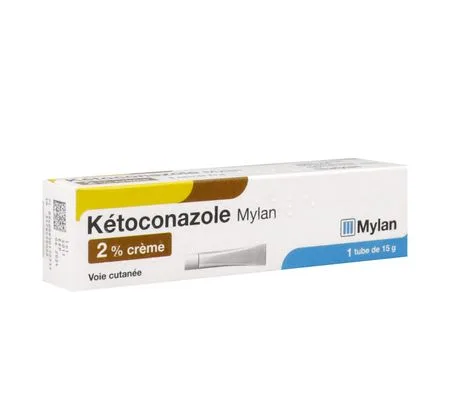
KETOCONAZOLE VIATRIS 2 %, cream
Composition
Ketoconazole..................................................................................................................................................20 mg
For 1 g of cream.
Excipients with known effect: 1 g of cream contains 200 mg of propylene glycol (E1520), 75 mg of stearyl alcohol, 20 mg of cetyl alcohol, 1 mg of polysorbate 80 (E433) and 15 mg of polysorbate 60 (E435).
Propylene glycol (E1520), cetyl alcohol, stearyl alcohol, polysorbate 80 (E433), polysorbate 60 (E435), isopropyl myristate, sorbitan stearate, anhydrous sodium sulfite (E221), purified water.
Indications
This medicine is indicated for the topical treatment of dermatophyte skin infections, cutaneous candidiasis and Pityriasis versicolor in adults.
Dosage and administration
The use of KETOCONAZOLE VIATRIS 2 %, cream is reserved for adults.
Cutaneous candidiasis, dermatophytoses of the body skin, inguinal dermatophytoses, dermatophytoses of the hand, athlete's foot and pityriasis versicolor : it is recommended that KETOCONAZOLE VIATRIS 2%, cream be applied once or twice daily to cover the affected area and its immediate periphery.
The usual duration of treatment is: from 2 to 3 weeks for pityriasis versicolor, for 2 to 3 weeks for cutaneous yeast infection, for 2 to 4 weeks for inguinal dermatophytosis, for 3 to 4 weeks for cutaneous body dermatophytosis, for 4 to 6 weeks for athlete's foot.
Paediatric population
The safety and efficacy of KETOCONAZOLE VIATRIS 2%, cream, in children aged less than 18 years, have not been established.
Contraindications
Hypersensitivity to the active substance (ketoconazole) or to any of the excipients listed in the section Composition.
Warnings and precautions
Special warnings
The cream is not suitable for ophthalmic use.
In patients receiving a topical corticosteroid as prolonged treatment, application of a low-potency topical corticosteroid should be continued in the morning and KETOCONAZOLE VIATRIS 2 %, cream applied in the evening, then corticosteroid therapy should be gradually discontinued over a period of 2 to 3 weeks in order to avoid a potential rebound effect.
• Candidiasis: it is not recommended to use an acidic pH soap (pH favouring the multiplication of candida).
• The low rate of cutaneous absorption makes the occurrence of systemic effects unlikely. However, over a large surface area and/or on damaged skin, caution is required.
Precautions for use
Excipients
This medicine contains 200 mg of propylene glycol per 1 g of cream, cetyl alcohol and stearyl alcohol.
Propylene glycol may cause skin irritation.
Cetyl alcohol and stearyl alcohol may cause local skin reactions (for example contact dermatitis).
Polysorbate 80 (E 433) and polysorbate 60 (E 435) may cause allergic reactions.
Interactions
Given the low systemic exposure to ketoconazole after application of KETOCONAZOLE VIATRIS 2 %, cream, drug interactions are unlikely to be clinically significant.
Fertility, pregnancy and breastfeeding
Pregnancy
No effect of KETOCONAZOLE VIATRIS 2 %, cream during pregnancy is expected since maternal systemic exposure is negligible. KETOCONAZOLE VIATRIS 2 %, cream may therefore be used during pregnancy.
Breast-feeding
No effect of KETOCONAZOLE VIATRIS 2 %, cream on the breastfed newborn or infant is expected, since maternal systemic exposure is negligible. KETOCONAZOLE VIATRIS 2 %, cream may therefore be used during breastfeeding.
Adverse effects
The tolerability of ketoconazole 2 %, cream administered to the skin was evaluated in 1079 subjects during 30 clinical trials.
Based on the pooled tolerability data from these clinical studies, the most frequently reported adverse reactions (incidence ≥ 1%) were: pruritus at the application site (2%), burning sensation of the skin (1,9%) and erythema at the application site (1%).
The adverse effects reported with ketoconazole 2 %, cream, either during clinical studies or after marketing, are listed below by frequency category, according to the following convention:
Very common (≥ 1/10), common (≥ 1/100 to < 1/10), uncommon (≥ 1/1 000 to < 1/100), rare (≥ 1/10 000 to < 1/1 000), very rare (< 1/10 000) and frequency not known (cannot be estimated from the available data).
|
System organ classes |
Adverse effects |
||
|
Frequency |
|||
|
Common (≥ 1/100 to < 1/10) |
Uncommon (≥1/1000 to <1/100) |
Frequency not known |
|
|
Immune system disorders |
|
Hypersensitivity |
|
|
Skin and subcutaneous tissue disorders |
Burning sensation of the skin |
Bullous eruption
|
Urticaria |
|
General disorders and administration site conditions |
Erythema at application site
|
Bleeding at the site of application
|
|
Reporting of suspected adverse reactions
Reporting suspected adverse reactions after authorisation of the medicinal product is important. It allows continued monitoring of the benefit/risk balance of the medicinal product. Healthcare professionals are asked to report any suspected adverse reaction via the national reporting system: National Agency for the Safety of Medicines and Health Products (ANSM) and the network of Regional Centres of Pharmacovigilance - Website: https://signalement.social-sante.gouv.fr/ .
Overdose
Ingestion
In case of accidental ingestion, treatment will be limited to supportive and symptomatic measures. To avoid aspiration of gastric contents, do not perform gastric lavage or induce vomiting.
Pharmacodynamics
Pharmacotherapeutic class: topical antifungals, imidazole and triazole derivatives, ATC code: D01AC08.
Ketoconazole is an antifungal of the imidazole group.
It has potent antifungal activity against:
• dermatophytes: in particular Trichophyton sp., Epidermophyton sp., Microsporum sp.,
• yeasts: in particular Candida sp. and Malassezia furfur (Pityrosporum ovale).
In vitro and in vivo in animals, ketoconazole inhibits the synthesis of leukotrienes.
Pharmacokinetics
Plasma concentrations of ketoconazole are not detectable after administration of 2 % ketoconazole cream to the skin in adults.
In a study in children with seborrhoeic dermatitis (n=19), plasma concentrations of ketoconazole were detected in 5 children at 32 to 133 ng/mL after daily application of 40 g of 2 % ketoconazole cream over 40% of the body surface.
Preclinical safety
Non-clinical data from conventional studies, including primary ocular or skin irritation, skin sensitisation and repeated-dose dermal toxicity, did not reveal any particular risk for humans.
Ketoconazole is teratogenic in rats by oral route from doses of 80 mg/kg; however, by dermal route the plasma concentrations of ketoconazole are 6000 times lower than those found by oral route for a dose of 40 mg/kg in rats.
Prescription, supply and reimbursement
| Marketing authorisation (AMM) |
|
| Price: |
|
Collection.
1 RUE DE TURIN
69007 LYON
Tel: 04 37 25 75 00 https://www.viatris.fr/
Source: VIDAL · Updated on 10/11/2026. This information does not replace advice from a healthcare professional.