Medicines
SmPC of 31/10/2017
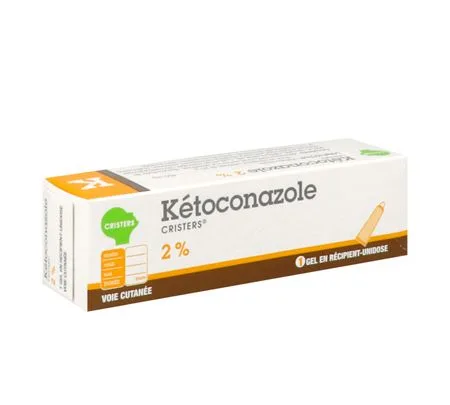
KETOCONAZOLE CRISTERS 2 %, gel in single-dose container
Composition
Ketoconazole ................................................................................................................................400 mg
For a single-dose container of 20 g.
Disodium monolauryl ether sulfosuccinate, sodium lauryl sulfate, dihydroxyethyl alkanamide, macrogol 120 methylglucose dioleate, hydroxypropyl lauryl dimethyl ammonium chloride, imidurea, erythrosine (E 127), sodium hydroxide, sodium chloride, purified water.
Indications
This medicine is indicated in the treatment of Pityriasis versicolor in adults and adolescents (≥ 12 years).
Dosage and administration
The use of KETOCONAZOLE CRISTERS 2 %, gel in single-dose container is reserved for adults and adolescents (≥ 12 years).
The safety and efficacy of KETOCONAZOLE CRISTERS 2 %, gel in single-dose container have not been established in children under 12 years. No data are available.
Dosage
Single application of the contents of the tube (20 g).
Method of administration
Cutaneous application to the scalp and/or skin.
- Thoroughly wet the affected areas, skin and/or scalp. Apply the entire contents of one tube of gel over the entire surface of the body including the scalp, optionally using a wet glove.
- Avoid contact with the eyes.
- Lather the gel, focusing on the affected areas. Leave in place for a minimum of 5 minutes. For good efficacy, it is important to respect this minimum duration.
- Then rinse the skin and/or scalp thoroughly and not only the hair.
Contraindications
- Hypersensitivity to the active substance or to any of the excipients listed in section Composition.
Warnings and precautions
Warnings special
When using KETOCONAZOLE CRISTERS 2 %, gel in single-dose container in patients who have received prolonged treatment with topical corticosteroids, it is recommended to gradually discontinue corticosteroid therapy over a period of 2 to 3 weeks in order to avoid any potential rebound effect.
Precautions for use
Avoid any contact with the eyes. In case of accidental contact with the eye, rinse with water.
Interactions
Given the low systemic exposure to ketoconazole after application of KETOKONAZOLE CRISTERS 2 %, gel in single-dose container, drug interactions are unlikely to be clinically significant.
Fertility, pregnancy and breastfeeding
Pregnancy
No effect of KETOCONAZOLE CRISTERS 2 %, gel in single-dose container during pregnancy is expected since maternal systemic exposure is negligible. KETOCONAZOLE CRISTERS 2 %, gel in single-dose container may therefore be used during pregnancy.
Breast-feeding
No effect of KETOCONAZOLE CRISTERS 2 %, gel in single-dose container in breastfed newborns or infants is expected, since maternal systemic exposure is negligible. KETOCONAZOLE CRISTERS 2 %, gel in single-dose container may therefore be used during breastfeeding.
Adverse effects
The tolerability of ketoconazole administered to the scalp and/or skin was evaluated in 2890 patients across 22 clinical trials. Based on the pooled tolerability data from these clinical trials, no adverse reaction with an incidence ≥ 1% was reported.
The adverse effects reported with ketoconazole, either during clinical studies or after marketing, are listed below by frequency category, according to the following convention:
Very common (≥ 1/10), common (≥ 1/100 to < 1/10), uncommon (≥ 1/1 000 to < 1/100), rare (≥ 1/10 000 to < 1/1 000), very rare (< 1/10 000) and not known (cannot be estimated from the available data).
|
Organ system classes |
Adverse effects |
||
|
Frequency |
|||
|
Uncommon |
Rare |
Not known |
|
|
(≥ 1/1 000 to <1/100) |
(≥ 1/10 000 to < 1/1 000) |
|
|
|
Immune system disorders |
|
Hypersensitivity
|
|
|
Nervous system disorders |
|
Dysgeusia
|
|
|
Infections and infestations
|
Folliculitis
|
|
|
|
Eye disorders
|
Increased lacrimation |
Eye irritation |
|
|
Skin and subcutaneous tissue disorders
|
Alopecia Dry skin Abnormal hair texture Rash Skin burning sensation |
Acne Contact dermatitis Skin disorders Skin desquamation
|
Angioedema Urticaria Change in hair colour
|
|
General disorders and administration site conditions
|
Erythema at the application site Irritation at the application site Pruritus at the application site Reaction at the application site |
Hypersensitivity at the application site Pustules at the application site
|
|
Reporting of suspected adverse reactions
Reporting suspected adverse reactions after authorisation of the medicinal product is important. It allows continuous monitoring of the benefit/risk balance of the medicinal product. Healthcare professionals should report any suspected adverse reaction via the national reporting system: National Agency for the Safety of Medicines and Health Products (ANSM) and the network of Regional Pharmacovigilance Centres. Website: www.ansm.sante.fr.
Overdose
Ingestion
In case of accidental ingestion, treatment will be limited to supportive and symptomatic measures. To avoid aspiration of gastric contents, do not perform gastric lavage or induced vomiting.
Pharmacodynamics
Pharmacotherapeutic class: Antifungal for topical use - imidazole and triazole derivatives, ATC code: D01AC08
Ketoconazole is an antifungal of the imidazole group. It has potent antifungal activity against:
- dermatophytes: in particular Trichophyton sp. Epidermophyton sp.., Microsporum sp.
- yeasts: in particular Candida sp. and Malassezzia furfur (Pityrosporum ovale).
In vitro and in vivo in animals, ketoconazole inhibits the synthesis of leukotrienes.
Pharmacokinetics
Plasma concentrations of ketoconazole are not detectable after local administration of ketoconazole to the scalp.
Low but occasionally measurable plasma levels (from 11 to 33 ng/ml with an assay detection limit of 5 ng/ml) were observed in 3 out of 6 patients with a Pityriasis versicolor after local administration of ketoconazole over the entire body (estimated dose of 400 mg for 5 minutes).
Preclinical safety
Non-clinical data from conventional studies, including primary ocular or skin irritation, skin sensitisation and repeated-dose dermal toxicity, did not reveal any particular risk for humans.
Ketoconazole is teratogenic in rats by oral route from doses of 80 mg/kg; however, by cutaneous route the plasma concentrations of ketoconazole are 6 000 times lower than those found by oral route for a dose of 40 mg/kg in rats.
Prescription, supply and reimbursement
| Marketing authorisation (AMM) |
|
| Price: |
|
Collection.
22 QUAI GALLIENI
92150 SURESNES
Tel: 01 42 04 88 94 https://www.laboratoirecristers.com/
Source: VIDAL · Updated on 10/11/2026. This information does not replace advice from a healthcare professional.