
Medicines
SmPC of 07/07/2025
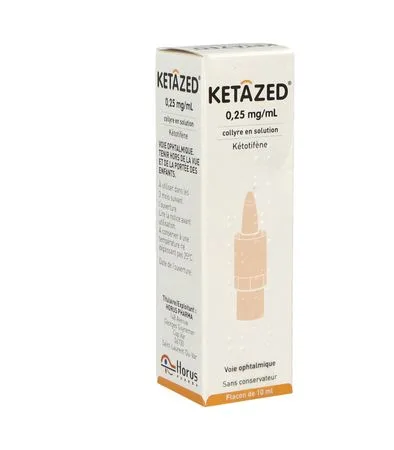
KETAZED 0,25 mg/mL, eye drops in solution
Forms and presentations
Eye drops in solution (clear, colourless to slightly yellow-tinted), pH: 4,8-6,4.
Box of 1 bottle of 10 mL of solution, closed with a pump.
Composition
For 1 mL:
Ketotifen: 0,250 mg
As ketotifen hydrogen fumarate: 0,345 mg
Each drop contains 9,5 micrograms of ketotifen fumarate.
Sodium hyaluronate, glycerol (E 422), sodium hydroxide (E 524), purified water
Dosage and administration
Dosage
Adults, elderly people and children (from the age of 3 years): one drop of KETAZED 0,25 mg/mL, eye drops in solution, to be instilled into the conjunctival sac, twice a day.
Paediatric population
The safety and efficacy of KETAZED 0,25 mg/mL, eye drops in solution have not been established in children aged less than 3 years.
Method of administration
To avoid any contamination, do not touch any surface with the tip of the bottle.
Contraindications
Hypersensitivity to the active substance or to any of the excipients listed in section Composition.
Interactions
In case of concomitant treatment with another eye drop, the eye drops must be instilled at least 5 minutes apart.
Oral use of ketotifen may potentiate the effects of central nervous system depressants, antihistamines and alcohol. Although this has not been observed with ketotifen fumarate, the possibility of such interactions cannot be excluded.
Fertility, pregnancy and breastfeeding
Pregnancy
There are no relevant clinical data concerning exposure of pregnant women to ketotifen in eye drops. Animal studies using maternotoxic oral doses showed an increase in pre- and post-natal mortality, but no teratogenic effect. Systemic levels observed after ocular instillation are far lower than those observed after oral administration. Nevertheless, caution will be required when prescribing this medicine to pregnant women.
Breast-feeding
Although animal studies after oral administration show passage into breast milk, topical administration in humans is unlikely to produce detectable amounts in breast milk. KETAZED 0.25 mg/mL eye drops in solution may be used during breastfeeding.
Fertility
No data are available concerning the effects of ketotifen fumarate on fertility in humans.
Driving and using machines
Patients with visual disturbance or signs of drowsiness must refrain from driving vehicles or operating machinery.
Adverse effects
Undesirable effects are classified by frequency according to the following convention: very common (≥ 1/10); common (≥ 1/100, < 1/10); uncommon (≥ 1/1 000, < 1/100); rare (≥ 1/10 000, < 1/1 000); very rare (< 1/10 000); frequency not known (cannot be estimated from the available data).
Immune system disorders
Uncommon: Hypersensitivity reactions
Nervous system disorders
Uncommon: Headache
Eye disorders
Frequent: Eye irritation, eye pain, punctate keratitis, punctate erosion of the corneal epithelium.
Uncommon: Blurred vision (during instillation), dry eye, eyelid irritation, conjunctivitis, photophobia, conjunctival haemorrhage.
Gastrointestinal disorders
Uncommon: Dry mouth
Skin and subcutaneous tissue disorders
Uncommon: Skin rash, eczema, urticaria
General disorders and administration site conditions
Uncommon: Somnolence
Undesirable effects from post-marketing data (frequency not determined): Hypersensitivity reactions including local allergic reactions (mainly contact dermatitis, eye swelling, irritation and oedema of the eyelid), systemic allergic reactions including swelling/oedema of the face (sometimes associated with contact dermatitis) and exacerbation of pre-existing allergic conditions such as asthma and eczema.
Reporting of suspected adverse reactions
Reporting suspected adverse reactions after authorisation of the medicinal product is important. It allows continued monitoring of the benefit/risk balance of the medicinal product. Healthcare professionals are asked to report any suspected adverse reactions via the national reporting system: National Agency for the Safety of Medicines and Health Products (ANSM) and the network of Regional Pharmacovigilance Centres - Website: https://signalement.social-sante.gouv.fr.
Overdose
No cases of overdose have been reported.
Oral absorption of the contents of one 10 mL bottle is equivalent to 2,5 mg of ketotifen, which corresponds to 125 % of the recommended daily oral dose for a child of 3 years. Clinical results have not revealed any serious sign or symptom after oral ingestion of doses up to 20 mg of ketotifen.
Pharmacodynamics
Pharmacotherapeutic class: Ophthalmological drugs, other antiallergics, ATC code: S01GX08.
Ketotifen is an antagonist of histamine H1 receptors. In vivo animal studies and in vitro studies suggest additional mechanisms of action such as stabilisation of the mast cell membrane and inhibition of the infiltration, activation and degranulation of eosinophils.
Pharmacokinetics
In a pharmacokinetic study conducted in 18 healthy volunteers treated with an ophthalmic solution of ketotifen, plasma ketotifen levels after repeated ocular administration over 14 days were below the quantifiable limit (20 pg/mL) in most cases.
After oral administration, ketotifen is eliminated biphasically, with an initial half-life of 3 to 5 hours and a terminal half-life of 21 hours. About 1 % of the substance is excreted in the urine unchanged within 48 hours, and 60 to 70 % is excreted as metabolites. The main metabolite is the N-glucuronoconjugate derivative of ketotifen, which is practically inactive.
Preclinical safety
Non-clinical data from conventional studies of safety pharmacology, repeated-dose toxicity, genotoxicity, carcinogenesis, and reproduction and developmental functions revealed no particular risk for humans.
SPECIAL PRECAUTIONS FOR DISPOSAL AND OTHER HANDLING
No special requirements.
Any unused medicinal product or waste material should be disposed of in accordance with local requirements.
Prescription, supply and reimbursement
| Marketing authorisation (AMM) |
|
| Price: |
|
HORUS PHARMA
22, Allée Camille-Muffat
INEDI 5. 06200 Nice
Tel: 04 93 19 54 03. Fax: 04 93 19 54 09
https://www.horus-pharma.com
Source: VIDAL · Updated on 10/11/2026. This information does not replace advice from a healthcare professional.