
Medicines
Update of 23/01/2020
KEFORAL®
cefalexin
Forms and presentations
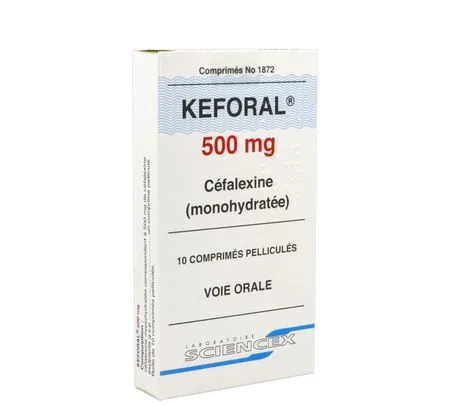
Film-coated tablet at 1 g (orange-yellow): Box of 6, under blister pack.Film-coated tablet at 500 mg (orange-yellow): Box of 10, under blister pack.
Powder for oral suspension (white) at 250 mg/5 mL: Bottle corresponding to 60 mL of reconstituted suspension (i.e. 12 measuring spoons of 5 mL), single-unit box.
Composition
| Lozenge: | p cp |
| Cefalexin monohydrate
|
1 g |
| or | 500 mg |
| Powder for oral suspension: | p c mes |
| Cefalexin monohydrate
|
250 mg |
Excipient with known effect: 2972,45 mg of sucrose per 5 mL after reconstitution.
Indications
They derive from the antibacterial activity and pharmacokinetic characteristics of cefalexin. They take into account both the clinical studies the medicinal product has undergone and its place among the antibacterial products currently available.They are limited to infections due to susceptible organisms when these infections permit oral antibiotic therapy and excluding meningeal localisations, in particular:
- ENT infections: documented group A beta-haemolytic streptococcal tonsillitis, sinusitis, otitis;
- lower respiratory tract infections:
- superinfections of acute bronchitis,
- exacerbations of chronic bronchitis,
- community-acquired pneumonia in subjects: without risk factors, without signs of clinical severity, in the absence of arguments suggesting resistance to penicillin, in the absence of arguments suggestive of atypical pneumonia; Streptococcus pneumoniae to penicillin, in the absence of arguments suggestive of atypical pneumonia;
- superinfections of acute bronchitis,
- uncomplicated urinary tract infections, except prostatitis and pyelonephritis.
Dosage and administration
Dosage- Subjects with normal renal function:
-
- Adult: 2 g per day in at least 2 doses.
- Child (over 6 years for the tablet form): 25 to 50 mg/kg every 24 hours in at least 2 doses, not to exceed the adult dose.
- Adult: 2 g per day in at least 2 doses.
- Subjects with renal insufficiency:
-
Creatinine clearance (ml/min) Loading dose (mg) Dose
(mg)Interval
(h)30 - 60 - 500 12 10 - 30 500 500 24 5 - 10 250 250 12 ≤ 5 250 250 24
- Paediatric population:
- Kéforal film-coated tablet must not be used in children under 6 years, due to the pharmaceutical form.
- Duration of treatment:
- The duration of treatment is on average 7 to 10 days for all therapeutic indications, and may extend up to 14 days for pneumonia.
- The duration of treatment for tonsillitis is 10 days.
Method of administration:
To be taken preferably away from meals, particularly in children, due to a bioavailability reduced by 40% with milk intake.
- Powder for oral suspension:
- Instructions for mixing: turn the bottle over and tap to dislodge the powder before adding water. Add the water in 2 portions until reaching the red arrow marked on the bottle. Replace the cap on the bottle and shake vigorously until all the powder is in suspension.
Contraindications
This medicine must never be used:- in case of allergy to antibiotics of the cephalosporin group;
- tablet: in children under 6 years, due to the pharmaceutical form.
Warnings and precautions
- The occurrence of any allergic reaction requires discontinuation of the treatment.
- Cases of acute generalised exanthematous pustulosis (AGEP) have been reported with cephalexin treatment. At the time of prescription, patients must be informed of the signs and symptoms, and closely monitored for skin reactions. If signs or symptoms suggestive of these reactions appear, cephalexin must be stopped immediately and alternative treatment should be considered. Most of these reactions have probably occurred during the first week of treatment.
- Prescribing cephalosporins requires prior questioning of the patient.
- Allergy to penicillins is cross-reactive with allergy to cephalosporins in 5 to 10% of cases:
- the use of cephalosporins must be extremely cautious in patients sensitive to penicillins; strict medical monitoring is required from the first administration,
- The use of cephalosporins is strictly contraindicated in subjects with a history of immediate-type allergy to cephalosporins. In case of doubt, the physician must be present with the patient at the first administration in order to treat a possible anaphylactic reaction.
- the use of cephalosporins must be extremely cautious in patients sensitive to penicillins; strict medical monitoring is required from the first administration,
- Hypersensitivity reactions (anaphylaxis) observed with these two types of substances may be severe and sometimes fatal.
- In case of renal insufficiency, adjust the dosage according to creatinine clearance or serum creatinine (see Posology/Method of administration).
- It is prudent to monitor renal function during treatment when cephalexin is combined with potentially nephrotoxic antibiotics (aminoglycosides in particular) or potent diuretics.
- As with other broad-spectrum antibiotics, prolonged use of cephalexin may lead to selection of non-susceptible organisms, which may necessitate discontinuation of treatment.
- The exceptional occurrence of severe and persistent diarrhoea during or after use of the antibiotic may be symptomatic of pseudomembranous colitis and requires discontinuation of treatment. Diagnosis established after colonoscopy requires initiation of specific antibiotic therapy.
- Beta-lactams expose patients to the risk of encephalopathy (confusion, impaired consciousness, epilepsy, or abnormal movements), particularly in cases of overdose or renal insufficiency.
- Paraclinical examinations:
-
- A positive Coombs test has been obtained during treatment with cephalosporins. This could also occur in subjects treated with cephalexin.
- A false-positive reaction may occur when testing urine for glucose with reducing substances, but not when using glucose oxidase-specific methods.
- Cephalexin may interfere with the determination of creatinine by alkaline picrates, giving a falsely elevated result, probably of no clinical importance.
- A positive Coombs test has been obtained during treatment with cephalosporins. This could also occur in subjects treated with cephalexin.
- Excipient with known effect:
-
- Powder for oral suspension:
- This medicine contains sucrose. Patients with fructose intolerance, glucose-galactose malabsorption syndrome or sucrase/isomaltase deficiency (rare hereditary diseases) must not take this medicine.
Interactions
Particular problems with INR imbalance:Many cases of increased activity of oral anticoagulants have been reported in patients receiving antibiotics. A marked infectious or inflammatory context, age and general condition of the patient appear to be risk factors. In these circumstances, it is difficult to distinguish between the infectious disease and its treatment in the occurrence of the INR imbalance. However, certain classes of antibiotics are more involved: these include fluoroquinolones, macrolides, cyclines, cotrimoxazole and certain cephalosporins.
Fertility, pregnancy and breastfeeding
Pregnancy:Animal studies have not shown any teratogenic effect. In the absence of a teratogenic effect in animals, a malformative effect in humans is not expected. Indeed, to date, substances responsible for malformations in humans have been shown to be teratogenic in animals in well-conducted studies in two species.
In clinical practice, analysis of a large number of exposed pregnancies apparently revealed no particular malformative or foetotoxic effect of cephalexin. However, only epidemiological studies would allow verification of the absence of risk.
Consequently, cephalexin may be prescribed during pregnancy if needed.
Breastfeeding:
The passage of cephalexin into breast milk is low and the quantities ingested are far below therapeutic doses. Consequently, breastfeeding is possible when this antibiotic is taken.
However, interrupt breastfeeding (or the medicinal product) if diarrhoea, candidiasis or skin rash occurs in the infant.
Driving and using machines
Kéforal may have a significant influence on the ability to drive vehicles and use machines, notably due to the possible occurrence of encephalopathy (see Warnings and Precautions for UseAdverse effectsOverdose).Adverse effects
- Allergic manifestations: skin eruptions, fever, anaphylactic shock, Quincke's oedema, ano-genital pruritus (with or without candidiasis), very exceptionally erythema multiforme, Stevens-Johnson syndrome, Lyell's syndrome.
- Skin and subcutaneous tissue disorders: acute generalised exanthematous pustulosis (AGEP).
- Haematological manifestations: eosinophilia, thrombocytopenia, leukopenia reversible on discontinuation of treatment, haemolytic anaemia.
- Gastrointestinal manifestations: diarrhoea, nausea, vomiting. As with other broad-spectrum antibiotics, rare cases of pseudomembranous colitis have been reported.
- Hepatic manifestations: transient elevation of transaminases ASAT and ALAT, hepatic impairment, jaundice.
- Nephrotoxicity: as with other cephalosporins, a few rare cases of reversible interstitial nephritis have been reported.
As with any antibiotic, prolonged use of the medicinal product may lead to the emergence of resistance in the organisms involved.
Beta-lactams expose patients to the risk of encephalopathy (confusion, impaired consciousness, epilepsy, or abnormal movements), particularly in cases of overdose or renal insufficiency.
Reporting of suspected adverse reactions:Reporting suspected adverse reactions after authorisation of the medicinal product is important. It allows continuous monitoring of the benefit/risk balance of the medicinal product. Healthcare professionals should report any suspected adverse reaction via the national reporting system: National Agency for the Safety of Medicines and Health Products (ANSM) and the network of Regional Pharmacovigilance Centres. Website: www.signalement-sante.gouv.fr.
Overdose
- Symptoms:
- Nausea, vomiting, epigastric pain, diarrhoea and haematuria may occur following an overdose of cefalexin.
- Treatment:
- Symptomatic treatment and monitoring of vital signs should be undertaken. Absorption of the drug from the gastrointestinal tract may be reduced by administration of activated charcoal. The efficacy of treatments such as forced diuresis, peritoneal dialysis, haemodialysis or charcoal haemoperfusion has not been demonstrated in the treatment of overdoses.
Beta-lactams expose patients to the risk of encephalopathy (confusion, impaired consciousness, epilepsy, or abnormal movements), particularly in cases of overdose or renal insufficiency.
Pharmacodynamics
Pharmacotherapeutic class: Antibacterials for systemic use (ATC code: J01DA01; J: anti-infectives).
Antibacterial antibiotic of the beta-lactam family, cephalosporin group, of 1re generation.
This bactericidal antibiotic acts by inhibiting bacterial cell wall synthesis.
The critical concentrations separate susceptible strains from strains of intermediate susceptibility, and the latter from resistant strains: S ≤ 8 mg/l and R > 32 mg/l.
The prevalence of acquired resistance can vary according to geography and time for certain species. It is therefore useful to have information on local resistance prevalence, especially for the treatment of severe infections. These data can only provide guidance on the probabilities of the susceptibility of a bacterial strain to this antibiotic.
When the variability of resistance prevalence in France is known for a bacterial species, the frequency of acquired resistance in France (> 10 %; extreme values) is indicated in parentheses.
Susceptible species:- Aerobic Gram-positive: Corynebacterium diphtheriae, Propionibacterium acnes, Staphylococcus methicillin-S, Streptococcus, Streptococcus pneumoniae (30 - 70 %).
- Aerobic Gram-negative: Branhamella catarrhalis, Citrobacter koseri, Escherichia coli (20 - 30 %), Klebsiella (0 - 30 %), Neisseria gonorrhoeae, Pasteurella.
- Anaerobes: Fusobacterium (10 - 20 %), Prevotella (60 - 70 %).
- Aerobic Gram-negative: Haemophilus influenzae, Proteus mirabilis.
- Anaerobes: Clostridium perfringens, Peptostreptococcus.
- Gram-positive aerobes: enterococci, Listeria monocytogenes, Staphylococcus spp. methicillin-R*.
- Aerobic Gram-negative: Acinetobacter, Citrobacter freundii, Enterobacter, Morganella morganii, Proteus vulgaris, Providencia, Pseudomonas, Serratia.
- Anaerobes: Bacteroides, Clostridium difficile.
Pharmacokinetics
- Absorption:
-
- For a dose of 500 mg and 1 g, absorption is respectively 85 to 90 % and 75 %.
- Absorption is delayed, but not significantly decreased by the presence of food.
- For a dose of 500 mg and 1 g, absorption is respectively 85 to 90 % and 75 %.
- Distribution:
-
- After oral administration in adults of 250 mg, 500 mg and 1 g, the mean serum peak is respectively 8 to 10 µg/ml, 18 to 20 µg/ml and 32 to 40 µg/ml; it is reached approximately 40 to 60 minutes after intake.
- Protein binding: between 6 and 10 %.
- At peak, tissue concentrations generally reach 5 to 20 % of maximum circulating concentrations. Passage into the CSF is low.
- After oral administration in adults of 250 mg, 500 mg and 1 g, the mean serum peak is respectively 8 to 10 µg/ml, 18 to 20 µg/ml and 32 to 40 µg/ml; it is reached approximately 40 to 60 minutes after intake.
- Disposal:
-
- Cephalexin is not metabolised in the body.
- Cephalexin is excreted mostly by the kidney (glomerular filtration and tubular secretion) in active form. After administration of 250 mg and 1 g, urinary concentrations of 1000 µg/ml and 4000 µg/ml are reached.
- Biliary elimination is very low, but concentrations reached in bile are greater than 5-10 mg/l after a dose of 500 mg.
- The elimination half-life is in the order of 45 to 70 minutes.
- Cephalexin is not metabolised in the body.
Storage conditions
- Tablets:
- Shelf life 3 years.
- No special precautions for storage.
- Powder for oral suspension:
- Shelf life before reconstitution: 3 years.
- Store at a temperature not exceeding + 25 °C.
- Shelf life after reconstitution: Store for 14 days in the refrigerator (between + 2 °C and + 8 °C).
HANDLING/DISPOSAL INSTRUCTIONS
No special requirements for disposal.
Any unused medicinal product or waste material should be disposed of in accordance with local requirements.
- Powder for oral suspension:
- Do not keep the product after the end of the treatment for which it was prescribed.
- Shake well before each use.
Prescription, supply and reimbursement
LIST I| Marketing authorisation (AMM) | 3400931986522 (1983, SmPC rev 09.01.2019) cp 1 g. |
| 3400931357520 (1983, SmPC rev 09.01.2019) cp 500 mg. | |
| 3400932121458 (1983, SmPC rev 09.01.2019) powder. |
| Price: | 4,57 euros (6 tablets 1 g). |
| 3,75 euros (10 tablets 500 mg). | |
| 3,13 euros (1 vial 250 mg/5 mL). | |
| Reimbursed by Social Security at 65 %. Collective. | |
Laboratoire SCIENCEX
9, rue Nicolas-Charlet. 75015 Paris
Tel: 01 40 65 95 99
Source: VIDAL · Updated on 10/11/2026. This information does not replace advice from a healthcare professional.