
Medicines
SmPC of 08/04/2026
JORVEZA 1 mg, orodispersible tablets
Forms and presentations
Marketed products
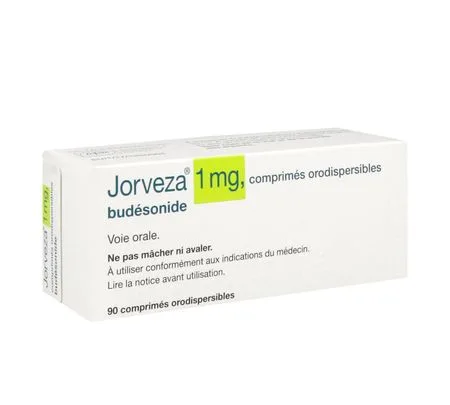
JORVEZA 1 mg, orodispersible tablets
JORVEZA 0,5 mg, orodispersible tablets
Orodispersible tablet
Jorveza 0,5 mg, orodispersible tablets
White, round, biconvex orodispersible tablets, 7,1 mm in diameter and 2,2 mm thick. They bear the engraved imprint "0.5" on one side.
Jorveza 1 mg, orodispersible tablets
White, round, biconvex orodispersible tablets, 7,1 mm in diameter and 2,2 mm thick.
Composition
Jorveza 0,5 mg, orodispersible tablets
Each orodispersible tablet contains 0,5 mg of budesonide.
Excipient with known effect
Each 0,5 mg orodispersible tablet contains 26 mg of sodium.
Jorveza 1 mg, orodispersible tablets
Each orodispersible tablet contains 1 mg of budesonide.
Excipient with known effect
Each 1 mg orodispersible tablet contains 26 mg of sodium.
Jorveza 0,5 mg and 1 mg, orodispersible tablets
Sodium citrate acid, docusate sodium, macrogol (6000), magnesium stearate, mannitol (E421), anhydrous monosodium citrate, povidone (K25), sodium bicarbonate, sucralose.
Indications
Jorveza is indicated for the treatment of eosinophilic esophagitis (EoE) in adults (aged over 18 years).
Dosage and administration
Treatment with this medicinal product must be initiated by a gastroenterologist or by a physician experienced in the diagnosis and treatment of eosinophilic esophagitis.
Dosage
Induction of remission
The recommended daily dose is 2 mg of budesonide, i.e. one 1 mg tablet in the morning and one 1 mg tablet in the evening.
The induction treatment usually lasts 6 weeks. For patients who do not respond adequately within the first 6 weeks, the treatment duration may be extended up to 12 weeks.
Maintenance of remission
The recommended daily dose is 1 mg of budesonide, i.e. one 0,5 mg tablet in the morning and one 0,5 mg tablet in the evening, or 2 mg of budesonide, i.e. one 1 mg tablet in the morning and one 1 mg tablet in the evening, according to the patient's clinical needs.
A maintenance dose of 1 mg of budesonide twice daily is recommended for patients with long-standing disease and/or extensive esophageal inflammation during the acute phase of the disease, see also section Pharmacodynamics.
The duration of maintenance treatment is determined by the prescribing physician.
Special populations
Renal impairment
No data are currently available for patients with renal impairment. As budesonide is not excreted by the kidneys, patients with mild to moderate renal impairment may be treated, with caution, at the same doses as patients without renal impairment. The use of budesonide is not recommended in patients with severe renal impairment.
Hepatic impairment
When patients with hepatic impairment were treated with other budesonide-containing medicines, budesonide levels were increased. However, no systematic study has been conducted to assess the different levels of hepatic impairment. Patients with hepatic impairment must not be treated (see sections Warnings and precautions and Pharmacokinetics).
Paediatric population
The safety and efficacy of Jorveza orodispersible tablets in children and adolescents aged under 18 years have not been established. No data are available. Jorveza 0,2 mg/mL, oral suspension is available for paediatric patients with EoE.
Method of administration
Oral use.
The orodispersible tablet must be taken immediately after being removed from the blister.
The orodispersible tablet must be taken after a meal.
It must be placed on the tip of the tongue and gently pressed against the palate where it will disintegrate. This will generally take at least two minutes, but may take up to 20 minutes. The effervescent process of the tablet begins as soon as Jorveza comes into contact with saliva and stimulates the production of additional saliva. The budesonide-laden saliva must be swallowed gradually while the orodispersible tablet disintegrates. The orodispersible tablet must not be taken with liquid or food.
One must then wait at least 30 minutes before eating or drinking, or brushing the teeth. Likewise, oral solutions, sprays or chewable tablets must be taken at least 30 minutes before or after administration of Jorveza.
The orodispersible tablet must be neither chewed nor swallowed before it has dissolved. These measures ensure optimal exposure of the oesophageal mucosa to the active substance thanks to the adhesive properties of the mucins contained in saliva.
Contraindications
Hypersensitivity to the active substance or to any of the excipients listed in section Composition.
Warnings and precautions
Infections
Suppression of the inflammatory response and immune function increases susceptibility to infections and their severity. Symptoms of infections may be atypical or masked.
During clinical studies conducted with Jorveza, oral, oropharyngeal and oesophageal infections due to Candida were observed at a high frequency (see section Adverse effects).
If needed, symptomatic candidiasis of the mouth and throat may be treated with a local or systemic antifungal while continuing treatment with Jorveza.
Chickenpox, herpes zoster and measles may worsen in patients treated with glucocorticoids. The vaccination status of patients who have not previously contracted these diseases must be checked, and particular caution is required to avoid exposure.
Vaccines
Concomitant administration of live vaccines and glucocorticoids must be avoided, as the immune response to vaccines may be reduced. The antibody response to other vaccines could also be diminished.
Special populations
Patients with tuberculosis, hypertension, diabetes mellitus, osteoporosis, gastroduodenal ulcer, glaucoma or cataract, and patients with a family history of diabetes or glaucoma, may be at higher risk of developing systemic glucocorticoid adverse effects (see below and section Adverse effects), so these patients should be monitored to detect the possible occurrence of such effects.
When hepatic function is impaired, elimination of budesonide may be reduced, leading to greater systemic exposure. The risk of adverse effects (systemic glucocorticoid effects) will be increased. In the absence of systematic data available, patients with hepatic impairment must not be treated.
Systemic glucocorticoid effects
Systemic glucocorticoid effects (for example, Cushing's syndrome, adrenal insufficiency, growth retardation, cataract, glaucoma, decreased bone mineral density and various psychiatric disorders) may occur (see also section Adverse effects). These adverse effects depend on the duration of treatment, concomitant and previous glucocorticoid treatments, and the individual sensitivity of the patient.
Angioedema
Cases of angioedema have been reported with the use of Jorveza, most often in the context of an allergic reaction accompanied by rash and itching. Treatment must be stopped if signs of angioedema are observed.
Visual disorders
Visual disturbances may occur during systemic or local corticosteroid therapy. In case of blurred vision or any other visual symptom occurring during corticosteroid therapy, an ophthalmological consultation should be considered to investigate possible causes, including cataract, glaucoma or a rarer condition such as central serous chorioretinopathy, which have been described following systemic or local administration of corticosteroids.
Other
Glucocorticoids may cause inhibition of the hypothalamic-pituitary-adrenal (HPA) axis and reduce the stress response. When patients undergo surgery or other forms of stress, it is recommended to administer additional systemic glucocorticoid treatment.
Concomitant treatment with ketoconazole or other inhibitors of CYP3A4 should be avoided (see section Interactions).
Interference with serological tests
Adrenal function may be suppressed during treatment with budesonide, so the results of the ACTH stimulation test for diagnosis of adrenal insufficiency could be affected (low values).
Sodium content
Jorveza 0,5 mg and 1 mg, orodispersible tablets contain 52 mg of sodium per daily dose, which is equivalent to 2,6 % of the WHO-recommended maximum daily dietary intake of 2 g of sodium per adult.
Interactions
CYP3A4 inhibitors
Concomitant administration of potent CYP3A inhibitors, such as ketoconazole, ritonavir, itraconazole, clarithromycin, cobicistat and grapefruit juice, could lead to a significant increase in plasma concentration of budesonide and should increase the risk of systemic side effects. Therefore, their concomitant use should be avoided, unless the benefits outweigh the increased risk of systemic corticosteroid side effects; in this case, patients should be monitored for possible systemic corticosteroid side effects.
Concomitant oral administration of 200 mg of ketoconazole once daily increases budesonide plasma concentrations about six-fold (3 mg single dose). When ketoconazole is administered about 12 hours after budesonide, budesonide plasma concentrations increase by a factor of about 3.
Oestrogens and oral contraceptives
High plasma concentrations and more pronounced effects of glucocorticoids have been observed in women also receiving oestrogens or oral contraceptives. This type of effect has not been observed with concomitant use of budesonide and low-dose combined oral contraceptives.
Cardiac glycosides
The action of the glycoside may be enhanced in the case of potassium deficiency, which is known to be a potential undesirable effect of glucocorticoids.
Potassium-depleting diuretics
Concomitant use of glucocorticoids may lead to increased potassium excretion and worsened hypokalaemia.
Fertility, pregnancy and breastfeeding
Pregnancy
Use of this medicine during pregnancy should be avoided, except where treatment with Jorveza is absolutely necessary. Little data are available on pregnancy outcomes after oral administration of budesonide in women. Although data on inhaled budesonide use in a large number of pregnancies have not shown adverse effects, maximum plasma concentrations of budesonide are expected to be higher during treatment with Jorveza compared with inhaled budesonide. In pregnant animals, budesonide, like other glucocorticoids, causes abnormalities of foetal development (see section Preclinical safety). The relevance of these findings has not been confirmed in humans.
Breast-feeding
Budesonide is excreted in human milk (data on excretion after inhalation administration are available). However, only minor effects on the breastfed infant are expected after oral intake of Jorveza at the stated therapeutic doses. A decision must be made either to discontinue breastfeeding or to discontinue/abstain from treatment with Jorveza, taking into account the benefit of breastfeeding for the child against the benefit of treatment for the woman.
Fertility
There are no data on the effect of budesonide on human fertility. In animal studies, fertility was not affected after treatment with budesonide (see section Preclinical safety).
Driving and using machines
Jorveza has no or negligible influence on the ability to drive and use machines.
Adverse effects
Summary of the safety profile
Fungal infections of the mouth, pharynx and oesophagus were the most frequently observed adverse reactions in clinical studies with Jorveza. In clinical studies BUL-1/EEA and BUL-2/EER, fungal infections associated with clinical symptoms of mild to moderate intensity occurred in 44 of 268 patients (16,4 %) exposed to Jorveza. In total, infections (including those diagnosed by endoscopy and histology in the absence of symptoms) numbered 92 and occurred in 72 of 268 patients (26,9 %). Long-term treatment with Jorveza, for a duration of up to 3 years (48 weeks of treatment in study BUL-2/EER, followed by an open-label treatment period of 96 weeks), did not increase the frequency of adverse reactions, including local candidiasis.
Tabulated summary of adverse reactions
Adverse reactions observed in clinical studies with Jorveza are listed in the table below, by MedDRA system organ class and by frequency. Frequency categories are defined as follows: very common (≥ 1/10), common (≥ 1/100, < 1/10), uncommon (≥ 1/1 000, < 1/100), rare (≥ 1/10 000, < 1/1 000), very rare (< 1/10 000), or not known (cannot be estimated from the available data).
|
MedDRA system organ class |
Very common |
Common |
Uncommon |
|
Infections and infestations |
Esophageal candidiasis, oral and/or oropharyngeal candidiasis |
Rhinopharyngitis, pharyngitis |
|
|
Immune system disorders |
Angioedema |
||
|
Psychiatric disorders |
Sleep disorder |
Anxiety, agitation |
|
|
Nervous system disorders |
Headache, dysgeusia |
Vertigo |
|
|
Eye disorders |
Dry eye |
||
|
Vascular disorders |
Hypertension |
||
|
Respiratory, thoracic and mediastinal disorders |
Cough, dry throat, oropharyngeal pain |
||
|
Gastrointestinal disorders |
Gastro-oesophageal reflux, nausea, oral paraesthesia, dyspepsia, upper abdominal pain, dry mouth, glossodynia, tongue disorder, oral herpes |
Abdominal pain, abdominal distension, dysphagia, erosive gastritis, gastric ulcer, lip oedema, gingival pain |
|
|
Skin and subcutaneous tissue disorders |
Rash, urticaria |
||
|
General disorders and administration site conditions |
Fatigue |
Foreign body sensation |
|
|
Investigations |
Decreased blood cortisol |
Decreased osteocalcin, increased weight |
The following adverse effects, known to be associated with the therapeutic class (corticosteroids, budesonide), could also occur with Jorveza (frequency not known).
|
MedDRA system organ class |
Adverse effects |
|
Immune system disorders |
Increased risk of infection |
|
Endocrine disorders |
Cushing's syndrome, adrenal suppression, growth retardation in children |
|
Metabolism and nutrition disorders |
Hypokalaemia, hyperglycaemia |
|
Psychiatric disorders |
Depression, irritability, euphoria, psychomotor hyperactivity, aggressiveness |
|
Nervous system disorders |
Idiopathic intracranial hypertension, including papilledema in adolescents |
|
Eye disorders |
Glaucoma, cataract (including subcapsular cataract), blurred vision, central serous chorioretinopathy (CSCR) (see also section Warnings and precautions) |
|
Vascular disorders |
Increased risk of thrombosis, vasculitis (withdrawal syndrome after prolonged treatment) |
|
Gastrointestinal disorders |
Duodenal ulcer, pancreatitis, constipation |
|
Skin and subcutaneous tissue disorders |
Allergic exanthema, petechiae, delayed wound healing, contact dermatitis, ecchymoses |
|
Musculoskeletal and systemic disorders |
Muscle and joint pain, muscle weakness and cramps, osteoporosis, osteonecrosis |
|
General disorders and administration site conditions |
Malaise |
Reporting of suspected adverse reactions
Reporting suspected adverse reactions after authorisation of the medicinal product is important. It allows continued monitoring of the benefit/risk balance of the medicinal product. Healthcare professionals are asked to report any suspected adverse reaction via the national reporting system: National Agency for the Safety of Medicines and Health Products (ANSM) and the network of Regional Centres of Pharmacovigilance - Website: https://signalement.social-sante.gouv.fr.
Overdose
In case of short-term overdose, no emergency medical treatment is required. There is no specific antidote. Management will then consist of symptomatic treatment and supportive measures.
Pharmacodynamics
Pharmacotherapeutic class: antidiarrheals, intestinal anti-inflammatory/anti-infectives, corticosteroids for local use, ATC code: A07EA06.
Mechanism of action
Budesonide is a non-halogenated glucocorticoid that acts primarily as an anti-inflammatory agent by binding to glucocorticoid receptors. In the treatment of EoE with Jorveza, budesonide inhibits the antigen-stimulated secretion of numerous pro-inflammatory signaling molecules, such as thymic stromal lymphopoietin, interleukin 13 and eotaxin 3, in the esophageal epithelium, resulting in a significant reduction of eosinophilic inflammatory infiltrates in the esophagus.
Clinical efficacy and safety
In a randomized, placebo-controlled, double-blind Phase III clinical study (BUL-1/EEA) including 88 adult patients with active EoE (randomization ratio of 2:1), administration twice daily for 6 weeks of 1 mg budesonide as an orodispersible tablet resulted in clinico-pathological remission (defined both by a maximum of eosinophils < 16/mm2 under high-power field in esophageal biopsies and by the absence of dysphagia or painful swallowing symptoms, or only limited symptoms) in 34 of 59 patients receiving budesonide (57,6%) versus 0 patient/29 (0%) in the placebo group. The open-label extension study of treatment with 1 mg budesonide as an orodispersible tablet twice daily for an additional 6 weeks in patients who did not achieve remission during the double-blind phase increased the proportion of patients in clinico-pathological remission to 84,7%.
In a randomized, placebo-controlled, double-blind Phase III clinical study (BUL-2/EER) including 204 adult patients with EoE in clinico-pathological remission, patients were randomized to receive treatment with 0,5 mg budesonide twice daily (2x/d), 1 mg budesonide 2x/d, or placebo (all three administered as orodispersible tablets) for 48 weeks. The primary endpoint was the proportion of patients free of treatment failure, defined as clinical relapse (severity of dysphagia or painful swallowing ≥ 4 points on a numerical rating scale from 0 to 10, respectively) and/or histological relapse (peak of ≥ 48 eosinophils/mm2 under high-power field) and/or an impact on feeding requiring endoscopic intervention and/or the need for endoscopic dilation and/or premature withdrawal from the study, for whatever reason. A significantly greater number of patients in the 0,5 mg 2x/d group (73,5%) and in the 1 mg 2x/d group (75,0%) were free of treatment failure at Week 48 compared with the placebo group (4,4%).
The most stringent secondary endpoint, "deep disease remission," defined by deep clinical, endoscopic and histological remission, showed a greater clinically relevant efficacy in the 1 mg 2x/d group (52,9%) than in the 0,5 mg 2x/d group (39,7%), indicating that a higher dose of budesonide was preferable for achieving and maintaining deep disease remission.
The double-blind period was followed by an optional open-label treatment period of 96 weeks at the recommended dose of 0,5 mg budesonide 2x/d or at a dose of up to 1 mg budesonide 2x/d. In more than 80% of patients, maintenance of clinical remission (defined by a weekly score ≤ 20 on the Eosinophilic Esophagitis Activity Index self-assessment questionnaire) was observed throughout the 96-week period, and an impact on feeding was observed in only 2 of 166 patients (1,2%). Furthermore, deep histological remission (0 eosinophil/mm2 under high-power field for all biopsies) was maintained in 40 of 49 patients (81,6%) between enrollment in study BUL-2/EER and the end of the 96-week open-label treatment period. No loss of efficacy was observed over a period of up to 3 years (i.e., the 48-week double-blind Jorveza maintenance treatment period followed by the 96-week open-label treatment period).
For information on observed adverse reactions, see section Adverse effects.
Pharmacokinetics
Absorption
Following administration of Jorveza, budesonide is rapidly absorbed. Pharmacokinetic data obtained after single doses of 1 mg budesonide in healthy fasting subjects in two different studies show a median lag time of 0,17 hour (range: 0,00 hour-0,52 hour) and a median time to reach maximum plasma concentration of 1,00 hour-1,22 hour (range: 0,50 hour-2 hours). The mean maximum plasma concentration was 0,44 ng/mL-0,49 ng/mL (range: 0,18 ng/mL-1,05 ng/mL) and the area under the plasma concentration-time curve (AUC0-∞) was 1,50 h*ng/mL-2,23 h*ng/mL (range: 0,81 h*ng/mL-5,14 h*ng/mL).
Pharmacokinetic data obtained after administration of a single dose to patients with EoE (eosinophilic esophagitis) in the fasting state are available for budesonide at 4 mg: the median lag time was 0,00 hour (range: 0,00-0,17), the median time to reach maximum plasma concentration was 1,00 hour (range: 0,67-2,00 hours); the maximum plasma concentration was 2,56 ± 1,36 ng/mL and the AUC0-12 of 8,96 ± 4,21 h*ng/mL.
Patients showed an increase of 35% in maximum plasma concentrations and an increase of 60% in AUC0-12 compared with healthy subjects.
Proportionality of systemic exposure (Cmax and AUC) with dose was demonstrated, from orodispersible tablets at 0,5 mg to orodispersible tablets at 1 mg.
Distribution
The apparent volume of distribution after oral administration of 1 mg of budesonide in healthy subjects was 35,52 ± 14,94 L/kg and it was 42,46 ± 23,90 L/kg after administration of 4 mg of budesonide in patients with EoE. Plasma protein binding is approximately 85-90%.
Biotransformation
Metabolism of budesonide is decreased in patients with EoE compared with healthy subjects, resulting in increased plasma concentrations of budesonide.
Budesonide is extensively metabolised by CYP3A4 in the small intestine mucosa and in the liver into metabolites with low glucocorticoid activity. The glucocorticoid activity of the main metabolites, the 6β-hydroxybudesonide and the 16α-hydroxyprednisolone, represents less than 1% of that of budesonide. CYP3A5 does not play a significant role in the metabolism of budesonide.
Elimination
The median elimination half-life is 2 to 3 hours in healthy subjects (receiving 1 mg of budesonide) and 4 to 5 hours in patients with EoE (receiving 4 mg of budesonide). The clearance of budesonide is approximately 13 to 15 L/h/kg in healthy subjects and 6,54 ± 4,4 L/h/kg in patients with EoE. Budesonide is not eliminated renally, or only in negligible amounts. No budesonide was detected in urine, only budesonide metabolites.
Hepatic impairment
A significant proportion of budesonide is metabolised in the liver by CYP3A4. Systemic exposure to budesonide increases considerably in patients with severe hepatic impairment. No study has been conducted with Jorveza in patients with hepatic impairment.
Preclinical safety
Preclinical data from acute, subchronic and chronic toxicity studies conducted with budesonide revealed atrophy of the thymus and adrenal cortex and a decrease in particularly lymphocytes.
Budesonide had no mutagenic effect in a number of tests in vitro and in vivo.
A slight increase in the number of basophilic liver foci was observed in chronic studies in rats with budesonide. Carcinogenicity studies revealed a higher incidence of primary hepatocellular neoplasms, astrocytomas (in male rats) and mammary tumours (in female rats). These tumours are probably due to action on specific steroid receptors, increased metabolic load and anabolic effects at hepatic level. These effects are also known with other glucocorticoids in studies conducted in rats and therefore represent a class effect in this species.
Budesonide had no effect on fertility in rats. In pregnant animals, budesonide, like other glucocorticoids, caused foetal deaths and foetal developmental abnormalities (reduced litter size, intrauterine growth retardation of foetuses and skeletal abnormalities). Some glucocorticoids have been reported to cause cleft palate in animals. However, the clinical relevance of these observations has not been established in humans (see section Fertility, pregnancy and breastfeeding).
Special storage precautions
Store at a temperature not exceeding 25 °C. Store in the original package, protected from light and moisture.
SPECIAL PRECAUTIONS FOR DISPOSAL AND OTHER HANDLING
Any unused medicinal product or waste material should be disposed of in accordance with local requirements.
Prescription, supply and reimbursement
| Marketing authorisation (AMM) |
|
| Price: |
|
Reimbursed by social security at 65% and Collective in the treatment of eosinophilic esophagitis (EoE) in adults (aged over 18 years) only in patients not responding to PPIs.
Initial annual prescription restricted to specialists in hepatology-gastroenterology. Renewal not restricted.
| Marketing authorisation (AMM) |
|
| Price: |
|
Source: VIDAL · Updated on 10/11/2026. This information does not replace advice from a healthcare professional.