
Medicines
SmPC of 21/08/2025
IZINOVA, solution to be diluted for oral solution
Forms and presentations
Solution to be diluted for oral solution (clear to slightly cloudy).
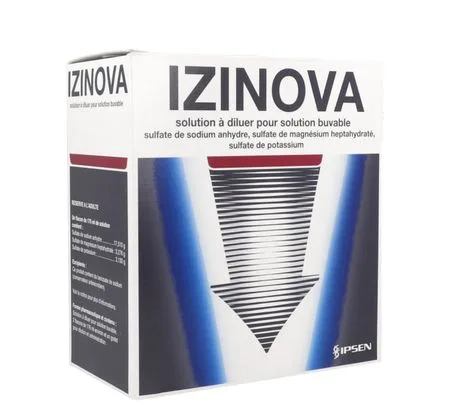
Box containing: 2 bottles of approximately 176 ml of solution (fitted with a child-resistant closure) + 1 measuring cup (with a fill line defining a volume of approximately half a litre, to be used as a dilution and administration device).
Composition
This medicine is a concentrated sulphate-based saline solution, which must be diluted in water before administration (see section Dosage and administration). A treatment consists of taking two bottles. The contents of each of the two bottles are identical. The quantities of active substances contained in 1 and 2 bottles are listed below:
|
1 bottle containing approximately 176 ml of solution to be diluted (195,375 g) |
2 bottles corresponding to approximately 2 x 176 ml of solution to be diluted (390,750 g) |
|
|
Anhydrous sodium sulfate |
17,510 g |
35,020 g |
|
Magnesium sulphate heptahydrate |
3,276 g |
6,552 g |
|
Potassium sulphate |
3,130 g |
6,260 g |
The total electrolyte content is as follows:
|
Content in g |
Content in mmol |
|||
|
1 bottle |
2 bottles |
1 bottle |
2 bottles |
|
|
Sodium* |
5,684 |
11,367 |
247,1 |
494,2 |
|
Potassium |
1,405 |
2,81 |
35,9 |
71,8 |
|
Magnesium |
0,323 |
0,646 |
13,3 |
26,6 |
|
Sulphate |
14,845 |
29,69 |
154,5 |
309,0 |
* from sodium sulphate (active substance) and sodium benzoate (excipient).
Sodium benzoate (E211), anhydrous citric acid, malic acid, sucralose, purified water, fruit cocktail flavouring*.
* Composition of the fruit cocktail flavouring: natural and synthetic flavourings, propylene glycol (E1520), ethyl alcohol, acetic acid and benzoic acid (E210).
Indications
IZINOVA is indicated in adults for colonic lavage prior to any procedure requiring a clean intestine (for example, visualisation of the intestine during an endoscopic or radiological examination, or surgical intervention).
IZINOVA is not a treatment for constipation.
Dosage and administration
Dosage
Adult
Two bottles of IZINOVA are required to perform a correct colonic lavage. Before administration, the contents of each bottle must be diluted in water, using the cup provided, to obtain a total volume of approximately 0,5 litres. For each bottle, intake must be accompanied, over the following 2 hours, by the additional ingestion of 1 litre of water or clear liquid.
Permitted clear liquids are: water, tea or coffee (no milk or cream), carbonated or non-carbonated sodas, pulp-free fruit juices (except red or purple ones), broth or strained soup to remove solid pieces.
Before the procedure, ingestion of a total volume of 3 litres of liquid is necessary to perform the colonic lavage. This medicine may be administered either as a split dose (over two days, with the first bottle to be taken the evening before the procedure, and the second to be taken the following morning), or as a single-day dose, as described below (see Method of administration). The exact arrangements and timing of IZINOVA administration will be determined by the physician.
If the time before the procedure allows, the split-dose administration regimen over 2 days should be preferred over the single-day regimen. The single-day administration regimen may be a potentially useful alternative.
Method of administration
Split-dose administration regimen (over two days)
The day before the procedure:
In the early evening before the procedure (for example around 18 h), the following instructions must be followed:
- The contents of one bottle of IZINOVA must be poured into the cup provided in the box and diluted with water up to the filling line (approximately 0,5 litre).
- The patient must drink this diluted solution, then, over the following two hours, drink two additional cups, filled up to the filling line with water or a clear liquid (i.e. approximately 1 litre).
On the day of the procedure:
On the morning of the procedure (10 to 12 hours after the evening dose), the instructions from the day before must be repeated:
- The contents of the second bottle of IZINOVA must be poured into the cup provided in the box and diluted with water up to the filling line (approximately 0,5 litres).
- The patient must drink this diluted solution, then over the following two hours, drink two additional cups, filled up to the filling line with water or a clear liquid (i.e. approximately 1 litre).
Intake of the entire diluted IZINOVA solution and the additional liquid (water or clear drink) must be completed:
- In the absence of anaesthesia: at least 1 hour before the start of the procedure.
- In case of anaesthesia: usually at least 2 hours before the start of the procedure, referring to the instructions of the anaesthetist.
Single-day administration regimen (alternative dosing schedule, to be used according to the patient's clinical needs)
The day before the procedure:
In the early evening before the procedure (for example around 18 h):
- The contents of one bottle of IZINOVA must be poured into the cup provided in the box and diluted with water up to the filling line (approximately 0,5 litre).
- The patient must drink this diluted solution, then over the following two hours, drink two additional cups, filled up to the filling line with water or with a clear liquid (i.e. approximately 1 litre).
Approximately 2 hours after the start of the first dose (for example around 20 h):
- The contents of the second bottle of IZINOVA must be poured into the cup provided in the box and diluted with water up to the filling line (approximately 0,5 litre).
- The patient must drink this diluted solution, then over the following two hours, drink two additional cups, filled up to the filling line with water or with a clear liquid (approximately 1 litre).
Intake of the entire diluted IZINOVA solution and the additional liquid (water or clear drink) must be completed:
- In the absence of anaesthesia: at least 1 hour before the start of the procedure.
- In case of anaesthesia: usually at least 2 hours before the start of the procedure, referring to the instructions of the anaesthetist.
After the procedure
In order to compensate for fluid losses occurring during preparation for the procedure, patients should be encouraged to drink a sufficient amount of liquid after the procedure to maintain an adequate level of hydration.
Dietary restrictions
On the day before the procedure, a light breakfast may be taken. Afterwards, the patient must consume only clear liquids at lunch, dinner or any other meal, until the procedure. Red and purple liquids, milk and alcoholic beverages must be avoided.
Special populations
Elderly
Overall, no difference in terms of safety or efficacy was observed between elderly patients and other patients during the clinical development of IZINOVA (see section Pharmacodynamics). No dose adjustment is necessary in elderly subjects. However, particular precautions must be taken in this population, as in any high-risk population (see section Warnings and precautions).
Renal impairment
There are no sufficient data in this population. No dose adjustment is necessary in patients with mild to moderate renal impairment. However, particular precautions must be taken in this population, as in any high-risk population. IZINOVA must not be used in cases of severe renal impairment (see sections Contraindications and Warnings and precautions).
Hepatic impairment
There are no sufficient data in this population. No dose adjustment is necessary in patients with hepatic impairment. However, particular precautions must be taken in this population, as in any high-risk population (see section Warnings and precautions).
Paediatric population
The safety and efficacy of IZINOVA in the paediatric population (under 18 years) have not yet been established. No data are available (see section Pharmacodynamics).
Contraindications
IZINOVA is contraindicated in the following cases:
- Hypersensitivity to the active substances or to any of the excipients listed in section Composition.
- Congestive heart failure.
- Severe alterations of the general condition such as severe dehydration.
- Severe acute phase of an active inflammatory bowel disease (including Crohn's disease, ulcerative colitis).
- Known or suspected gastrointestinal perforation.
- Toxic colitis or toxic megacolon
- Patients who may present with or who already have ileus
- Patients who may present with or who already have gastrointestinal obstruction or stenosis
- Disorders of gastric emptying (for example: gastroparesis, gastric stasis).
- Acute abdominal conditions requiring surgery such as acute appendicitis
- Nausea and vomiting
- Ascites
- Severe renal impairment (glomerular filtration rate < 30 ml/min/1,73 m2).
Warnings and precautions
Electrolyte disturbances and dehydration:
- Given the potential risk of severe electrolyte disturbances, the benefit/risk ratio of IZINOVA must be carefully evaluated before initiating treatment in at-risk populations. When prescribing IZINOVA to any patient, particular attention must be paid to the known contraindications and precautions for use, including the importance of adequate hydration.
- All patients must be informed of the need for sufficient hydration before, during and after taking IZINOVA. If a patient experiences severe vomiting or signs of dehydration after taking the medicine, rehydration measures must be implemented in order to avoid the potential risk of serious complications associated with fluid and electrolyte disturbances (such as convulsions and cardiac arrhythmia). In addition, performing laboratory tests before the procedure (blood electrolytes, creatinine and urea) should be considered. The patient must be informed of the need to drink as much water or clear liquids as necessary to maintain an adequate level of hydration.
- Dehydration may lead to reversible functional renal impairment with administration of appropriate fluids.
Patients at risk:
- In frail patients, elderly subjects, those with significant renal, hepatic or cardiac impairment and subjects at risk of electrolyte imbalance, the physician should consider performing an electrolyte panel and a renal function assessment before and after treatment.
- Before any administration of the bowel cleansing preparation, dehydration or electrolyte abnormalities must have been corrected. In addition, caution is required in patients suffering from conditions or taking medicinal products that increase the risk of fluid and electrolyte imbalance (including hyponatraemia and hypokalaemia) or that may increase the risk of potential complications. In such cases, patients must be monitored appropriately.
- There is a theoretical risk of QT interval prolongation, which may occur secondarily to an electrolyte imbalance.
Use with caution in cases of:
- Impaired pharyngeal reflex and in patients predisposed to regurgitation or aspiration. These patients must be placed under surveillance during administration of the bowel cleansing preparation.
- Gastrointestinal hypomotility or a history of gastrointestinal disease or surgery that predisposes to hypomotility.
Hyperuricaemia:
- IZINOVA may cause a transient, mild to moderate increase in uric acid (see section Adverse effects). The risk of increased uric acid must be considered before administering IZINOVA to patients with a history of gout or hyperuricaemia (see section Adverse effects).
Ischaemic colitis:
- Osmotic laxatives may induce aphthoid ulceration of the colonic mucosa. Severe cases of ischaemic colitis requiring hospitalisation have been reported. Therefore, this diagnosis should be considered in case of abdominal pain, whether or not accompanied by rectal bleeding, following administration of IZINOVA.
Additional information:
- IZINOVA is not intended to be ingested directly. Direct ingestion of the undiluted solution may increase the risk of nausea, vomiting, dehydration and electrolyte disturbances. Each bottle must be diluted with water and accompanied by an additional intake of fluid, in accordance with the recommendations, to ensure tolerability.
- This medicinal product contains sodium. This medicinal product contains 247,1 mmol (or 5,684 g) of sodium per bottle. To be taken into account in patients on a strict low-sodium diet.
- This medicinal product contains potassium. This medicinal product contains 35,9 mmol (or 1,405 g) of potassium per bottle. This amount must be taken into account in patients with renal impairment or in patients on a potassium-restricted diet.
Interactions
As with any bowel cleansing solution:
- Use with caution in patients treated with calcium channel blockers, diuretics, lithium, or other medicinal products that may alter electrolyte levels.
- Caution is required when taking medicinal products that prolong the QT interval.
- As diarrhoea is an expected effect, concomitant orally administered medicinal products taken within 3 hours of starting treatment and until the end of the bowel cleansing may be eliminated from the gastrointestinal tract without being adequately absorbed. The therapeutic effect of regularly taken oral medicinal products with a narrow therapeutic index or a short half-life (for example, oral contraceptives, antiepileptics, antidiabetics, antibiotics, levothyroxine, digoxin, ...) may be particularly affected.
Fertility, pregnancy and breastfeeding
Pregnancy
No animal reproduction studies have been conducted with sodium, magnesium and potassium sulfates (see section Preclinical safety).
There are no data on the use of this product in pregnant women.
IZINOVA is not recommended during pregnancy.
Breast-feeding
It is not known whether IZINOVA passes into breast milk.
A risk to newborns or infants cannot be excluded.
Breast-feeding must be interrupted during treatment with IZINOVA, for up to 48 hours after the second dose.
Fertility
No data on fertility are available.
Adverse effects
Summary of the safety profile
Diarrhoea is the expected result of a bowel cleansing preparation and therefore occurs after taking IZINOVA. As with any procedure of this type, adverse reactions occur in the majority of patients. The adverse reactions frequently reported during clinical studies and after marketing are discomfort, abdominal distension, abdominal pain, nausea and vomiting.
In clinical trials, vomiting was reported by a greater number of patients when IZINOVA was administered as a single-day dose, compared with a split dose over 2 days.
Tabulated summary of adverse reactions
The frequency of undesirable effects of IZINOVA is described as follows:
Very common (≥ 1/10), common (≥ 1/100 to < 1/10), uncommon (≥ 1/1 000 to < 1/100), rare (≥ 1/10 000 to < 1/1 000), very rare (< 1/10 000), not known (cannot be estimated from the available data).
The table below presents the undesirable effects reported during clinical trials, and includes events observed in isolated patients. Undesirable events reported after marketing are also mentioned.
|
System organ class |
Frequency |
Adverse effects |
|
Immune system disorders |
not known (post-marketing data) |
Hypersensitivity (including urticaria, pruritus, skin rash, erythema, dyspnoea, sensation of tightness in the throat) |
|
Metabolism and nutrition disorders |
not known (post-marketing data) |
Dehydration |
|
not known (post-marketing data) |
Electrolyte imbalance |
|
|
Psychiatric disorders |
not known (post-marketing data) |
Confusional state* |
|
Nervous system disorders |
Uncommon |
Headache, dizziness |
|
not known (post-marketing data) |
Loss of consciousness* |
|
|
not known (post-marketing data) |
Tremor* |
|
|
Cardiac disorders |
not known (post-marketing data) |
Cardiac arrhythmia*, Palpitations* |
|
Gastrointestinal disorders |
Very common |
Abdominal distension, abdominal pain, nausea, vomiting |
|
Uncommon |
Anorectal discomfort, dry mouth |
|
|
not known (post-marketing data) |
Ischemic colitis |
|
|
Skin and subcutaneous tissue disorders |
not known (post-marketing data) |
Hyperhidrosis* |
|
Musculoskeletal and connective tissue disorders |
not known (post-marketing data) |
Muscle spasms* |
|
Renal and urinary disorders |
Uncommon |
Dysuria |
|
General disorders and administration site conditions |
Very common |
Discomfort |
|
Uncommon |
Chills |
|
|
not known (post-marketing data) |
Asthenia* |
|
|
Investigations |
Uncommon |
Increased aspartate aminotransferase, increased blood creatine phosphokinase, increased blood lactate dehydrogenase, increased blood phosphorus, hyperbilirubinaemia, biochemical abnormalities including hyponatraemia, hypokalaemia, hypocalcaemia and hyperuricaemia |
* Clinical consequences of dehydration and/or electrolyte imbalance.
Additional information in special populations
Transient elevations of uric acid have been observed during clinical trials. For patients with a history of gout manifestations or presenting with hyperuricaemia, see section Warnings and precautions.
Overall, during the clinical development of IZINOVA, no difference in terms of safety was observed between elderly patients and other patients (see section Pharmacodynamics). However, particular precautions for use should be taken in elderly patients, as in any high-risk population (see section Warnings and precautions).
In patients with renal or hepatic impairment, see sections Contraindications and Warnings and precautions.
Reporting of suspected adverse reactions
Reporting suspected adverse reactions after authorisation of the medicinal product is important. It allows continued monitoring of the benefit/risk balance of the medicinal product. Healthcare professionals are asked to report any suspected adverse reactions via the national reporting system: National Agency for the Safety of Medicines and Health Products (ANSM) and the network of Regional Pharmacovigilance Centres - Website: https://signalement.social-sante.gouv.fr/.
Overdose
In case of overdose or misuse (for example: failure to dilute the preparation and/or ingestion of an insufficient quantity of water), nausea, vomiting, diarrhoea and electrolyte disturbances may occur. Symptomatic treatment is generally sufficient; oral rehydration should be implemented. In the rare cases of overdose resulting in severe metabolic disturbance, intravenous rehydration should be implemented.
Pharmacodynamics
Pharmacotherapeutic class: Osmotic laxative.
ATC code: A06AD10 (mineral salts in combination).
Mechanism of action
IZINOVA is an osmotic laxative. Its mechanism of action relies mainly on the process of limited and saturable active transport of sulfates. Saturation of the gastrointestinal transport mechanism results in retention of sulfates in the intestine. The osmotic effect of the unabsorbed sulfates causes water retention in the intestine and allows colonic cleansing.
Pharmacodynamic effects
When administered with a large volume of water, the osmotic effect of the unabsorbed ions causes abundant watery diarrhoea. In clinical trials, the mean time to onset of clear diarrhoea was approximately 6,3 hours when doses were spaced 12 hours apart and approximately 2,8 hours when they were spaced 1 hour apart.
Clinical efficacy and safety
The clinical efficacy of IZINOVA was demonstrated in two pivotal, randomised, controlled, multicentre, investigator-blinded phase III clinical studies.
The analysis of the primary efficacy endpoint was based on the success or failure rate of colonic cleansing, determined for each subject. For statistical analysis, colonic cleansing judged as "good" or "excellent" was considered a "success", while colonic cleansing judged as "fairly good" or "poor" was considered a "failure". Patients who did not undergo colonoscopy were considered treatment failures.
The results of these studies comparing IZINOVA to a solution of 2 litres of polyethylene glycol (PEG) combined with electrolytes, administered either in split doses (379 randomised patients, 356 patients in the per protocol (PP) population) or as a single-day dose (408 randomised patients, 364 patients in the PP population), demonstrate on the primary evaluation endpoint the non-inferiority of IZINOVA compared with the 2-litre PEG-based solution for both administration schedules: the proportion of colonic cleansings judged as "good" or "excellent" was similar in the IZINOVA group and in the group treated with the 2-litre PEG-based solution (PP results):
- For the split-dose schedule: 97,2% and 96,1% respectively, for IZINOVA and for the 2-litre PEG-based solution [95% CI: -2,7 to 4,8 within the predefined margin of 15%];
- For the single-day schedule: 84% and 82,9% respectively, for IZINOVA and for the 2-litre PEG-based solution [95% CI: -6,5 to 8,8 within the predefined margin of 15%].
The adverse effects were mainly gastrointestinal, as expected for any colonic cleansing product. The most frequently reported symptoms were: abdominal distension, nausea, abdominal pain and vomiting.
Paediatric population
The European Medicines Agency has granted a waiver of the obligation to submit study results with IZINOVA in infants from birth to 6 months, and has deferred the obligation to submit study results in the remainder of the paediatric population, i.e. children aged 6 months to 17 years inclusive (see section Dosage and administration the information concerning paediatric use).
Pharmacokinetics
The absorption of sulfates is a limited and saturable active transport process. Absorbed sulfates are excreted mainly via the renal route. After administration of a clinical study preparation containing the same sulfate content as IZINOVA to six healthy volunteers, according to a split-dose administration schedule (two doses administered 12 hours apart), the maximum serum sulfate concentration was observed approximately 16 hours after the first dose and 5 hours after the second dose [Cmax: 499,50 micromol/l (CV: 33,03%)] compared with baseline values of 141-467 micromol/l, on average 335 micromol/l (CV: 34,40%)]. The serum concentration subsequently decreased with a half-life of 8,5 hours (CV: 53,76%). Faecal excretion was the main route of elimination of sulfates (approximately 70% of the administered dose).
Systemic exposure (AUC and Cmax) to sulfate after administration of IZINOVA was also compared between healthy volunteers, six patients with moderate renal impairment (creatinine clearance of 30 to 49 ml/min) and six patients with mild to moderate hepatic impairment (Child-Pugh class A (n = 5) and B (n = 1)). Renal impairment resulted in a decrease in the amount of sulfate excreted in the urine. Consequently, the mean values of AUC and Cmax were approximately 50% higher than in healthy subjects. Systemic exposure to sulfate was not modified by hepatic impairment. Serum sulfate concentrations returned to baseline 6 days after administration of IZINOVA in all three groups studied. In this study, administration of IZINOVA did not lead to clinically significant hypersulfatemia in patients with hepatic or renal impairment.
Preclinical safety
No reproductive toxicity or mutagenic or carcinogenic potential studies have been performed with a combination of sodium, magnesium and potassium sulfate salts.
Limited non-clinical data reveal no particular risk for humans based on repeated-dose toxicity studies.
Sodium, magnesium and potassium sulfate salts are unlikely to pose a risk to the environment; no special precautions or safety measures are required for storage and handling of medicines containing these substances. For special disposal precautions, see section Disposal and handling.
INCOMPATIBILITIES
In the absence of compatibility studies, this medicinal product must not be mixed with other medicinal products.
Shelf life
3 years.
After first opening of the vial and/or dilution in water, the solution must be used immediately.
Special storage precautions
This medicinal product does not require any special precautions for storage regarding temperature.
Store in the original package, protected from light.
For storage conditions after first opening or dilution of the medicinal product, see section Shelf life.
SPECIAL PRECAUTIONS FOR DISPOSAL AND OTHER HANDLING
This product must be diluted before use, with the amount of water indicated in the method of administration (see section Dosage and administration).
No special disposal requirements.
Prescription, supply and reimbursement
| Marketing authorisation (AMM) |
|
| Price: |
|
MAYOLY PHARMA FRANCE
3, Renault Square. 92500 Rueil-Malmaison
Medical information:
Tel: 01 58 33 51 16
Source: VIDAL · Updated on 10/11/2026. This information does not replace advice from a healthcare professional.