
Medicines
RCP of 05/01/2021
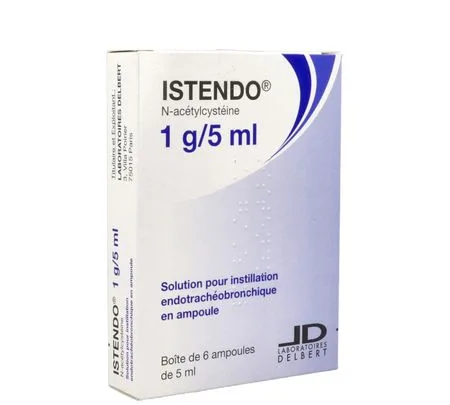
ISTENDO 1 g/5 ml, solution for endotracheobronchial instillation in ampoule
Composition
Acetylcysteine................................................................................................................. 1,00000 g
For 1 ampoule of 5 ml of solution
Sodium edetate, sodium hydroxide, water for injectable preparations.
Indications
Care of tracheostomized patients: treatment of airway obstruction by local instillation.
Dosage and administration
Dosage
1 to 2 ml of solution diluted in an equal quantity of physiological saline or distilled water, instilled via the tracheostomy cannula.
Method of administration
Endotracheal route.
Do not inject.
Contraindications
Hypersensitivity to the active substance or to any of the excipients listed in section Composition.
Warnings and precautions
There is a risk of sudden liquefaction of bronchial secretions which may lead to bronchial flooding and may, in this case, require emergency bronchial aspiration.
ISTENDO 1 g/5 ml should be used with caution in subjects with a history of asthma or bronchospasm.
After local administration of the product, it should be ensured that secretions are evacuated.
Many patients with bronchospasm are rapidly relieved by the use of a bronchodilator in nebulised form. If the bronchospasm progresses, ISTENDO 1 g/5 ml must be stopped immediately.
Interactions
The data available to date do not suggest the existence of clinically significant interactions.
Fertility, pregnancy and breastfeeding
Pregnancy
Animal studies have not shown a teratogenic effect. The clinical data available in pregnant women with acetylcysteine are limited. Nevertheless, given the mode of administration of ISTENDO by endotracheobronchial instillation, the risk of impact on an ongoing pregnancy is unlikely.
Breast-feeding
It is possible to breastfeed during treatment with this medicine.
Adverse effects
- Bronchospasm,
- Bronchial flooding,
- Tracheal burning sensation or irritating cough (particularly if the product is insufficiently diluted or used neat),
- Hypersensitivity reactions with possible anaphylactic shock, anaphylactoid reactions, angioedema, skin rashes,
- Cases of rhinorrhoea, drowsiness, sweating, chest tightness have been reported.
Reporting of suspected adverse reactions
Reporting suspected adverse reactions after authorisation of the medicinal product is important. It allows continued monitoring of the benefit/risk balance of the medicinal product. Healthcare professionals are asked to report any suspected adverse reactions via the national reporting system: National Agency for the Safety of Medicines and Health Products (ANSM) and the network of Regional Pharmacovigilance Centres - Website: www.signalement-sante.gouv.fr.
Overdose
No cases of overdose have been reported; however, a possible overdose may lead to an exacerbation of undesirable effects.
Pharmacodynamics
Pharmacotherapeutic class: mucolytic (R: respiratory system)
Mechanism of action
Acetylcysteine is a mucomodifier of the mucolytic type. It acts on the gel phase of mucus, probably by breaking the disulfide bridges of glycoproteins, and thus facilitates the liquefaction of secretions.
INCOMPATIBILITIES
As N-acetylcysteine is a reducing agent:
- Certain materials (for example: rubber and certain metals, in particular iron and copper) may react with ISTENDO 1 g/5 ml. Therefore, do not bring ISTENDO 1 g/5 ml into contact with these materials.
- There is a probability of physicochemical incompatibilities with antibiotics or corticosteroids. Therefore, do not mix ISTENDO 1 g/5 ml with these products in the same container.
Prescription, supply and reimbursement
| Marketing authorisation (AMM) |
|
49 RUE ROUELLE
75015 PARIS
Tel: 01 46 99 68 20 contact@delbert.fr
http://www.laboratoires-delbert.fr/
Source: VIDAL · Updated on 10/11/2026. This information does not replace advice from a healthcare professional.