
Medicines
Update of the 11/04/2025
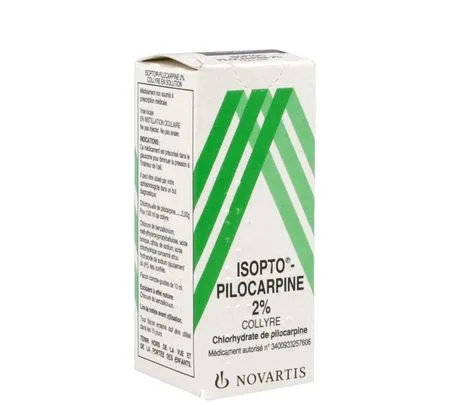
ISOPTO®-PILOCARPINE
pilocarpine
Forms and presentations
Eye drops in solution at 2 %: Dropper bottle of 10 ml.Composition
| p bottle | |
| Pilocarpine hydrochloride
|
200 mg |
Excipient with known effect: benzalkonium chloride.
Indications
- Simple chronic glaucoma.
- Acute glaucoma attack (angle-closure).
- Diagnosis of the causes of mydriasis.
Dosage and administration
DosageOcular instillations according to intraocular pressure readings and type of glaucoma. A single drop is sufficient for each instillation.
A dark iris may require a higher concentration of miotic or a greater frequency of administration, and care must be taken to avoid overdosage.
- Paediatric population:
- No data are available.
Method of administration:
Topical use.
For ocular instillation.
Nasolacrimal occlusion or gentle closure of the eyelid after administration is recommended. This may reduce the systemic absorption of ocularly administered medicines and lead to a decrease in systemic adverse effects.
After opening the cap, if the safety ring is too loose, remove it before using the product.
Contraindications
- Hypersensitivity to the active substance or to any of the excipients listed in section Composition.
- Miotics are contraindicated in cases where pupillary constriction is not desired, such as in acute iritis or anterior uveitis.
Warnings and precautions
For ophthalmic use only.
Warnings:
Repeated and/or prolonged instillations may result in a non-negligible systemic passage of the active substance.
A dark iris may require a higher concentration of miotic or a greater frequency of administration, and care must be taken to avoid overdosage.
Retinal detachments have been reported when miotics are used in susceptible individuals, such as young patients with myopia or patients with a history of retinal detachment. It is advised to perform a fundus examination before initiating treatment with Isopto-Pilocarpine 2 percent, eye drops. See Undesirable effects.
Miotics should be avoided in cases of acute inflammatory diseases of the anterior chamber of the eye.
A paradoxical increase in intraocular pressure may be observed in patients in whom outflow through the trabecular pathway is severely damaged.
Caution is recommended in the presence of corneal or conjunctival lesions in order to avoid excessive penetration that could produce systemic toxicity.
Isopto-Pilocarpine 2 percent, eye drops should be used with caution in patients with acute heart failure, bronchial asthma, gastroduodenal ulcer, hyperthyroidism, gastrointestinal spasms, Parkinson's disease, urinary tract obstruction, recent myocardial infarction, hypertension and hypotension, due to the risk of worsening these conditions.
- Benzalkonium chloride:
- This medicine contains 1,0 mg of benzalkonium chloride per 10 ml of eye drops, equivalent to 0,1 mg/ml.
- Benzalkonium chloride is known to cause eye irritation, dry eye syndrome symptoms, and may affect the tear film and corneal surface. Should be used with caution in patients with dry eye and those at risk of corneal damage.
- Patients should be monitored in case of prolonged use.
- Based on the limited data available, the adverse reaction profile in children is similar to that in adults. However, a stronger reaction to a given stimulus is generally observed in children than in adults. Irritation may affect treatment adherence in children.
- Benzalkonium chloride may be absorbed by soft contact lenses and change their colour. It is recommended to remove contact lenses before application and to wait at least 15 minutes before reinserting them.
Interactions
No interaction studies have been performed.
No clinically significant interaction has been described.
Topical NSAIDs may reduce the effect of pilocarpine.
The use of pilocarpine with beta-adrenergic antagonists may increase the risk of conduction disorders.
If several topical ophthalmic products are used, their administration should be separated by at least 5 minutes. Ophthalmic ointments should be administered last.
In case of surgical intervention, inform the anaesthetist and the surgeon (possibility of potentiation of muscle relaxants).
Fertility, pregnancy and breastfeeding
Pregnancy:There are no data or limited data on the use of Isopto-Pilocarpine 2 percent, eye drops in pregnant women. However, animal studies have shown harmful effects on reproduction in rats following systemic exposure to pilocarpine.
Isopto-Pilocarpine 2 percent, eye drops is not recommended during pregnancy.
Breastfeeding:
It is not known whether pilocarpine is excreted in breast milk; however, excretion in breast milk can be expected. There are also no data on the tolerability of pilocarpine-based ophthalmic preparations used during breastfeeding. However, a risk to the breastfed child cannot be excluded.
A decision must be made either to discontinue breastfeeding or to discontinue/abstain from treatment with Isopto-Pilocarpine 2 percent, eye drops, taking into account the benefit of breastfeeding for the child relative to the benefit of treatment for the woman.
Fertility:No study has been carried out to assess the effect of topical ophthalmic administration of Isopto-Pilocarpine 2 percent, eye drops on fertility.
Driving and using machines
Isopto-Pilocarpine 2 percent, eye drops has a major influence on the ability to drive vehicles or use machines. Miosis may cause blurred vision and difficulties with visual adaptation in the dark. Patients should be informed of the precautions to take when driving at night or carrying out risky activities in low-light conditions.Adverse effects
During clinical trials, the most frequently reported undesirable effects were: headache and blurred vision.
The following undesirable effects were reported during clinical trials with Isopto-Pilocarpine 2 percent, eye drops and are classified according to the following convention: very common (≥ 1/10), common (≥ 1/100 to < 1/10), uncommon (≥ 1/1000 to < 1/100), rare (≥ 1/10 000 to < 1/1000), very rare (< 1/10 000). Within each frequency group, undesirable effects are presented in order of decreasing seriousness.
| System organ class | |
| Frequency | Adverse effects
(MedDRA Preferred Term [v 15.1]) |
| Nervous system disorders | |
| Very common | Headache |
| Common | Vertigo |
| Eye disorders | |
| Very common | Blurred vision |
| Common | Reduced visual acuity, eye pain, photopsia, vitreous floaters, eye irritation, ocular hyperaemia |
| Uncommon | Retinal tear, vitreous haemorrhage, eyelid oedema, miosis, vitreous detachment, glare, sensation of foreign body in the eyes |
| Gastrointestinal disorders | |
| Common | Nausea |
Other adverse effects, identified from post-marketing surveillance, are presented below. Frequencies cannot be estimated from the available data. Within each system organ class, adverse effects are presented in decreasing order of seriousness.
| System organ class | Adverse effects
(MedDRA Preferred Term [v 15.1]) |
| Eye disorders | Increased intraocular pressure, corneal oedema |
| Gastrointestinal disorders | Vomiting |
- Possible change in visual field.
- Spasm of accommodation that appears rapidly after instillation and disappears about 2 hours later.
- A few cases of eyelid blinking that subsequently disappear.
- Increased tear secretion.
- Conjunctival vasodilation.
Long-term administration of miotics may be associated with an increased risk of cataracts, iris cysts or retinal detachment in patients who already have retinal pathologies. A fundus examination is advised for all patients before initiating treatment (see Warnings and Precautions for Use).
Symptoms of para-sympathomimetic effects such as nausea, vomiting, excessive salivation, sweating or bronchospasm may rarely occur with the use of topical ocular miotics. This is mainly observed after excessive use of the medicine. A paradoxical increase in intraocular pressure may be observed in patients in whom outflow through the trabecular pathway is severely damaged (see Warnings and Precautions for Use).
Reporting of suspected adverse reactions:Reporting suspected adverse reactions after authorisation of the medicinal product is important. It allows continuous monitoring of the benefit/risk balance of the medicinal product. Healthcare professionals should report any suspected adverse reaction via the national reporting system: National Agency for the Safety of Medicines and Health Products (ANSM) and the network of Regional Pharmacovigilance Centres. Website: https://signalement.social-sante.gouv.fr.
Overdose
Systemic effects are rare and are only observed in patients using repeated doses during angle-closure glaucoma and in young children.
In case of overdose or accidental ingestion, symptoms of toxicity may include: headache, excessive salivation, sweating, syncope, bradycardia, hypotension, abdominal cramps, vomiting, asthma and diarrhoea.
In case of severe systemic toxicity, treatment with anticholinergic medicinal products may be necessary.
In case of ocular overdose, the eye may be rinsed with lukewarm water.
In case of poisoning, use anticholinergic medicinal products and rehydrate the patients.
Pharmacodynamics
Pharmacotherapeutic class: Antiglaucoma agents and miotics/Parasympathomimetics (ATC code: S01EB01).
- Parasympathomimetic with direct cholinergic action.
- Pilocarpine lowers intraocular pressure by increasing the outflow facility of the aqueous humour and by decreasing the ciliary secretion rate. It acts on accommodation (slow onset of action) and on the depth of the anterior chamber of the eye (increase through relaxation of the zonule). The concentration in the cornea and aqueous humour is maximal 5 minutes after instillation.
Storage conditions
- Shelf life
- 4 years.
Any opened bottle must be used within 15 days.
HANDLING/DISPOSAL INSTRUCTIONS
No special requirements.
Prescription, supply and reimbursement
| Marketing authorisation (AMM) | 3400933257606 (1988, SmPC rev 25.03.2025). |
| Price: | 1,71 euros (bottle of 10 ml at 2 %). |
| Reimbursed by Social Security at 65 %. Collective. | |
Novartis Pharma SAS
8/10, Rue Henri-Sainte-Claire-Deville. CS 40150. 92563 Rueil-Malmaison cdx
Tel: 01 55 47 60 00
Medical Information and Communication:
Tel: 01 55 47 66 00
E-mail: icm.phfr@novartis.com
http://www.novartis.fr
Source: VIDAL · Updated on 10/11/2026. This information does not replace advice from a healthcare professional.