
Medicines
SmPC of 05/01/2024
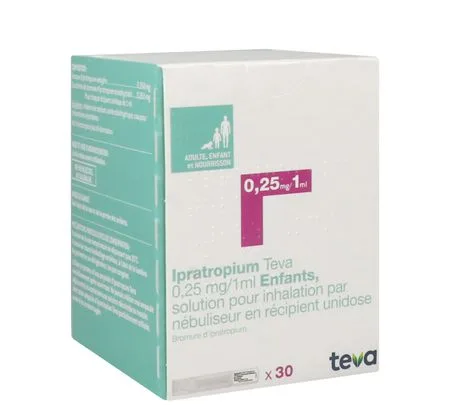
IPRATROPIUM TEVA 0,25 mg/1 ml CHILDREN, solution for inhalation by nebulizer in single-dose container
Forms and presentations
Solution for inhalation by nebulizer, in single-dose container.
Clear colorless solution with a pH between 3,0 and 4,0 and an osmolality between 245 and 299 mOsmol/kg.
Composition
Anhydrous ipratropium bromide....................................................................................................................0,250 mg
As ipratropium bromide monohydrate................................................................................0,261 mg
For each single-dose container of 1 ml.
Sodium chloride, hydrochloric acid for pH adjustment, water for injections.
Indications
Treatment of reversible bronchospasm associated with chronic obstructive pulmonary disease (COPD).
Symptomatic treatment of asthma in combination with an inhaled beta 2-agonist.
Ipratropium bromide is indicated in adults, adolescents and children aged 0 to 12 years.
Dosage and administration
For inhalation by nebulization only.
Dosage
IPRATROPIUM TEVA 0,25 mg/1 ml is used when the optimal dose corresponds to the content of an ampoule of 1 ml.
The dosage will be adjusted to the individual needs of the patient. IPRATROPIUM TEVA 0,25 mg/1 ml corresponds to the dosage adapted to children under 12 years of age.
Recommended doses:
Adults (including the elderly) and adolescents over 12 years :
0,25 to 0,50 mg (i.e. 1 ampoule of 0,25 mg/1 ml or 1 ampoule of 0,50 mg/2 ml) 3 to 4 times a day.
Treatment of acute bronchospasm: 0,50 mg.
Nebulizations may be repeated until the clinical condition of the patient stabilizes. The interval between each nebulization will be determined by the physician.
It is recommended not to exceed the recommended daily dose, whether during the acute or maintenance treatment phase. Daily doses greater than 2 mg in adults and adolescents must be administered under medical supervision only.
Paediatric population
Asthma
Children from 6 to 12 years :
0,25 mg (i.e. 1 ampoule of 0,25 mg/1 ml) up to a total daily dose of 1 mg (4 ampoules of 0,25 mg/1 ml). The interval between each nebulization will be adjusted by the physician according to the clinical condition of the patient.
Children aged 0 to 5 years (acute asthma treatment only) :
As data in children are limited, treatment will be administered under medical supervision.
The recommended dose is: 0,125 mg to 0,250 mg (i.e., half to one ampoule of 0,25 mg/1 mL) up to a total daily dose of 1 mg (i.e., 4 ampoules of 0,25 mg/1 mL).
In children under 5 years, nebulizations of ipratropium bromide must be spaced at least 6 hours apart.
In case of acute bronchospasm, nebulizations may be repeated until the clinical condition of the patient stabilizes.
If the treatment does not bring satisfactory improvement or if the patient's clinical condition deteriorates, the therapeutic approach should be reassessed.
The onset of acute dyspnea or a sudden worsening must lead to a reassessment of the therapeutic approach.
Method of administration
The single-dose container is exclusively intended for administration by inhalation using a suitable nebulizer; it must not be taken orally or administered parenterally.
IPRATROPIUM TEVA may be administered using an ultrasonic or compressed air nebulizer device (optimal flow rate: 6 to 8 liters per minute). The doses delivered may vary depending on the nebulizer device used.
IPRATROPIUM TEVA may be inhaled in undiluted form or diluted in physiological saline. In this case, the volume of physiological saline will be adjusted according to the nebulizer used.
If the quantity of product to be administered in a single intake corresponds to the dose of IPRATROPIUM TEVA, the entire contents of the ampoule may be inhaled.
Preparation procedures :
1. Prepare the nebulizer following the manufacturer's recommendations for the device.
2. Detach an ampoule as indicated in Figure 1.
3. Open the plastic ampoule by a twisting motion as indicated in Figure 2.
4. Fill the nebulizer reservoir as indicated in Figure 3.
5. Depending on the device used, add physiological saline if necessary.
6. Assemble the nebulizer according to the manufacturer's instructions. The inhalation time for a complete dose is generally between 5 and 15 minutes.
7. After inhalation, discard the solution remaining in the reservoir and clean the nebulizer according to the manufacturer's recommendations.
The single-dose container contains no preservative and its contents must therefore be administered immediately upon opening. A new ampoule must be used for each administration to avoid microbial contamination.
Visually inspect the product before use; in case of discoloration or a cloudy solution, discard the solution (see section Special storage precautions).
Opened or damaged single-dose containers must also be discarded (see section Disposal and handling).
Contraindications
Hypersensitivity to the active substance, to atropine, to atropine derivatives, or to any of the excipients listed in section Composition.
Warnings and precautions
Hypersensitivity
Rare cases of urticaria, angioedema, rash, bronchospasm, oropharyngeal edema, and anaphylaxis have revealed immediate hypersensitivity reactions following the use of IPRATROPIUM TEVA.
Paradoxical bronchospasm
As with other inhaled medicinal products, IPRATROPIUM TEVA may cause paradoxical bronchospasm that can be life-threatening. In case of paradoxical bronchospasm, treatment with IPRATROPIUM TEVA must be stopped immediately and replaced by another treatment.
Ocular complications
Caution is advised in patients predisposed to narrow-angle glaucoma, although the occurrence of systemic anticholinergic adverse effects is extremely unlikely with this route of administration.
Rare cases of ocular complications (mydriasis, increased intraocular pressure, angle-closure glaucoma, and eye pain) have been reported following accidental intraocular spraying of ipratropium bromide alone or combined with a beta2-sympathomimetic.
The onset of eye pain or discomfort, blurred vision, visual perception of colored rings or images associated with conjunctival redness or corneal congestion are warning signs of angle-closure glaucoma and require instillation of a miotic eye drop and immediate specialist medical advice.
Therefore, the patient must be clearly informed of the appropriate methods of use of IPRATROPIUM TEVA. Caution is recommended to avoid intraocular spraying of the product. In general, it is preferable to administer the nebulized ipratropium solution via a mouthpiece. If this is not possible, a suitable mask may be used provided it fits the patient correctly. Patients at risk of glaucoma in particular will be advised to protect their eyes from possible spray.
Renal and urinary effects
Caution is required in patients with obstructions of the urinary drainage system (for example, prostatic hypertrophy or bladder neck obstruction), although the occurrence of systemic anticholinergic adverse effects is extremely unlikely with this route of administration.
Gastrointestinal motility disorders
Patients with cystic fibrosis may be prone to disorders of gastrointestinal motility.
Ipratropium bromide should be used with caution in cases of cardiac pathology.
If doses higher than the recommended dosages are needed to control the symptoms of bronchoconstriction (or bronchospasm), the therapeutic approach should be reassessed.
Paediatric population
See section Dosage and administration.
Interactions
Chronic administration of IPRATROPIUM TEVA with other anticholinergic medicinal products has not been studied. The adverse effects of other anticholinergic compounds may be potentiated.
Therefore, chronic co-administration of IPRATROPIUM TEVA with other anticholinergic medicinal products is not recommended.
Beta 2-sympathomimetics and xanthine derivatives may increase the bronchodilator effect of ipratropium bromide.
The risk of acute glaucoma in patients with a history of narrow-angle glaucoma may be increased when nebulised ipratropium bromide and beta 2-agonists are administered simultaneously (see section Warnings and precautions). Separate administration or wearing well-fitted goggles may reduce this risk.
IPRATROPIUM TEVA may be co-administered with other medicinal products frequently used in the treatment of chronic obstructive pulmonary disease, including sympathomimetic bronchodilators, methylxanthines, corticosteroids and disodium cromoglicate.
IPRATROPIUM TEVA, solution for inhalation by nebuliser, must NOT be mixed with other solutions for inhalation containing the preservative benzalkonium chloride in the same nebuliser (see section Incompatibilities).
Fertility, pregnancy and breastfeeding
Pregnancy
There are few or no data on the use of ipratropium bromide in pregnant women. Animal studies have not shown any direct or indirect toxic effect on pregnancy, embryonic and foetal development, parturition or postnatal development (see section Preclinical safety).
The potential risk in humans is not known. Consequently, the use of IPRATROPIUM TEVA should be considered during pregnancy only if necessary.
Breast-feeding
It is not known whether ipratropium bromide or its metabolites are excreted in human milk. It is unlikely that ipratropium bromide will reach the infant to a significant extent, particularly when administered by inhalation. However, caution is advised when administering IPRATROPIUM TEVA to breastfeeding women.
Fertility
There are no clinical data on fertility for ipratropium bromide.
Non-clinical studies conducted with ipratropium bromide have not shown any adverse effect on fertility (see section Preclinical safety).
Driving and using machines
No studies have been conducted on the effects on the ability to drive and use machines. However, patients should be informed that they may experience adverse effects such as dizziness, accommodation disorders, mydriasis and blurred vision during treatment with IPRATROPIUM TEVA. Therefore, caution is recommended when driving a vehicle or using a machine.
Adverse effects
a) Summary of the safety profile
Most of the listed adverse effects can be attributed to the anticholinergic properties of ipratropium bromide. As with all inhalation treatments, IPRATROPIUM TEVA may cause symptoms of local irritation. The reported incidence of adverse effects is based on data from clinical studies and post-marketing pharmacovigilance.
The adverse effects most frequently reported in clinical trials were dizziness, headache, throat irritation, cough, dry mouth, gastrointestinal motility disorders (constipation, diarrhoea, vomiting) and nausea.
b) Table listing adverse effects
Adverse events are listed in the table below, by system organ class according to MedDRA and by frequency category. Frequencies are defined as follows: very common (≥ 1/10), common (≥ 1/100 to < 1/10), uncommon (≥ 1/1 000 to < 1/100), rare (≥ 1/10 000 to ≤1/1 000), very rare (< 1/10 000), frequency not known (cannot be estimated from the available data).
|
System organ class |
Frequency |
Symptoms |
|
Immune system disorders |
Uncommon |
Allergic reactions, angioedema, anaphylaxis |
|
Nervous system disorders |
Common |
Dizziness, headache |
|
Eye disorders |
Uncommon |
Blurred vision, increased intraocular pressure, eye pain, mydriasis, perception of halos, angle-closure glaucoma, conjunctival hyperaemia, corneal oedema |
|
Rare |
Disorders of visual accommodation |
|
|
Cardiac disorders |
Uncommon |
Palpitations, supraventricular tachycardia |
|
Rare |
Tachycardia, atrial fibrillation |
|
|
Respiratory, thoracic and mediastinal disorders |
Common |
Cough, local throat irritation |
|
Uncommon |
Inhalation-induced bronchospasm, laryngospasm, pharyngeal oedema, dry throat |
|
|
Gastrointestinal disorders |
Common |
Dry mouth, gastrointestinal motility disorders, nausea |
|
Uncommon |
Vomiting, stomatitis, taste disturbance |
|
|
Skin and subcutaneous tissue disorders |
Uncommon |
Rash, pruritus |
|
Rare |
Urticaria |
|
|
Renal and urinary disorders |
Uncommon |
Urinary retention |
Reporting of suspected adverse reactions
Reporting suspected adverse reactions after authorisation of the medicinal product is important. It allows continued monitoring of the benefit/risk balance of the medicinal product. Healthcare professionals are asked to report any suspected adverse reaction via the national reporting system: National Agency for the Safety of Medicines and Health Products (ANSM) and the network of Regional Centres of Pharmacovigilance - Website: https://signalement.social-sante.gouv.fr/.
Overdose
No specific symptoms have been observed after overdose.
Local administration and the wide therapeutic margin do not expose the patient to a risk of serious anticholinergic adverse effects in case of overdose. Moderate-intensity adverse effects related to the anticholinergic effect may occur, such as dry mouth, visual accommodation disturbances and tachycardia.
Symptoms of severe overdose correspond to an increase in atropine-like effects such as tachycardia, tachypnoea, hyperthermia and central nervous system effects of the type agitation, confusion and hallucinations. Appropriate symptomatic treatment should then be instituted. In case of respiratory disorders, respiratory assistance must be implemented. Administration of physostigmine is generally not recommended because of its cardiotoxic effects and the risk of convulsions; it will require electrocardiographic (ECG) monitoring and the means to ensure assisted ventilation if needed.
Pharmacodynamics
Pharmacotherapeutic class: other drugs for obstructive airway diseases by inhalation, anticholinergics, ATC code: R03BB01.
Mechanism of action
Ipratropium bromide is a quaternary ammonium with anticholinergic (parasympatholytic) properties. Preclinical studies have shown that it inhibits vagally mediated reflexes by an antagonistic effect on the action of acetylcholine, the transmitter agent released from the vagus nerve. Anticholinergics prevent the increase in intracellular concentration of Ca++, which is caused by the interaction between acetylcholine and the muscarinic receptor located on bronchial smooth muscle. The release of Ca++ is mediated by the second messenger system composed of IP3 (inositol triphosphate) and DAG (diacylglycerol).
Pharmacodynamic effects
Inhaled ipratropium bromide exerts a local bronchodilator effect in the bronchi.
Preclinical and clinical studies have not demonstrated any effect of ipratropium bromide on mucus secretion, mucociliary clearance or gas exchange.
Clinical studies
The bronchodilator effect of ipratropium bromide in the treatment of acute bronchospasm associated with asthma has been demonstrated in studies conducted in adults and children older than six years. In most of these studies, ipratropium bromide was co-administered with an inhaled beta-agonist.
Although data are limited, ipratropium bromide has been shown to have a therapeutic effect in the treatment of bronchospasm associated with viral bronchiolitis and bronchopulmonary dysplasia in young and very young children.
In controlled trials lasting 85 to 90 days in patients suffering from bronchospasm associated with chronic obstructive pulmonary disease (COPD), a significant improvement in lung function occurred within 15 minutes, reached its maximum within 1 to 2 hours and was maintained for 4 to 6 hours.
Pharmacokinetics
Absorption
The therapeutic effect is produced by a local action in the airways. The times to bronchodilation and to systemic pharmacokinetics are not parallel.
After inhalation, 10 to 30 % of the dose is deposited in the lungs, depending on the formulation, the device and the inhalation technique. The major part of the dose is swallowed and passes through the gastrointestinal tract.
After oral inhalation, the active substance is very rapidly absorbed. The maximum plasma concentration is reached 10 to 20 minutes after inhalation.
The total systemic bioavailability of oral doses and of orally inhaled doses is estimated at 2 % and 7–28 %, respectively. The portion of the ipratropium dose that is swallowed therefore does not contribute significantly to systemic exposure.
Distribution
The pharmacokinetic parameters of the active substance were calculated on the basis of plasma levels after intravenous administration. Plasma levels of ipratropium bromide showed a rapid decrease and a biphasic course. The volume of distribution (Vz) is 338 L (corresponding to ± 4,6 L/kg). The plasma protein binding of ipratropium is low (less than 20 %). Non-clinical data indicate that the quaternary amine ipratropium does not cross the placental barrier or the blood-brain barrier.
Biotransformation
After intravenous administration, approximately 60 % of the dose is metabolised, the major part probably by oxidation in the liver.
The known metabolites, formed by hydrolysis, dehydration or elimination of the hydroxymethyl group in the functional group of tropic acid, have very low or no affinity for the muscarinic receptor and must be considered inactive.
Elimination
The half-life of the terminal elimination phase is approximately 1,6 hour. The total clearance of the active substance is 2,3 L/minute. Approximately 40 % of the clearance is renal (0,9 L/minute). After inhalation of ipratropium bromide aerosol, the cumulative renal clearance of ipratropium bromide over 24 hours was approximately 12 %.
Preclinical safety
No safety-related risk for humans was detected in laboratory animals. This finding is based on data from safety pharmacology studies, repeated-dose toxicology, reproductive function (administration by inhalation), genotoxicity and carcinogenesis.
INCOMPATIBILITIES
IPRATROPIUM TEVA must NOT be mixed in the same nebuliser with other inhalation solutions containing benzalkonium chloride as preservative. The formation of a deposit is possible.
Special storage precautions
Store at a temperature not exceeding 25°C.
Store in the outer packaging, protected from light.
Do not refrigerate, do not freeze.
Use the contents of an IPRATROPIUM TEVA ampoule immediately after opening. Never use an ampoule that has already been opened or that contains a discoloured or cloudy solution. Discard any partially used, opened or damaged IPRATROPIUM TEVA ampoule.
SPECIAL PRECAUTIONS FOR DISPOSAL AND OTHER HANDLING
Once inhalation is complete, the unused solution remaining in the reservoir must be discarded and the nebuliser must be cleaned in accordance with the instructions for use.
Any unused medicinal product or waste material should be disposed of in accordance with local requirements.
Prescription, supply and reimbursement
Prescription restricted to specialists in paediatrics and pneumology.
| Marketing authorisation (AMM) |
|
| Price: |
|
Collection.
COEUR DEFENSE 100-110 ESPLANADE DU GAL DE GAULLE
92931 PARIS LA DEFENSE CEDEX
Tel: 01 55 91 78 00 www.teva-sante.fr
Source: VIDAL · Updated on 10/11/2026. This information does not replace advice from a healthcare professional.