Medicines
SmPC of 26/06/2023
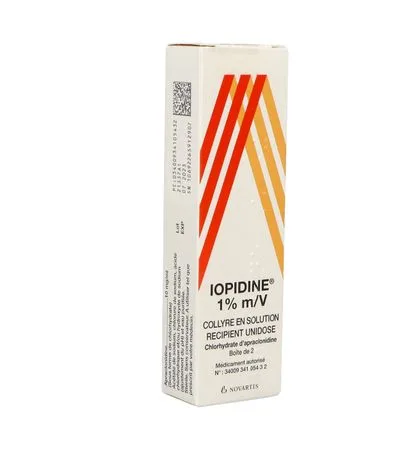
IOPIDINE 1 % w/v, eye drops solution
Forms and presentations
Eye drops solution (pale yellow).
Single-dose container of 0,25 ml, sealed and placed in a sealed multilayer pouch. Box of 2.
Composition
For one single-dose container:
Apraclonidine: 10 mg/ml
(As hydrochloride)
Sodium acetate, sodium chloride, hydrochloric acid and/or sodium hydroxide (pH adjustment), purified water.
Indications
IOPIDINE 1 % is indicated for the control or prevention of post-surgical elevations of intraocular pressure in patients who have just undergone laser surgery on the anterior segment of the eye (clinical studies were conducted on trabeculoplasties, iridotomies and capsulotomies).
Dosage and administration
Dosage
Adults (including the elderly):
Instil one drop of IOPIDINE 1 % into the eye to be operated on, one hour before the start of the laser surgery on the anterior segment of the eye. Instil a second drop into the same eye, immediately after the end of the laser procedure.
If the drop of IOPIDINE 1 % is not retained by the eye after administration, for whatever reason, instil a second drop.
Administration in elderly subjects does not require any particular precautions.
Paediatric population
As the tolerability and efficacy of IOPIDINE have not been established in children, IOPIDINE 1 % is therefore not recommended in children.
Method of administration
This eye drops solution must be administered by ocular route only.
Nasolacrimal occlusion or gentle closure of the eyelids after instillation is recommended. This may reduce systemic absorption of ocularly administered treatments and lead to a reduction in systemic side effects.
In case of concomitant treatment with several ophthalmic medicinal products, wait at least 5 minutes between each administration. Ophthalmic ointments must be administered last.
Contraindications
- In case of a history of severe or unstable and uncontrolled cardiovascular disease.
- In children
- In patients receiving monoamine oxidase inhibitors, systemic sympathomimetics or tricyclic antidepressants
- In patients with hypersensitivity to the active substance (clonidine or apraclonidine) or to any of the excipients mentioned in section Composition.
Warnings and precautions
Special warnings
Although instillation of two drops of IOPIDINE 1 % had little effect on heart rate or blood pressure in clinical studies conducted in patients undergoing laser surgery of the anterior segment of the eye, including those with cardiovascular disease, the possible occurrence of a vasovagal reaction must be taken into account, and precautions must be taken in patients with such a history. IOPIDINE 1 % must be administered with caution in patients with a history of angina, severe coronary insufficiency, recent myocardial infarction, overt heart failure, cerebrovascular disease, chronic renal failure, Raynaud's disease or thromboangiitis obliterans. Particular attention and monitoring are recommended in depressed subjects, as apraclonidine has, in rare cases, been associated with depression.
Precautions for use
There are no data on topical apraclonidine in patients with renal or hepatic impairment. Systemic absorption of apraclonidine after topical administration is low and leads to blood levels below 1,0 ng/ml. However, it is advised to monitor patients with renal or hepatic impairment. In patients with hepatic impairment, cardiovascular parameters must also be closely monitored, given that systemically administered clonidine is partially metabolised by the liver.
As apraclonidine is a potent hypotensive agent acting on intraocular pressure, patients in whom an excessive decrease in intraocular pressure occurs must be closely monitored.
Interactions
The risk of clinically relevant interactions appears low given the plasma concentrations of apraclonidine obtained after ocular administration.
IOPIDINE 1 % is contraindicated in patients receiving monoamine oxidase inhibitors (see section Contraindications).
Although no specific drug interaction with topical antiglaucoma medicinal products or with systemically administered medicinal products was identified during the clinical studies of IOPIDINE 1 %, the possibility of a potentiating or additive effect with central nervous system depressants (alcohol, barbiturates, opiates, sedatives, anaesthetics) must be taken into account. In theory, the use of IOPIDINE 1 % in combination with local sympathomimetics could cause an increase in systemic blood pressure, and therefore blood pressure should be checked at the start of treatment in patients receiving this type of therapeutic combination.
Caution is recommended in patients taking tricyclic antidepressants, which may act on the metabolism and reuptake of circulating amines.
An additive hypotensive effect has been reported when systemically administered clonidine was combined with neuroleptic treatment. Systemic administration of clonidine could inhibit the production of catecholamines in response to insulin-induced hypoglycaemia and mask the signs and symptoms of hypoglycaemia.
As apraclonidine may decrease heart rate and blood pressure, caution is recommended when using medicinal products such as beta-blockers (ophthalmic and systemic), antihypertensives and cardiac glycosides. The heart rate and blood pressure of patients receiving cardiovascular medicinal products at the same time as IOPIDINE 1 % should be monitored frequently. Caution is required in patients receiving clonidine and other related pharmacological agents simultaneously.
Fertility, pregnancy and breastfeeding
Pregnancy
There are no data on the use of IOPIDINE 1 % in pregnant women. Preclinical studies with apraclonidine have shown embryotoxicity (see section Preclinical safety). The potential risk in humans is not known. IOPIDINE 1 % is however not recommended during pregnancy.
Breast-feeding
It has not yet been established whether topically administered apraclonidine is excreted in human milk. A risk to newborns/infants cannot be excluded. Breast-feeding should be interrupted during treatment with IOPIDINE 1 %.
Fertility
No studies have been conducted to evaluate the effect of topical ocular administration of IOPIDINE 1 % eye drops on male or female fertility. In rats, no effect on fertility was observed after oral administration of apraclonidine.
Driving and using machines
IOPIDINE 1 % may cause dizziness and drowsiness; patients who experience drowsiness must not drive or use machines.
Adverse effects
Summary of the safety profile
In clinical studies, the most frequent adverse reaction was dry mouth, occurring in 5,6 % of patients. Other frequent adverse reactions included eyelid retraction and mydriasis, occurring in approximately 3 % to 4 % of patients. All other adverse reactions were reported in fewer than 2 % of patients.
The following adverse reactions have been reported from clinical studies and post-marketing surveillance and are classified according to the following convention: very common (≥ 1/10), common (≥ 1/100, < 1/10), uncommon (≥ 1/1 000, < 1/100), rare (≥ 1/10 000, < 1/1 000), very rare (< 1/10 000), or not known (cannot be estimated from the available data). Within each frequency grouping, adverse reactions are presented in order of decreasing seriousness.
|
System organ class |
MedDRA preferred term (v. 19.0) |
|
Immune system disorders |
Frequency not known : Hypersensitivity |
|
Nervous system disorders |
Common : Dysgeusia |
|
Uncommon : Vasovagal syncope, paraesthesia, decreased libido, irritability, postural dizziness, headache. |
|
|
Rare : Hypoaesthesia |
|
|
Eye disorders |
Common : Ocular hyperaemia, mydriasis, dry eye, abnormal sensation in eye, eyelid retraction, eye disorder (conjunctival blanching) |
|
Uncommon: Conjunctival haemorrhage, ocular inflammation, eyelid disorders (upper eyelid raising), ocular hypotony, reduced visual acuity (poor vision), blurred vision, ocular allergy, eyelid disorder (upper eyelid raising), ocular pruritus, ocular dryness, eye irritation, eye discomfort, punctate keratitis |
|
|
Cardiac disorders |
Uncommon Irregular heart rate, bradycardia, palpitations |
|
Psychiatric disorders |
Uncommon Insomnia, abnormal dreams. |
|
Respiratory, thoracic and mediastinal disorders |
Common Nasal dryness |
|
Rare: Dyspnoea, increased upper bronchial secretions, nasal discomfort |
|
|
Vascular disorders |
Uncommon Orthostatic hypotension |
|
Frequency not known Hypotension, hypertension |
|
|
Gastrointestinal disorders |
Common: Dry mouth |
|
Uncommon: Diarrhoea, vomiting, abdominal pain, gastric disorders, nausea |
|
|
Skin and subcutaneous tissue disorders |
Rare: Hyperhidrosis, pruritus. |
|
Musculoskeletal and connective tissue disorders |
Rare: Pain in the extremities. |
|
General disorders and administration site conditions |
Common Fatigue |
|
Rare: Chest pain, feeling of warmth, feeling of warmth and cold. |
Paediatric population
IOPIDINE 1 % is contraindicated in children. Reactions including lethargy, bradycardia and decreased oxygen saturation have been reported in newborns and infants under one year of age following a single administration of apraclonidine (see sections Contraindications and Overdose).
Reporting of suspected adverse reactions
Reporting suspected adverse reactions after authorisation of the medicinal product is important. It allows continued monitoring of the benefit/risk balance of the medicinal product. Healthcare professionals are asked to report any suspected adverse reactions via the national reporting system: National Agency for the Safety of Medicines and Health Products (ANSM) and the network of Regional Pharmacovigilance Centres - Website: https://signalement.social-sante.gouv.fr/.
Overdose
In case of accidental overdose, IOPIDINE 1 % can be removed from the eye by rinsing with water or with sterile saline solution.
A girl aged 2 months received 1 drop of IOPIDINE 1 % in each eye. Two or three hours later, the infant presented extreme pallor, hypothermia and miosis. She became comatose and was treated with a glucose infusion. The infant became awake but lethargic, and the heart rate was slow but regular. The infant fully recovered without sequelae.
A boy aged 23 months ingested a quantity of IOPIDINE 5 mg/ml. The child was admitted to hospital for hypothermia, bradycardia and drowsiness. Blood analysis revealed a serum apraclonidine level of 2,9 ng/ml. The child was rewarmed and treated with atropine and dopamine, leading to suppression of hypothermia and bradycardia within 4 hours. The child remained drowsy for 24 hours and was discharged from hospital 48 hours after admission with no sequelae reported.
The following manifestations have been reported in overdose with an oral form of clonidine: hypotension, transient hypertension, asthenia, vomiting, irritability, decreased or absent reflexes, lethargy, drowsiness, sedation or coma, pallor, hypothermia, bradycardia, conduction disorders, arrhythmia, dry mouth, miosis, apnoea, respiratory depression, hypoventilation and convulsion. Treatment of an oral overdose includes appropriate symptomatic treatment; respiratory function must be maintained. Haemodialysis is of limited interest as it can eliminate at most 5 % of the circulating drug.
Pharmacodynamics
Pharmacotherapeutic class: Ophthalmologicals; ANTI-GLAUCOMA AND MIOTICS, ATC code: S01EA03.
Apraclonidine is a relatively selective alpha-2-adrenergic agonist without membrane-stabilising (local anaesthetic) activity. After instillation into the eye, apraclonidine reduces intraocular pressure. Apraclonidine in ophthalmic solution has little effect on cardiovascular parameters.
Fluorophotometry studies in humans suggest that the mechanism of action of the ocular hypotensive effect of apraclonidine is related to a reduction in aqueous humour formation.
The onset of action of IOPIDINE 1 % is approximately one hour and the reduction of intraocular pressure usually reaches its maximum three to five hours after application of a single dose.
Pharmacokinetics
After topical ocular administration in New Zealand albino rabbits, apraclonidine reaches its maximum concentration in the aqueous humour, iris, ciliary body and lens within two hours. It is the cornea that shows the highest and most rapidly reached concentration (20 minutes). The tissue distribution of apraclonidine, from the highest concentration to the lowest, expressed in micrograms equivalent per gram of tissue, is as follows: cornea, iris-ciliary body, aqueous humour, lens and vitreous humour. The elimination half-life of apraclonidine in the aqueous humour is estimated at approximately two hours.
The plasma concentration of apraclonidine after bilateral topical ocular administration, three times daily, of apraclonidine 0,5 % eye drops in healthy volunteers is less than 1,0 ng/mL. Steady state is reached after five days of administration. The systemic elimination half-life of apraclonidine is approximately 8 hours.
Preclinical safety
Intravenous and ocular administration of apraclonidine in cats and monkeys results in a reduction of blood flow in the anterior segment, whereas flow to the posterior segment (retina, choroid or optic nerve head) is not affected. In primates, chronic treatment with apraclonidine hydrochloride at 1,5 % by ocular route, three times daily for one year, did not result in any morphological change.
Acute toxicity
Acute toxicity was evaluated by intravenous and oral routes in rats and mice and by oral route in primates. The approximate LD50 per os is between 5,04 mg/kg (mice) and 63,9 mg/kg (rats); no deaths occurred in primates at the dose of 55 mg/kg. In rodents, toxic signs included lethargy, hypothermia, corneal opacification, areas of haemorrhage and distension of the gastrointestinal tract.
The pronounced inhibition of gastrointestinal motility is considered to be the cause of mortality in mice. Reduction of intestinal motility was observed in mice after intravenous administration at a dose of 0,1 mg/kg. Lethargy and disturbances of transit were observed in monkeys after oral administration at a dose of 55 mg/kg. In humans for ophthalmic use, the normal dose is approximately 0,01 mg/kg/day.
Subchronic and chronic toxicity
Rabbits tolerated apraclonidine hydrochloride in solution at 0,5 %, 1 % or 1,5 % (2 drops 3 times daily) over a period of one month, with no sign of systemic toxicity. Minimal corneal opacification was sporadically observed in eyes receiving the apraclonidine hydrochloride solution at 1,5 %.
Rats and mice received orally daily doses up to 1,2 mg/kg and 2 mg/kg respectively over a period of 13 weeks. The lethal dose in rats is 1,2 mg/kg/day and 1,6 mg/kg/day in mice. Among the pharmacotoxic reactions, disturbances of transit, abdominal distension and corneal opacifications were predominantly observed in female mice in the high-dose group. In rats in the 'high-dose' group that died before the end of the study, lymphotoxic effects on the spleen and thymus were observed, but these effects were not noted in animals still alive at the end of the study. No ophthalmic or toxic manifestations attributable to treatment were observed in monkeys that received, 3 times daily for 1 year, by ocular route, apraclonidine hydrochloride solutions at 0,5 %, 1 % and 1,5 %.
Local tolerance
In rabbits, topical ocular administration of apraclonidine hydrochloride solutions at 0,5 %, 1 % and 1,5 % (2 drops instilled every 30 minutes in one eye, for 6 hours) led to dose-dependent corneal and conjunctival irritation.
Sensitisation tests carried out in guinea pigs showed that apraclonidine hydrochloride was moderately sensitising.
Mutagenic and carcinogenic potential
Mutagenicity tests of apraclonidine hydrochloride using different reference systems gave negative results.
Long-term two-year studies evaluating carcinogenic potential in rats (at doses of 0,1, 0,3 and 1,0 mg/kg/day) and in mice (at doses of 0,1, 0,3 and 0,6 mg/kg/day) revealed no sign of carcinogenic potential of apraclonidine hydrochloride.
Both species showed an increased frequency of ocular alterations (corneal mineralisation and neovascularisation and keratitis), which were attributed to the pharmacologically induced reduction of the tear film caused by the drug. In addition, renal changes (mineralisation) were observed in rats from 0,3 mg/kg/day.
Reproductive toxicity
Studies in rats and rabbits did not reveal teratogenic effects of apraclonidine. Embryotoxicity was observed in pregnant female rabbits given orally maternotoxic doses of apraclonidine (doses > 1,25 mg/kg/day), with exposure covering the entire organogenesis period at doses 100 times higher than the recommended daily dose for IOPIDINE 1 % in a subject weighing 50 kg.
Special storage precautions
Store at a temperature not exceeding 25 °C.
Keep the container in the outer packaging.
SPECIAL PRECAUTIONS FOR DISPOSAL AND OTHER HANDLING
Single use.
Discard any remaining solution immediately after use.
Prescription, supply and reimbursement
| Marketing authorisation (AMM) |
|
| Price: |
|
Essentiel Pharma Limited
Vision Exchange Building. Triq IT-Territorjals, Zone 1
Central Business District, Birkirkara, CBD 1070. Malte
www.essentialpharmagroup.com
Source: VIDAL · Updated on 10/11/2026. This information does not replace advice from a healthcare professional.