Medicines
SmPC of 24/04/2026
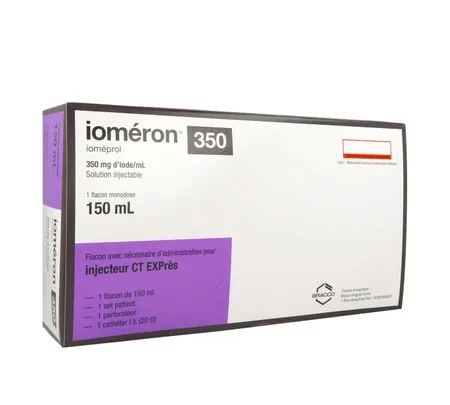
IOMERON 350 (350 mg Iodine/mL), injectable solution
Forms and presentations
Solution for injection.
Single-dose vials, except the 200 mL and 500 mL vials in multi-dose presentations.
Osmolality at 37°C: 618 mOsmol/kg H2O
Viscosity at 20°C: 14,5 mPa.s, at 37°C: 7,5 mPa.s
pH: 6,5 at 7,2
Composition
1 mL of solution contains:
Iomeprol .................................................................................................................................................714,00 mg
Quantity corresponding to iodine ...........................................................................................................350,00 mg
Tromethamine, hydrochloric acid, water for injection preparations.
Indications
This medicinal product is for diagnostic use only.
Intravenous urography, whole-body computed tomography, intravenous digital angiography, conventional angiography, intra-arterial digital angiography, conventional selective coronary arteriography, interventional coronary angiography, arthrography, hysterosalpingography, fistulography, galactography, dacryocystography, sialography, retrograde cholangiography.
Dosage and administration
|
Indication |
|
Recommended doses |
|
Intravenous urography |
Adults: Newborns: Infants: Children: |
50-150 mL 3-4,8 mL/kg 2,5-4 mL/kg ≤ 1 year 1-2,5 mL/kg > 1 year |
|
Whole-body computed tomography |
Adults: Childrena |
100-200 mL |
|
Digital intravenous angiography Venous |
Adults: Children (a) |
100-250 mL |
|
Conventional angiography |
|
|
|
Arteriography of the upper limbs |
Adults (b) |
|
|
Arteriography of the lower limbs and pelvis |
Adults (b) |
|
|
Abdominal arteriography |
Adults (b) |
|
|
Arteriography of the descending aorta |
Adults (b) |
|
|
Pulmonary angiography |
Adults: |
up to 170 mL |
|
Cerebral angiography |
Adults: |
up to 100 mL |
|
Interventional arteriography |
Adults (b) Children (a) |
|
|
Digital angiography by intra-arterial route |
|
|
|
Cerebral |
Adults: Children (a) |
30-60 mL for a general view, 5-10 mL in case of selective injection |
|
Aortic arch |
Adults (c) |
|
|
Aortography |
Adults (c) |
|
|
Angiocardiography |
Adults (b) Children: |
3-5 mL/kg |
|
Conventional selective coronary arteriography |
Adults (b)
|
|
|
Interventional coronary angiography
|
Adults:
|
4-10 mL per artery, to be repeated if necessary |
|
Arthrography |
Adults: |
Up to 10 mL per injection |
|
Hysterosalpingography |
Adults: |
up to 35 mL |
|
Fistulography |
Adults: |
up to 100 mL |
|
Galactography |
Adults: |
0,15-1,2 mL per injection |
|
Dacryocystography |
Adults: |
2,5-8 mL per injection |
|
Sialography |
Adults: |
1-3 mL per injection |
|
Retrograde cholangiography |
Adults: |
up to 60 mL |
Childrena : depending on body mass and age.
Adultsb : do not exceed 250 mL. The volume of each injection depends on the region examined.
Adultsc : do not exceed 350 mL.
To pierce the stopper and aspirate the contrast medium, it is recommended to use a cannula needle. The contrast medium must be aspirated into the syringe just before its use.
Instructions for multi-patient use from containers of 200 mL and above:
The contrast medium must be administered by means of an automatic injector approved for multiple uses, or according to another approved procedure ensuring the sterility of the contrast medium.
The vial stopper must be punctured only once.
The connection between the injector and the patient (patient line) must be changed after each patient.
The connecting tubing and/or all consumables of the injection system must be discarded as soon as the contrast medium vial is empty, or 16 hours after the first opening of the container.
The device manufacturer's instructions must be followed.
16 hours after first opening, any unused contrast medium remaining in the vial must be discarded.
By arterial route:
The average doses to be used vary according to the type of examination.
The dose must not exceed 4 to 5 mL/kg in repeated injection, without exceeding 100 mL per injection. The injection rate depends on the type of examination.
By intravenous route:
Doses must be adapted to the patient's weight and renal function, and the patient must be fasting without fluid restriction.
Ioméron does not act on coagulation, nor on platelet functions, and does not interfere physicochemically with heparins (unfractionated or low molecular weight). Therefore, its use should not modify the use of a heparin (unfractionated or low molecular weight) that could be given to prevent thrombosis, particularly on catheters.
To avoid any risk of physicochemical incompatibility, do not inject any other medication with the same syringe.
During vascular catheterisation procedures, catheters should be flushed regularly.
Prevention of extravasation : the injection of the contrast medium must be performed with caution in order to avoid extravasation.
Contraindications
• History of immediate major or delayed cutaneous reaction (see section Adverse effects) to the injection of Ioméron.
• Overt thyrotoxicosis.
• Hysterosalpingography in case of pregnancy.
• Hypersensitivity to the active substance or to any of the excipients listed in section Composition.
Warnings and precautions
Diagnostic procedures involving the use of a contrast medium must be performed under the responsibility of personnel with the required training and a thorough knowledge of the specific procedure to be carried out.
• Regardless of the route of administration and the dose, an allergic risk exists.
• The risk of intolerance is not uniform when it comes to products administered locally for the opacification of body cavities:
a) Administration by certain particular routes (articular, biliary, intrathecal, intrauterine...) results in a non-negligible systemic passage: systemic effects may be observed.
b) Administration orally or by the rectal route normally results in very limited systemic diffusion; if the digestive mucosa is normal, no more than 5% of the administered dose is then found in the urine, the remainder being eliminated in the faeces. On the other hand, in case of mucosal alteration, absorption is increased; it is total and rapid in case of perforation with passage into the peritoneal cavity, and the medicine is eliminated via the urinary route. The possible occurrence of dose-dependent systemic effects therefore depends on the state of the digestive mucosa.
c) The immuno-allergic mechanism, on the other hand, is not dose-dependent and may always be observed, regardless of the route of administration.
Therefore, from the point of view of the frequency and intensity of adverse effects, the following are contrasted:
• Products administered by the vascular route and certain local routes,
• Products administered by the digestive route and poorly absorbed in the normal state.
4.4.1. General warnings applicable to all iodinated contrast media
4.4.1.1 Warnings:
All iodinated contrast media may cause minor or major reactions that may be life-threatening. They may be immediate (within 60 minutes) or delayed (up to 7 days). They are often unpredictable.
The risk of a major reaction requires that the means necessary for emergency resuscitation, including oxygen and manual ventilation equipment, be immediately available.
Several mechanisms have been proposed:
• direct toxicity on the vascular endothelium and tissue proteins,
• pharmacological action modifying the concentration of certain endogenous factors (histamine, complement fractions, inflammatory mediators), more frequent with hyperosmolar products,
• immediate IgE-dependent allergy to the contrast medium (anaphylaxis),
• allergic reactions of cellular mechanism (delayed cutaneous reactions).
Patients who have already had a reaction during a previous administration of an iodinated contrast medium have an increased risk of a new reaction if the same, or possibly another contrast medium, iodinated or not, is re-administered, and are therefore considered to be at risk.
Prior sensitivity tests are not recommended, since severe reactions due to the contrast medium, which may be life-threatening, cannot be predicted from the patient's history or from a sensitivity test.
Iodinated contrast media and thyroid (see also "Precautions for use" Dysthyroidism)
Before administering iodinated contrast media, it should be ensured that the patient will not undergo scintigraphic or biological exploration of the thyroid or administration of radioactive iodine for therapeutic purposes.
Indeed, administration of iodinated contrast media, by whatever route, disrupts hormone assays and iodine uptake by the thyroid or by thyroid cancer metastases until urinary iodine normalises.
Newborns, infants, children : infants (aged less than 1 year), particularly newborns, are especially predisposed to electrolyte imbalances and haemodynamic alterations. Particular attention must be paid to the dosage, the details of the procedure and the patient's status.
Elderly : elderly people present a particular risk of reactions related to a high dose of contrast medium. The frequently encountered association of neurological disorders and severe vascular pathologies constitutes a serious complication.
4.4.1.2. Precautions for use
4.4.1.2.1. Intolerance to iodinated contrast media:
Before the examination:
• identify subjects at risk through a precise history-taking of past medical history. Corticosteroids and H1 antihistamines have been proposed as premedication in patients at greatest risk of intolerance reactions (known intolerants to an iodinated contrast medium). However, they do not prevent the occurrence of a severe or fatal anaphylactic shock.
During the examination, the following should be ensured:
• medical monitoring,
• maintenance of a venous access route.
After the examination:
• after administration of a contrast medium, the patient must remain under observation for at least 30 minutes, as the majority of serious adverse effects occur within this period.
• the patient must be informed of the possibility of delayed reactions (up to 7 days) (see section Adverse effects).
4.4.1.2.2. Renal insufficiency:
Iodinated contrast media may cause a transient alteration of renal function or worsen pre-existing renal insufficiency. The preventive measures are as follows:
• identify patients at risk: dehydrated patients, patients with renal insufficiency, diabetic patients, patients with hyperuricemia, patients with severe heart failure, patients with monoclonal gammopathy (multiple myeloma, Waldenström's macroglobulinemia and other paraproteinemias), sickle cell disease, subjects with a history of renal insufficiency after administration of iodinated contrast media, newborns and children, elderly subjects with atheromatous disease,
• hydrate with an appropriate hydrosaline intake where necessary,
• avoid combining nephrotoxic medicinal products (if such a combination is necessary, renal biological monitoring must be reinforced. The medicinal products concerned include in particular aminoglycosides, organoplatinums, high-dose methotrexate, pentamidine, foscarnet and certain antivirals (aciclovir, ganciclovir, valaciclovir, adefovir, cidofovir, tenofovir), vancomycin, amphotericin B, immunosuppressants such as ciclosporin or tacrolimus, ifosfamide),
• observe an interval of at least 48 hours between two radiological examinations involving injection of contrast medium, or postpone any new examination until the initial renal function is restored,
• prevent lactic acidosis in diabetics treated with metformin (see section Interactions).
Haemodialysed patients may receive iodinated contrast media because these are dialysable. Prior advice from the haemodialysis department should be obtained.
4.4.1.2.3. Asthma:
Stabilisation of asthma is recommended before injection of an iodinated contrast medium.
Patients using beta-blockers, particularly asthmatic patients, may have a lowered threshold for the onset of bronchospasm and respond less well to treatment with beta-agonists and adrenaline, which may require the use of higher doses.
4.4.1.2.4. Dysthyroidism and thyroid function tests:
The small quantity of free inorganic iodides that may be present in the contrast medium may have an effect on thyroid function: these effects appear more evident in patients with latent or manifest hyperthyroidism, or goitre. Episodes of hyperthyroidism have been reported after administration of iodinated contrast media.
4.4.1.2.5. Heart disease and pulmonary hypertension:
In case of established or incipient heart failure, coronary artery disease, pulmonary arterial hypertension, or valvular disease, the risks of pulmonary oedema, myocardial ischaemia, and arrhythmias or severe haemodynamic disturbances are increased after administration of the iodinated contrast medium.
Severe and chronic hypertension may increase the risk of renal impairment following administration of contrast medium, as well as the risks associated with the catheterisation procedure.
4.4.1.2.6. Neurological symptoms :
In case of intra-arterial injection, the benefit/risk ratio must be assessed on a case-by-case basis:
• due to the risk of worsening neurological symptoms in patients presenting with transient ischaemic attack, acute cerebral infarction, recent intracranial haemorrhage, cerebral oedema, idiopathic or secondary epilepsy (tumour, scar), or intracranial tumours or metastases.
• in case of intra-arterial use in patients with alcoholism (acute or chronic alcohol intoxication) and in patients addicted to other substances.
Neurological symptoms due to degenerative, ischaemic, inflammatory or neoplastic cerebrovascular pathologies may be exacerbated by administration of contrast medium. These patients have an increased risk of transient neurological complications.
Intravascular injections of contrast medium may cause vasospasm and consecutive cerebral ischaemic events.
4.4.1.2.7. Contrast media-induced encephalopathy :
Cases of encephalopathy have been reported with the use of iomeprol (see section Adverse effects).
Contrast encephalopathy may manifest as symptoms and signs of neurological dysfunction such as headache, visual disturbances, cortical blindness, confusion, convulsions, loss of coordination, hemiparesis, aphasia, loss of consciousness, coma and cerebral oedema within minutes or hours after administration of iomeprol, and generally resolves within a few days.
The product should be used with caution in patients suffering from conditions that disrupt the integrity of the blood-brain barrier (BBB), which may lead to increased permeability of the BBB to contrast media and increase the risk of encephalopathy. If contrast encephalopathy is suspected, administration of iomeprol must be discontinued and appropriate medical management must be initiated.
4.4.1.2.8. Pheochromocytoma:
Patients with phaeochromocytoma may develop a hypertensive crisis after intravascular administration of contrast medium. Pre-treatment with alpha-blockers and beta-blockers is recommended due to the risk of hypertensive crises.
4.4.1.2.9. Myasthenia:
Administration of contrast medium may worsen the symptoms of myasthenia.
4.4.1.2.10. Severe cutaneous adverse reactions
Serious cutaneous adverse reactions (SCARs), including Stevens-Johnson syndrome (SJS), toxic epidermal necrolysis (TEN), acute generalised exanthematous pustulosis (AGEP) and drug reaction with eosinophilia and systemic symptoms (DRESS), which may be life-threatening or fatal, have been reported in association with intravascular administration of iodinated contrast media (see section Adverse effects). At the time of administration, patients must be informed of the signs and symptoms and be closely monitored for skin reactions. If signs and symptoms suggestive of these reactions are observed, administration of Iomeron must be stopped immediately. If the patient has developed a serious reaction such as SJS, TEN, AGEP or DRESS during use of IOMERON, administration of Iomeron must not be resumed at any time for this patient.
4.4.1.2.11. Exacerbation of side effects:
The manifestations of adverse effects related to administration of iodinated contrast media may be exacerbated by pronounced states of excitation, anxiety and pain. Appropriate management may be necessary, up to and including sedation.
4.4.1.2.12. Risk of inflammation and extravasation:
This contrast medium must be injected with care to avoid passage of the product into the perivascular space. Nevertheless, significant extravasation may occur, particularly when using pressure injectors. As a general rule, this incident does not result in any notable tissue damage when conservative treatment is implemented.
Nevertheless, in isolated cases, serious tissue damage (including ulceration) requiring surgical treatment has been observed.
4.4.1.2.13. Paediatric population :
Hypothyroidism or transient thyroid suppression may be observed following exposure to iodinated contrast media.
Particular attention must be paid to paediatric patients aged less than 3 years, as the occurrence of hypothyroidism during the first years of life could have an adverse effect on motor, auditory and cognitive development, and could require transient replacement treatment with T4. The incidence of hypothyroidism in patients aged less than 3 years exposed to iodinated contrast media has been reported to be between 1,3% and 15% depending on patient age and dose of iodinated contrast medium, and is more frequently observed in newborns and premature infants. Thyroid function should be evaluated in all paediatric patients aged less than 3 years after exposure to an iodinated contrast medium. If hypothyroidism is detected, the need for treatment will be assessed and thyroid function must be monitored until normalisation.
4.4.2. Warnings and precautions specific to certain routes of administration with notable systemic distribution
4.4.2.1. Products administrable by intrauterine route :
Contraindications :
Pregnancy in hysterosalpingography.
Precautions for use
Exposure to X-rays of the female genital tract must be subject to careful evaluation of the benefit/risk ratio.
In cases of acute pelvic inflammation or infection, hysterosalpingography may only be performed after careful evaluation of the benefit/risk ratio.
4.4.2.2. Endoscopic retrograde pancreatography (ERP) in cases of acute pancreatitis, except when there is an indication for sphincterotomy.
Interactions
4.5.1 Interactions with other medicinal products
+ Metformin : In order to avoid lactic acidosis in diabetic patients treated with oral antidiabetic agents of the biguanide class (metformin), these agents must be stopped in the following cases: before an intra-arterial administration of a contrast product with first-pass renal exposure, in patients whose eGFR is below 30 ml/min/1,73 m2 and who are administered a contrast product either intravenously or intra-arterially with second-pass renal exposure, or in patients with acute renal failure, and they may be restarted only after 48 hours if renal function has not changed significantly.
+ Radiopharmaceuticals (see section 4-4 Warnings): iodinated contrast products disturb the uptake of radioactive iodine by thyroid tissue for several weeks, which may lead on the one hand to a defect in fixation on thyroid scintigraphy and on the other hand to a decrease in the efficacy of treatment with iodine 131.
When a renal scintigraphy, performed by injection of a radiopharmaceutical secreted by the renal tubule, is planned, it is preferable to perform it before the injection of contrast product.
+ Beta-blockers : these medicinal products lead to a decrease in the efficacy of cardiovascular compensation mechanisms for blood pressure disorders: the physician must be informed before the injection of iodinated contrast products and have resuscitation facilities available.
+ Interleukin 2 : there is a risk of increased reaction to contrast products in the case of recent treatment with interleukin 2 (intravenous route): skin rash or, more rarely, hypotension, oliguria, or even renal failure.
Other medicinal products : consider stopping medicinal products that lower the epileptogenic threshold until 24 hours after intrathecal injection of contrast product, or in patients presenting with disorders of the blood-brain barrier (see section Warnings and precautions Neurological symptoms).
Anticonvulsant treatments must not be stopped and must be administered at the optimal dose.
4.5.2. Other forms of interaction
High concentrations of iodinated contrast product in plasma and urine may interfere with in vitro assays of bilirubin, proteins, and inorganic substances (iron, copper, calcium and phosphate); it is recommended not to carry out these assays within 24 hours following the examination.
Fertility, pregnancy and breastfeeding
Pregnancy
Embryotoxicity
Studies carried out in animals have not shown any teratogenic effect. In the absence of a teratogenic effect in animals, a malformative effect in humans is not expected. Indeed, to date, substances responsible for malformations in humans have proven to be teratogenic in animals in well-conducted studies on two species.
Foetotoxicity
The one-time iodine overload following administration of the product to the mother may lead to fetal dysthyroidism if the examination takes place after 14 weeks of amenorrhea. However, the reversibility of this effect and the expected maternal benefit justify not postponing the one-time administration of an iodinated contrast product where the indication for the radiological examination in a pregnant woman has been carefully weighed.
It is recommended to monitor the thyroid function of newborns who have been exposed to iomeprol in utero.
Mutagenicity and fertility
Toxicological studies performed on reproductive function have not shown any effect on reproduction, fertility or foetal and post-natal development.
Breast-feeding
A one-time administration of iodinated contrast product to the mother does not require interruption of breastfeeding.
Fertility
Not applicable.
Driving and using machines
Ioméron has no or negligible influence on the ability to drive vehicles and use machines.
Adverse effects
4.8.1 Intravascular administration
The adult patients included in clinical trials with intravascular administration number 4 739.
Adults
|
System organ class |
Adverse effects |
|||
|
Common (≥ 1/100 to < 1/10) |
Uncommon (≥ 1/1 000 to < 1/100) |
Rare (≥ 1/10 000 to < 1/1 000) |
Frequency cannot be estimated |
|
|
Blood and lymphatic system disorders |
|
|
|
Thrombocytopenia Haemolytic anaemia |
|
Immune system disorders |
|
|
|
Anaphylactoid and hypersensitivity reaction |
|
Endocrine disorders |
|
|
|
Hyperthyroidism |
|
Psychiatric disorders |
|
|
|
Anxiety |
|
Nervous system disorders |
|
Headache Vertigo |
Presyncope |
Loss of consciousness Transient ischaemic attack Agitation Confusion Amnesia Speech disorders Paresthesia Paresis Paralysis Convulsions Coma Dysgeusia Somnolence Contrast product-induced encephalopathy** |
|
Eye disorders |
|
|
|
Visual disorders Transient blindness |
|
Cardiac disorders |
|
Extrasystoles |
Tachycardia Bradycardia |
Arrhythmia Ventricular or atrial fibrillation Atrioventricular block Heart failure Angina Myocardial infarction Cardiac arrest |
|
Vascular disorders |
|
Hypertension |
Hypotension |
Vagal malaise Vasodilation Cardiovascular collapse Cyanosis Coronary thrombosis Coronary embolism Vasospasm*** Ischaemia*** |
|
Respiratory, thoracic and mediastinal disorders |
|
Dyspnoea |
|
Sneezing Cough Sensation of throat tightness Bronchospasm Respiratory arrest Pulmonary oedema Acute respiratory distress syndrome Laryngeal oedema Pharyngeal edema Asthma |
|
Gastrointestinal disorders |
|
Nausea Vomiting |
|
Abdominal pain Hypersalivation Hypertrophy of the salivary glands Diarrhoea Dysphagia |
|
Skin and subcutaneous tissue disorders |
|
Pruritus Erythema Urticaria |
Rash
|
Acute generalised exanthematous pustulosis Angioedema Hyperhidrosis Stevens-Johnson syndrome Toxic epidermal necrolysis Erythema multiforme Drug hypersensitivity syndrome with eosinophilia and systemic symptoms |
|
Musculoskeletal and systemic disorders |
|
|
Tremors Back pain |
|
|
Renal and urinary disorders |
|
|
|
Acute renal failure**** |
|
General disorders and administration site conditions |
Sensation of heat |
Chest pain Reaction at the injection site* |
Asthenia Stiffness Pyrexia |
Malaise Local sensation of cold |
|
Investigations |
|
|
Transient increase in serum creatinine |
Minor ECG changes ST segment elevation |
* Injection site reactions include pain at the injection site and swelling. In the majority of cases, they follow extravasation of the contrast medium. They are generally transient and regress without sequelae. Cases of extravasation with inflammation, skin necrosis and, occasionally, development of compartment syndrome have been reported.
** Encephalopathy may manifest with symptoms and signs of neurological dysfunction such as headache, visual disturbances, cortical blindness, confusion, convulsions, loss of coordination, hemiparesis, aphasia, loss of consciousness, coma and cerebral edema.
*** Vasospasm and consequent ischemia have been observed during intra-arterial injections of contrast medium, in particular after coronary and cerebral angiography, often related to the procedure, and probably triggered by the catheter tip or excessive pressure from the catheter.
**** Transient renal failure with oliguria, proteinuria and increased serum creatinine may develop, in particular in patients with renal insufficiency. In case of extravascular injection, a tissue reaction may develop in rare cases.
Paediatric population
Experience in children is limited. Clinical trials included 184 children. The tolerance profile is comparable in children and adults. Transient hypothyroidism may occur in newborns, in particular in premature infants or low birth weight newborns, and in children (0 to 3 years) exposed to iomeprol.
4.8.2 Administration into body cavities
After administration of an iodinated contrast medium into body cavities, the contrast medium is slowly absorbed from the administration site into the systemic circulation and is subsequently eliminated via the kidneys.
An increase in blood amylase is frequent after ERCP. Very rare cases of pancreatitis have been reported.
Reactions reported after arthrography or fistulography are generally related to irritative manifestations added to pre-existing tissue inflammation.
Hypersensitivity reactions are rare, generally mild and in the form of skin reactions. However, the risk of severe anaphylactoid reaction cannot be excluded.
As with other iodinated contrast media, pelvic pain and malaise may occur after hysterosalpingography.
Reporting of suspected adverse reactions
Reporting suspected adverse reactions after authorisation of the medicinal product is important. It allows continued monitoring of the benefit/risk balance of the medicinal product. Healthcare professionals are asked to report any suspected adverse reaction via the national reporting system: National Agency for the Safety of Medicines and Health Products (ANSM) and the network of Regional Centres of Pharmacovigilance - Website: https://signalement.social-sante.gouv.fr/
Overdose
In case of very high dose, water and electrolyte loss must be compensated by appropriate rehydration. Renal function should be monitored for at least three days.
If necessary, hemodialysis may be performed.
Pharmacodynamics
Pharmacotherapeutic class: Contrast agent, ATC code: V08AB10
Triiodinated, water-soluble, non-ionic contrast agent.
Pharmacokinetics
When injected intravascularly, the product distributes within the vascular system and the interstitial space, without significantly increasing blood volume and without disturbing hemodynamic balance. Distribution follows a bi-compartmental model, with a rapid distribution phase and a slower elimination phase. In healthy volunteers, the mean distribution and elimination half-lives of iomeprol are, respectively, 23 +/- 14 minutes and 109 +/- 20 minutes.
Elimination in unchanged form, because it is not metabolised, is rapid and renal by glomerular filtration. Osmotic diuresis is particularly reduced by the low osmolality of the solutions.
This bioavailability makes it possible to visualise the vascular system and the urinary tract in radiology.
When renal function is normal, the cumulative urinary excretion, expressed as a percentage of the administered dose, is approximately 24 to 34% after 60 minutes, 84% after 8 hours, 87% after 12 hours and 95% within 24 to 96 hours following administration.
In cases of renal insufficiency, the elimination half-life is prolonged depending on the degree of insufficiency. Heterotopic elimination occurs via the biliary, salivary, sudoral and colonic routes. Iomeprol does not bind to plasma proteins; it is dialysable.
Preclinical safety
Preclinical safety data reveal no particular risk for use in humans, based on conventional studies of pharmacology, repeated-dose toxicity, genotoxicity, or reproductive toxicity.
The effects observed in preclinical studies were only seen at doses far higher than those used in humans, and are therefore of little significance in clinical practice.
The results of studies in rats, mice and dogs show that iomeprol, after intravenous or intra-arterial administration, has acute toxicity comparable to that observed with other non-ionic contrast agents, as well as good systemic tolerance after repeated intravenous administration in rats and dogs.
INCOMPATIBILITIES
Specific compatibility studies have shown that Iomeron does not act on coagulation or platelet functions, and does not physico-chemically interfere with heparins (unfractionated or low molecular weight).
In the absence of compatibility studies, this medicinal product must not be mixed with other medicinal products.
Shelf life
3 years for boxes containing vials of 50, 100 and 150 mL with administration set.
5 years for other presentations.
In use: physicochemical stability has been demonstrated for 16 hours at 25°C for containers of 200 mL and 500 mL. From a microbiological standpoint, the storage duration and conditions are the sole responsibility of the user and must not exceed 16 hours at 25°C.
Special storage precautions
Keep the primary container in the outer packaging to protect it from light. Although the sensitivity of iomeprol to X-rays is low, it is advised to keep it protected from ionising radiation.
Do not freeze.
SPECIAL PRECAUTIONS FOR DISPOSAL AND OTHER HANDLING
Before using the product, ensure that no component of the primary container is damaged. Do not use the product if it is discoloured, contains particles, or if the primary container is damaged.
To pierce the stopper and aspirate the contrast medium, it is recommended to use a cannula needle. The contrast medium must be aspirated into the syringe just before its use.
Containers of contrast agents are not intended for multiple-dose withdrawal, except for vials of 200 mL and 500 mL in multidose presentations.
Instructions for multi-patient use from containers of 200 mL and above:
The contrast medium must be administered by means of an automatic injector approved for multiple uses, or according to another approved procedure ensuring the sterility of the contrast medium.
The vial stopper must be punctured only once.
The connection between the injector and the patient (patient line) must be changed after each patient.
The connecting tubing and/or all consumables of the injection system must be discarded as soon as the contrast medium vial is empty, or 16 hours after the first opening of the container.
The device manufacturer's instructions must be followed.
16 hours after first opening, any unused contrast medium remaining in the vial must be discarded.
Any unused product or waste must be disposed of in accordance with the regulations in force.
Prescription, supply and reimbursement
| Marketing authorisation (AMM) |
|
Hospital model(s) (Fl/500ml).
Collection.
7 LÉONARD DE VINCI STREET
91300 MASSY
Tel: 01 60 79 82 76 www.bracco.com
Source: VIDAL · Updated on 10/11/2026. This information does not replace advice from a healthcare professional.