
Medicines
Update of 09/07/2024
IMPORTAL®
lactitol
Forms and presentations
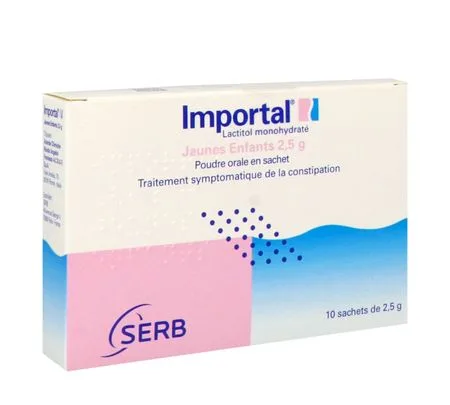
Powder for oral solution at 10 g (white to off-white): Sachets, box of 20.Oral powder at 5 g and 2,5 g (white to off-white): Sachets, boxes of 10.
Composition
| per sachet | |
| Lactitol (INN) monohydrate
|
10 g |
| or | 5 g |
| or | 2,5 g |
Indications
- Importal 10 g, powder for oral solution:
- Symptomatic treatment of constipation.
- Hepatic encephalopathy.
- Importal 5 g and 2,5 g oral powder:
- Symptomatic treatment of constipation.
Dosage and administration
Importal 10 g, powder for oral solution:
Dosage
- Constipation:
- The dosage must be adapted to each subject according to the results obtained.
- If diarrhoea occurs, reduce the dosage.
-
It is on average:
- Adults: 2 sachets per day, in a single dose.
- Adults: 2 sachets per day, in a single dose.
- Paediatric population:
-
- Children aged 7 to 14 years: 1 sachet per day.
- Children aged 7 to 14 years: 1 sachet per day.
- Hepatic encephalopathy:
- In all cases, the ideal dose is the one that leads to two soft stools per day.
-
The duration of treatment varies depending on the symptoms:
- Initial treatment via gastric tube or enema in case of coma or precoma: 4 to 8 sachets diluted in water;
- Relay treatment: 1 to 2 sachets 3 times per day.
- Initial treatment via gastric tube or enema in case of coma or precoma: 4 to 8 sachets diluted in water;
Method of administration:
Oral use.
This medicine may be taken diluted in a drink (water-infusion) or mixed with food (yogurt).
The daily dose must be administered in a single intake.
Rectal route.
This medicine must be dissolved in water.
To obtain the 40 % solution:- dissolve 200 g of product in 200 mL of hot distilled water while stirring constantly;
- after dissolution, add 168 mL of cold distilled water.
This solution may be administered, in case of acute crisis, at a dose of 1 to 2 mL/kg/day (i.e. 0,4 to 0,8 g/kg/day).
Solutions prepared under sterile conditions may be stored for 4 to 6 weeks in the refrigerator, otherwise they must be used immediately.
Importal 5 g and 2,5 g, oral powder:
Dosage
Paediatric population:
The dosage must be adapted to each subject according to the results obtained.
The daily dose must be administered in a single intake.
- Importal 5 g, oral powder:
-
The dosage is on average:
- Children aged 1 to 6 years: 1 sachet per day.
- Children aged 7 to 14 years: 2 sachets per day, in a single intake.
- Children aged 1 to 6 years: 1 sachet per day.
- Importal 2,5 g, oral powder:
-
The dosage is on average:
- Infants aged 0 to 12 months: 1 sachet per day.
- Children aged 1 to 6 years: 2 sachets per day, in a single intake.
- Children aged 7 to 14 years: 4 sachets per day, in a single intake.
- Infants aged 0 to 12 months: 1 sachet per day.
Method of administration:
Oral use.
The sachets must be dissolved in a drink or mixed with food.
Contraindications
- Hypersensitivity to the active substance or to any of the excipients listed in section Composition.
- Inflammatory bowel disease (ulcerative colitis, Crohn's disease).
- Obstructive or subobstructive syndrome.
- Digestive perforation or suspicion of perforation.
- Abdominal painful syndromes of undetermined cause.
- Galactose-free diet due to the presence in the powder of this related sugar (8 %):
- in breastfed infants;
- in children with a hereditary autosomal recessive fructose intolerance;
- in cases of galactosemia (incomplete metabolism of lactitol may lead to the development of fructosemia and galactosemia with sequelae).
- in breastfed infants;
- Pre-existing fluid and electrolyte imbalance.
Warnings and precautions
Prolonged use in the treatment of constipation is not recommended.
Drug treatment of constipation is only an adjunct to dietary and hygiene treatment:- enrichment of the diet with vegetable fibers and beverages;
- Advice on physical activity and rehabilitation of evacuation.
Paediatric population: in infants and young children, the use of Importal is possible on medical recommendation.
The use of Importal is not recommended in patients with fructose or galactose intolerance, galactosemia, glucose-galactose malabsorption syndrome, or lactase deficiency.
Diarrhea that may be induced by Importal may lead to disturbances of fluid and electrolyte balance; this medicine should therefore be used with caution in patients prone to fluid and electrolyte disturbances.
Interactions
Drug interactionsLaxatives should not be taken at the same time as other medicines: after taking a medicine, wait at least 2 hours before taking a laxative.
Fertility, pregnancy and breastfeeding
Pregnancy
There is no reliable data on teratogenicity in animals.
There are currently no relevant or sufficient data to assess a possible malformative or fetotoxic effect of lactitol when administered during pregnancy.
However, given the absence of absorption, no effect is expected during pregnancy, so Importal may be used during pregnancy.
Breast-feeding
Given the absence of absorption, no effect is expected during breastfeeding, so Importal may be used during breastfeeding.
Driving and using machines
Importal has no known influence on the ability to drive vehicles and use machines.Adverse effects
At the start of treatment, Importal may cause abdominal discomfort, such as flatulence and, although rarely, abdominal pain or sometimes a feeling of bloating. Such effects tend to decrease or disappear after a few days of treatment with Importal.
Due to inter-individual differences, some patients, even when taking the recommended dose, may experience diarrhea. A reduction in dosage will resolve this problem.
The following adverse effects have been reported during clinical trials and confirmed by spontaneous reports. Adverse effects are classified by frequency and by organ class.
Frequency is defined by the following convention: very common (≥ 1/10), common (≥ 1/100, < 1/10), uncommon (≥ 1/1 000, < 1/100), rare (≥ 1/10 000, < 1/1 000), very rare (< 1/10 000), frequency not known (cannot be estimated from the available data).
| System organ class | |
| Frequency | Adverse effects |
| Gastrointestinal disorders | |
| Rare | Abdominal pain, bloating, diarrhea, flatulence, vomiting |
| Very rare | Nausea, abnormal gastrointestinal sounds, anal pruritus |
Reporting suspected adverse reactions after authorisation of the medicinal product is important. It allows continuous monitoring of the benefit/risk balance of the medicinal product. Healthcare professionals should report any suspected adverse reaction via the national reporting system: National Agency for the Safety of Medicines and Health Products (ANSM) and the network of Regional Pharmacovigilance Centres. Website: https://signalement.social-sante.gouv.fr.
Overdose
- Symptoms:
- Diarrhea and abdominal pain.
- Treatment:
- Discontinuation of therapy or dose reduction.
- Correction of possible fluid and electrolyte disorders in cases of significant fluid loss secondary to diarrhoea.
Pharmacodynamics
Pharmacotherapeutic class: osmotic laxative, hypoammonaemic agent (ATC code: A06AD12; A: alimentary tract and metabolism).
Mechanism of action
- Lactitol causes an increase in osmotic pressure, promoting hydration of the stools and an increase in intestinal peristalsis.
- In the colon, the conversion of lactitol into organic acids lowers the pH of the colonic contents, thereby reducing the absorption of ammonia.
Pharmacokinetics
Absorption
Lactitol, a synthetic disaccharide, passes through the upper parts of the digestive tract unchanged and without absorption.
Elimination
In the colon, under the action of the local saccharolytic flora, it is converted into organic acids (lactic and acetic) which are eliminated in the stools.
Storage conditions
- Shelf life
-
- Importal 10 g and 5 g: 5 years.
- Importal 2,5 g: 3 years.
- Importal 10 g and 5 g: 5 years.
Store in the original packaging, protected from moisture.
HANDLING/DISPOSAL INSTRUCTIONS
No special requirements for disposal.
Any unused medicinal product or waste material should be disposed of in accordance with local requirements.
Prescription, supply and reimbursement
| Marketing authorisation (AMM) | 3400933069988 (1988, SmPC rev 28.05.2024) 10 g. |
| 3400933586478 (1992, SmPC rev 28.05.2024) 5 g. | |
| 3400933586539 (1992, SmPC rev 28.05.2024) 2,5 g. |
| Price: | 3,09 euros (20 sachets of 10 g). |
| 1,69 euros (10 sachets of 5 g). | |
| 1,69 euros (10 sachets of 2,5 g). | |
| Social Security reimbursement at 30%. Collect. | |
Marketing authorisation holder: Angelini Pharma SpA, Viale Amelia 70, 00181 Rome, Italy.
Operator:
SERB
40, avenue George-V. 75008 Paris
Tel: 01 73 03 20 00
www.serb.eu
Source: VIDAL · Updated on 10/11/2026. This information does not replace advice from a healthcare professional.