
Medicines
Update of 21/07/2026
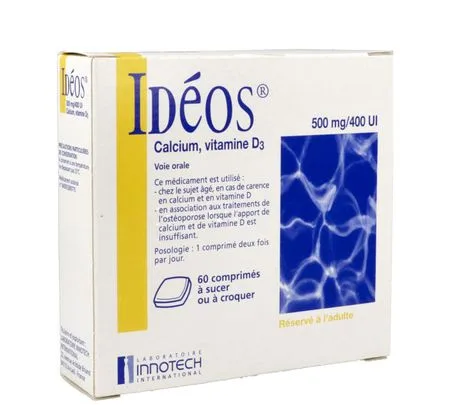
IDEOS®
calcium, cholecalciferol
Forms and presentations
Sucking or chewable tablet at 500 mg/400 IU (grey-white, square): Tube* of 15, boxes of 2 and of 4.* Closed by a stopper (polypropylene) containing a desiccant (silica gel).
Composition
| per tablet | |
| Calcium
|
500 mg |
| (in the form of calcium carbonate: 1 250 mg) | |
| Cholecalciferol (vitamin D3)
|
400 IU |
| (in the form of cholecalciferol concentrate powder(a) : 4 mg) | |
Excipients: xylitol, sorbitol (E420), povidone, lemon flavouring(b), magnesium stearate.
(a) Excipients of the cholecalciferol concentrate powder: alpha-tocopherol, hydrogenated soybean oil, gelatin, sucrose, silicon dioxide, corn starch.(b) Composition of the lemon flavouring: flavouring preparations, natural flavouring substances, maltodextrin, gum arabic, sodium citrate, citric acid, butylated hydroxyanisole.
Excipients with known effect: each tablet contains 475,0 mg of sorbitol (E420), 1,53 mg of sucrose, and 0,3 mg of hydrogenated soybean oil.
Indications
IDEOS is indicated only in adults- For the correction of combined Vitamin D-Calcium deficiencies in elderly subjects.
- As a Vitamin D-Calcium supplement associated with specific treatments of osteoporosis in patients who are deficient or at high risk of combined Vitamin D-Calcium deficiency.
Dosage and administration
Dosage
Adults
1 tablet twice a day.
Paediatric population
There is no justified use of IDEOS in the paediatric population.
Method of administration
Oral use.
The tablets are to be dissolved or chewed.
Contraindications
- Hypersensitivity to the active substances or to any of the excipients listed in section Composition.
- This product contains hydrogenated soybean oil. Patients must not take this medicine if they are allergic to peanuts or soy.
- Hypercalcaemia, hypercalciuria, pathologies and/or conditions that may lead to hypercalcaemia and/or hypercalciuria (e.g. myeloma, bone metastases, primary hyperparathyroidism).
- Renal lithiasis, nephrocalcinosis.
- Severe renal insufficiency (glomerular filtration rate < 30 ml/min). In patients with severe renal insufficiency, vitamin D3 in the form of cholecalciferol is not metabolised by the normal pathway and other forms of vitamin D3 must be used.
- Hypervitaminosis D.
Warnings and precautions
- This medicine must be prescribed with caution in patients with sarcoidosis due to the possible increase in vitamin D metabolism to its active form. In these patients, serum calcium and urinary calcium must be monitored.
- This medicine must be used with caution in patients with renal insufficiency (glomerular filtration rate ≥ 30 ml/min) with monitoring of the calcium-phosphorus balance. The risk of soft tissue calcification must be taken into consideration.
- Calcium and antacid intake from other sources (food, dietary supplements and other medicines) must be taken into account when prescribing IDEOS. Burnett syndrome, or milk-alkali syndrome (hypercalcaemia, metabolic alkalosis, renal insufficiency and soft tissue calcification), may occur with ingestion of large quantities of calcium and antacids (such as carbonates). In this case, frequent monitoring of serum calcium and urinary calcium may be necessary.
- In cases of prolonged immobilisation accompanied by hypercalciuria and/or hypercalcaemia, vitamin D-calcium treatment should only be used when mobilisation is resumed (see Contraindications).
- In cases of long-term treatment, it is justified to monitor serum calcium, urinary calcium and renal function (creatinine clearance). It is advised to reduce or temporarily interrupt treatment if urinary calcium exceeds 7,5 mmol/24 h (300 mg/24 h). This monitoring is particularly important in elderly subjects, in cases of concomitant treatment with cardiac glycosides or thiazide diuretics (see Interactions) and in patients frequently prone to renal calculi. In cases of hypercalcaemia or renal function problems, the dose must be reduced or treatment discontinued.
- Additional administration of vitamin D or calcium must be carried out under strict medical supervision. In this case, weekly monitoring of serum calcium and urinary calcium is absolutely necessary.
Excipients:
- IDEOS contains sorbitol (E420). Patients with hereditary fructose intolerance (HFI) must not take this medicine.
- IDEOS contains sucrose (sucrose is present in small quantities in the cholecalciferol concentrate). Patients with fructose intolerance, glucose-galactose malabsorption syndrome or sucrase-isomaltase deficiency (rare hereditary diseases) must not take this medicine. Sucrose may be harmful to the teeth if the medicine is to be taken over a prolonged period, for example for two weeks or more.
Interactions
Associations requiring precautions for use
+ Digoxin
Risk of serious rhythm disorders. Clinical monitoring and, where appropriate, ECG and serum calcium monitoring.
+ Bisphosphonates
Risk of reduced digestive absorption of bisphosphonates. It is advised to take calcium salts at a distance from bisphosphonates (an interval of at least thirty minutes to more than two hours).
+ Strontium
Reduced digestive absorption of strontium when administered concomitantly with products containing calcium. It is advised to take calcium at an interval of more than two hours from medicines containing strontium.
+ Oral tetracyclines
Possible decrease in tetracycline absorption. It is advised to take calcium salts at least two hours apart from tetracyclines.
+ Rifampicin
Possible decrease in vitamin D concentrations. Vitamin D concentrations should be monitored and supplementation should be offered if necessary.
+ Ciprofloxacin, norfloxacin
Risk of decreased digestive absorption of these fluoroquinolones. It is advised to take calcium more than two hours apart from ciprofloxacin or norfloxacin.
+ Dolutegravir
Risk of decreased digestive absorption of dolutegravir. It is advised to take calcium at least two hours after or six hours before taking dolutegravir.
+ Iron salts
Risk of decreased digestive absorption of iron salts. It is advised to maintain an interval of more than two hours between taking calcium and taking iron salts.
+ Zinc
Risk of decreased digestive absorption of zinc. It is advised to maintain an interval of more than two hours between taking calcium and taking zinc.
+ Estramustine
Risk of decreased digestive absorption of estramustine. It is advised to maintain an interval of more than two hours between taking calcium and taking estramustine.
+ Thyroid hormones
Risk of decreased digestive absorption of thyroid hormones. It is advised to maintain an interval of more than two hours between taking calcium and taking thyroid hormones.
+ Enzyme-inducing anticonvulsants (carbamazepine, fosphenytoin, phenobarbital, phenytoin and primidone)
Possible decrease in vitamin D concentrations. Vitamin D concentrations should be monitored and supplementation should be offered if necessary.
Associations to be taken into account
+ Orlistat
Treatment with orlistat may potentially impair the absorption of vitamin D.
+ Thiazide diuretics
Risk of hypercalcemia due to decreased urinary elimination of calcium.
+ Food
Possibility of interactions with foods containing oxalic acid (spinach, rhubarb, sorrel, cocoa, tea, etc.), phosphates (cold cuts, ham, sausages, processed cheeses, dessert creams, cola drinks...) or phytic acid (whole grains, dried vegetables, oilseeds, chocolate...). For this reason, it is recommended to take meals containing this type of food shortly before or shortly after ingesting the product.
Fertility, pregnancy and breastfeeding
Pregnancy
In case of calcium and vitamin D deficiency, the recommended dose depends on national recommendations; however, IDEOS may be used during pregnancy in case of confirmed calcium and vitamin D deficiency3. During pregnancy, the daily dose must not exceed 2 000 mg of calcium and 4 000 IU of vitamin D3. The treating physician must determine the recommended dose (see section Warnings and precautions).
Animal studies have shown reproductive toxicity at high doses of vitamin D (see section Preclinical safety). In pregnant women, calcium and vitamin D overdose must be avoided, as prolonged hypercalcaemia may lead to mental and physical retardation, supravalvular aortic stenosis and retinopathy in the child. There is no data indicating that vitamin D at therapeutic doses is teratogenic in humans.
Breast-feeding
IDEOS may be administered during breastfeeding. Calcium and vitamin D3 pass into breast milk. This must be taken into consideration in case of concomitant administration of vitamin D to the child.
A decision must be made either to discontinue breastfeeding or to discontinue or adjust treatment with IDEOS, taking into account the benefit of breastfeeding for the child against the benefit of the treatment for the woman.
Fertility
No data are available on the effect of IDEOS on fertility. However, normal endogenous levels of calcium and vitamin D should not have undesirable effects on fertility.
Driving and using machines
IDEOS has no or negligible effect on the ability to drive vehicles and use machines.Adverse effects
Adverse effects are presented below, by system organ class and by frequency. The frequency of occurrence of adverse effects is defined according to the following convention: very common (≥ 1/10), common (≥ 1/100, < 1/10), uncommon (≥ 1/1 000, < 1/100), rare (≥ 1/10 000, < 1/1 000), very rare (< 1/10 000) and frequency not known (cannot be estimated from the available data).
Immune system disorders
Frequency not known: Hypersensitivity reactions such as angioedema (Quincke's edema) or laryngeal edema.
Metabolism and nutrition disorders
Uncommon: hypercalcemia and hypercalciuria.
Frequency not known: Milk-alkali syndrome (hypercalcemia, metabolic alkalosis and renal failure). This syndrome generally occurs only in cases of overdose (see Warnings and Precautions for UseOverdose).
Gastrointestinal disorders
Rare: constipation, flatulence, nausea, abdominal pain, diarrhea.
Skin and subcutaneous tissue disorders
Rare: pruritus, rash and urticaria.
Reporting of suspected adverse reactions:Reporting suspected adverse reactions after authorisation of the medicinal product is important. It allows continuous monitoring of the benefit/risk balance of the medicinal product. Healthcare professionals should report any suspected adverse reaction via the national reporting system: National Agency for the Safety of Medicines and Health Products (ANSM) and the network of Regional Pharmacovigilance Centres. Website: https://signalement.social-sante.gouv.fr.
Overdose
Overdose may result in hypervitaminosis and hypercalcemia.
Symptoms:
Symptoms of hypercalcemia are as follows: anorexia, thirst, nausea, vomiting, constipation, abdominal pain, muscle weakness, fatigue, hypertension, mental disorders, polydipsia, polyuria, musculoskeletal pain, renal calcinosis, kidney stones and, in more severe cases, cardiac arrhythmia. Severe hypercalcemia may lead to coma and death. Persistently elevated calcium levels may cause irreversible kidney damage and calcification of soft tissues.
The risk of overdose may be increased if other products containing calcium or alkaline agents are taken concomitantly (milk-alkali syndrome). See sections Warnings and precautionsAdverse effects.
Treatment of hypercalcemia:
Discontinuation of all calcium-vitamin D treatment3. The need to continue any other concomitant medicinal products should be reconsidered by the physician. Gastric lavage should be performed in patients with impaired consciousness. Rehydration and, depending on severity, treatment with or without diuretics, bisphosphonates, calcitonin and corticosteroids should be considered. Peritoneal dialysis should be considered in patients with renal failure or in patients refractory to other therapies. Blood electrolytes, renal function and diuresis should be monitored. In more severe cases, an ECG and monitoring of serum calcium are necessary.
Pharmacodynamics
Pharmacotherapeutic class: Calcium in combination with vitamin D and/or other substances, ATC code: A12AX.
Vitamin D corrects inadequate vitamin D intake.
It increases intestinal absorption of calcium and its fixation to bone tissue.
Calcium supplementation compensates for insufficient dietary calcium intake.
Optimal intakes in elderly people are estimated at 1500 mg/day of calcium and 500-1000 IU/day of vitamin D.
Vitamin D and calcium correct secondary senile hyperparathyroidism.
Pharmacokinetics
Calcium carbonate
In the gastric environment, calcium carbonate releases the calcium ion, depending on pH.
Calcium is mainly absorbed in the upper part of the small intestine.
The rate of absorption via the gastrointestinal route is of the order of 30 percent of the ingested dose.
Calcium is eliminated through sweat and gastrointestinal secretions.
Urinary calcium depends on glomerular filtration and the rate of tubular calcium reabsorption.
Vitamin D3
Vitamin D3 is absorbed in the intestine and transported by protein binding in the blood to the liver (first hydroxylation) and to the kidney (second hydroxylation).
Vitamin D3 non-hydroxylated is stored in reserve compartments such as adipose and muscle tissues.
Its plasma half-life is in the order of a few days. It is eliminated in feces and urine.
Preclinical safety
In acute toxicity studies, calcium was very weakly toxic by oral route in mice and rats (LD50 = 6450 mg/kg body weight).
For calcium carbonate, no genotoxic properties were observed in several in vitro tests, and neither carcinogenic potential nor reproductive toxicity potential has been described in dedicated studies.
Acute toxicity studies with vitamin D3 essentially showed that vitamin D3 at doses well above the human therapeutic dose (on the order of 10 mg/kg body weight) in dogs and rabbits by oral route, had toxic effects (multisystem failure), such as cardiac effects in rats.
In repeated-dose toxicity studies with vitamin D3, significant toxicological effects were only observed at doses or exposures far above the maximum dose or exposure in humans, indicating that these effects are limited or not relevant for clinical use. Among these effects can be cited: the possible induction of focal adrenal medullary proliferative lesions observed in rats fed for up to 6 months with vitamin D3.
In carcinogenicity studies, vitamin D3 induced a biphasic growth response: induction of proliferation of malignant cell lines at low doses and inhibition of proliferation of these lines at higher doses (reduction of cancer growth).
At very high doses, vitamin D3 was shown to be teratogenic in rabbits (at doses 4 to 15 times higher than the recommended therapeutic dose in humans) and it induced a change in sexual behaviour in juvenile rats treated at birth.
These data show that the non-clinical data with calcium and/or vitamin D3 reveal no specific risk for humans
Storage conditions
Shelf life 3 years.
Store at a temperature not exceeding 25 °C.
HANDLING/DISPOSAL INSTRUCTIONS
No special requirements.
Prescription, supply and reimbursement
| Marketing authorisation (AMM) | 3400933809607 (1994, SmPC rev 10.06.2026) 30 tablets - not marketed in France. |
| 3400933809775 (1994, SmPC rev 10.06.2026) 60 tablets - marketed in France. |
| Price: | 5,29 euros (60 tablets). |
| Reimbursed by Social Security at 65 %. Collective. | |
LABORATOIRE INNOTECH INTERNATIONAL
22, av Aristide-Briand. 94110 Arcueil
Tel: 01 46 15 29 00. Fax: 01 45 46 40 15
Pharmacovigilance and Medical Information:
Fax: 01 46 15 18 28
E-mail: information.vigilance@innothera.com
Source: VIDAL · Updated on 10/11/2026. This information does not replace advice from a healthcare professional.