
Medicines
SmPC of 15/12/2023
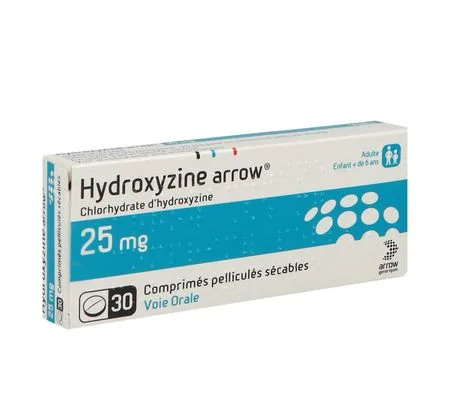
HYDROXYZINE ARROW 25 mg, film-coated scored tablet
Forms and presentations
Film-coated scored tablet, white to off-white, oblong and biconvex with a score line on both faces.
The tablet can be divided into equal doses.
Composition
Hydroxyzine hydrochloride.........................................................................................................................25 mg
For a scored film-coated tablet
Excipient with known effect: each tablet contains 69,80 mg of lactose.
Anhydrous lactose, microcrystalline cellulose, colloidal anhydrous silica, magnesium stearate.
Film coating
OPADRY white OY-58900: hypromellose, macrogol 400, titanium dioxide (E171).
Indications
• Minor manifestations of anxiety in adults.
• Premedication for general anaesthesia.
• Symptomatic treatment of pruritus.
• In children older than 6 years, second-line treatment of sleep-onset insomnia associated with a state of hyperarousal (increased vigilance linked to anxious manifestations at bedtime), after failure of behavioural measures alone.
Dosage and administration
The tablet is not a suitable form for children younger than 6 years (risk of choking).
Oral use.
Dosage
HYDROXYZINE ARROW must be taken at the lowest effective dose and for the shortest possible duration of treatment.
Adults
• Minor manifestations of anxiety: 50 mg/day in 3 separate doses of 12,5 mg - 12,5 mg - 25 mg. For more severe cases, doses of up to 100 mg/day may be used.
• Symptomatic treatment of pruritus: an initial dose of 25 mg at bedtime, followed if necessary by doses of up to 25 mg, 3 to 4 times a day.
• Premedication for general anaesthesia: 100 mg in adults.
In adults, the maximum daily dose is 100 mg.
Elderly subject
It is recommended to initiate treatment with half of the recommended dose because of the prolonged effect. The lowest possible dose should be chosen when treating elderly people.
The maximum daily dose is 50 mg (see section Warnings and precautions).
Hepatic impairment
It is recommended to reduce the dose by half.
Renal insufficiency
No dose adjustment is necessary in patients whose renal function is slightly decreased (glomerular filtration rate (GFR) 60 - < 90 mL/min).
The prescriber should adjust the dose according to the individual patient response for patients with moderately decreased renal function (GFR 30 - 60 mL/min) because the available data are limited to recommend a specific dose adjustment.
A dose adjustment to 50 % is recommended in patients with severely decreased renal function (GFR < 30 mL/min not requiring dialysis).
Hydroxyzine is contraindicated in patients with end-stage renal disease (ESRD) (GFR <15 mL/min requiring dialysis).
Paediatric population
• In sleep-onset insomnia in children over 6 years: the suggested dosage, for guidance, is 1 mg/kg/day, and treatment will be of short duration (2 weeks maximum).
• For symptomatic treatment of pruritus: in children aged 6 years and over: 1 mg/kg/day up to 2 mg/kg/day in divided doses.
• In other indications in children aged 6 years to 15 years: the recommended dose is 1 mg/kg/day.
In children up to 40 kg, the maximum daily dose is 2 mg/kg/day.
In children weighing more than 40 kg, the maximum daily dose is 100 mg.
Contraindications
• Hypersensitivity to the active substance or to any of the excipients listed in section Composition, to one of its metabolites, to another piperazine derivative, to aminophylline, or to ethylenediamine;
• Related to anticholinergic effect:
- risk of angle-closure glaucoma,
- risk of urinary retention related to urethro-prostatic disorder;
• Patients suffering from porphyria;
• Patients with known acquired or congenital QT interval prolongation;
• Patients with known risk factors for QT interval prolongation, including known cardiovascular disease, significant electrolyte disturbances (hypokalaemia, hypomagnesaemia), a family history of sudden cardiac death, significant bradycardia, and concomitant treatment with a medicine known to prolong the QT interval and/or likely to induce torsades de pointes (see sections Warnings and precautions and Interactions) ;
• Patients with end-stage renal disease with a GFR (glomerular filtration rate) below 15 mL/min.
Warnings and precautions
Special warnings
QT interval prolongation
Hydroxyzine is associated with QT interval prolongation on the electrocardiogram. During post-marketing surveillance, cases of QT interval prolongation and torsades de pointes have been reported in patients taking hydroxyzine. Most of these patients had other risk factors, electrolyte abnormalities and concomitant treatment that may have contributed (see section Adverse effects).
Hydroxyzine should be used at the lowest effective dose and for the shortest possible duration of treatment.
Treatment with hydroxyzine must be discontinued if signs or symptoms that may be associated with cardiac arrhythmia occur, and patients must immediately consult a physician.
Patients should be informed of the need to promptly report any cardiac symptoms.
Elderly patients
Hydroxyzine is not recommended in elderly patients due to decreased elimination of hydroxyzine in this population compared with the adult population and the higher risk of adverse effects (for example anticholinergic effects) (see sections Dosage and administration and Adverse effects).
It is recommended to initiate treatment with half the recommended dose due to the prolonged effect (see section Dosage and administration).
Patients should be advised against drinking alcoholic beverages during treatment.
Paediatric population
In the treatment of sleep-onset insomnia in children:
• hydroxyzine is not an appropriate treatment for insomnia of neurological cause, certain insomnias of organic origin (obstructive sleep apnoea syndrome - OSAS - in children, gastro-oesophageal reflux - GOR -, ENT infection, …), and insomnias of psychiatric origin;
• in case of impaired alertness the morning after a dose, hydroxyzine treatment should be discontinued;
• in the absence of a therapeutic response to a well-conducted drug treatment, specialist advice is recommended.
Precautions for use
Hydroxyzine is not an appropriate treatment for insomnia of neurological cause, certain insomnias of organic origin (see section "Special warnings"), and insomnias of psychiatric origin. The following main clinical signs, suggestive of an organic cause, should therefore be sought before any prescription of hydroxyzine in a child presenting with sleep disorders:
• loud snoring, feeding disorders, abnormal regurgitation;
• prolonged night-time awakenings (longer than 15 minutes), or awakenings beginning in the first part of the night, restless sleep between awakenings, inconsolable crying;
• daytime fatigue, unexpected naps, excessive activity, or behavioural disorders;
• growth and weight delay or break in the weight curve, or abnormal neurological or psychomotor examination.
This medicine should be used with caution:
• in young children, who are particularly sensitive to effects on the central nervous system (including convulsions);
• in cases of severe hepatic and/or renal impairment, due to the risk of accumulation (see section Dosage and administration).
Furthermore, administration of HYDROXYZINE ARROW is not recommended in patients with cognitive disorders or confusional syndrome, due to the risk of worsening linked to the pharmacodynamic properties of the product.
Because of its potential anticholinergic effects, hydroxyzine should be used with caution in patients suffering from glaucoma, urinary retention, decreased gastrointestinal motility, myasthenia gravis, or dementia.
Treatment must be discontinued at least 5 days (7 days in elderly subjects) before performing an allergy test or a methacholine bronchial provocation test, in order to avoid an effect on the test result.
Excipient with known effect
This medicine contains lactose. Patients with galactose intolerance, total lactase deficiency or glucose-galactose malabsorption syndrome (rare hereditary diseases) must not take this medicine.
Interactions
Contraindicated combinations
Co-administration of hydroxyzine with medicines known to prolong the QT interval and/or induce torsades de pointes, such as class IA antiarrhythmics (e.g. quinidine, disopyramide) and class III antiarrhythmics (e.g. amiodarone, sotalol), certain antihistamines, certain antipsychotics (e.g. haloperidol), certain antidepressants (e.g. citalopram and escitalopram), certain antimalarials (e.g. mefloquine and hydroxychloroquine), certain antibiotics (e.g. erythromycin, levofloxacin, moxifloxacin), certain antifungals (e.g. pentamidine), certain gastrointestinal medicines (e.g. prucalopride), certain anticancer medicines (e.g. toremifene, vandetanib) and methadone, increase the risk of cardiac arrhythmia. Therefore, these combinations are contraindicated (see section Contraindications).
Combinations not recommended
Alcohol
Alcohol increases the sedative effect of H1 antihistamines. Impaired alertness may make driving vehicles and using machinery dangerous.
Avoid taking alcoholic beverages and medicines containing alcohol.
Associations subject to Precautions for use
Medicines liable to induce bradycardia and hypokalaemia.
Hydroxyzine is metabolised by alcohol dehydrogenase and CYP3A4/5, and an increase in blood concentration of hydroxyzine may be expected when hydroxyzine is co-administered with medicines known to be potent inhibitors of these enzymes.
Associations to be taken into account
Other central nervous system depressants
Morphine derivatives (analgesics, antitussives and substitution treatments), benzodiazepines, anxiolytics other than benzodiazepines, barbiturates, hypnotics, neuroleptics, sedative antidepressants, centrally acting antihypertensives, baclofen, thalidomide.
Increased central depression. Impaired alertness may make driving a vehicle and operating machinery dangerous.
Atropine and other anticholinergic substances
Imipramine-type antidepressants, anticholinergic antiparkinsonian agents, atropine-like antispasmodics, disopyramide, phenothiazine neuroleptics.
Additive atropinic undesirable effects of the urinary retention, constipation, dry mouth type.
Fertility, pregnancy and breastfeeding
Pregnancy
Studies carried out in animals have demonstrated a teratogenic effect.
In clinical practice, analysis of a large number of exposed pregnancies apparently revealed no particular malformative effect of hydroxyzine. However, only epidemiological studies would make it possible to verify the absence of risk.
Consequently, the use of hydroxyzine should be considered during the first trimester of pregnancy only if necessary.
In newborns whose mothers took hydroxyzine at the end of pregnancy and/or during delivery, the following effects were observed immediately or a few hours after birth: hypotonia, abnormal movements including extrapyramidal disorders, clonic movements, CNS depression, hypoxic disorders, urinary retention.
Breast-feeding
In the absence of data on the passage of hydroxyzine into breast milk, and given the sedative and atropine-like properties of this substance, breastfeeding is not recommended during treatment with hydroxyzine.
Driving and using machines
HYDROXYZINE ARROW may cause drowsiness. This should be taken into account in drivers of vehicles and users of machinery, in whom concomitant use with other sedative medicinal products is moreover not recommended. If sleep duration is insufficient, the risk of impaired alertness is further increased.
Adverse effects
The adverse effects of HYDROXYZINE ARROW are mainly related to its action on the central nervous system, its anticholinergic effects and the hypersensitivity reactions it may cause.
In controlled studies versus placebo, adverse events, regardless of causality, whose frequency was greater than or equal to 1 % during treatment per os with hydroxyzine were the following:
|
Undesirable events |
% of patients |
|
|
Hydroxyzine (N=735) |
Placebo (N=630) |
|
|
Somnolence |
13,74 |
2,70 |
|
Headache |
1,64 |
1,90 |
|
Fatigue |
1,36 |
0,63 |
|
Dry mouth |
1,22 |
0,63 |
The adverse effects reported since marketing are:
Skin reactions
• erythema, pruritus, maculopapular rash, eczema; very rarely: fixed pigmented erythema, acute generalised exanthematous pustulosis, bullous dermatoses including Stevens-Johnson syndrome/toxic epidermal necrolysis and/or Lyell syndrome, erythema multiforme.
Allergic manifestations
• urticaria; more rarely bronchospasm, Quincke's oedema, anaphylactoid reaction.
Psychiatric effects
• confusion; more rarely agitation, hallucinations, disorientation.
Neurological effects
• rarely convulsions, dyskinesias, loss of consciousness (syncope), tremor, vertigo, insomnia.
Ophthalmological effects
• accommodation disorders.
Cardiac effects
• tachycardia; frequency not known: ventricular arrhythmias (e.g. torsade de pointes), prolongation of the QT interval (see section Warnings and precautions).
Vascular effects
• hypotension.
Hepatobiliary disorders
• frequency not determined: hepatitis, increase in liver enzymes: transaminases, alkaline phosphatases, gamma-GT and bilirubin.
Gastrointestinal effects
• nausea, constipation, vomiting.
Urological effects
• urinary retention.
General disorders and administration site conditions
• malaise, pyrexia.
Investigations
• frequency not known: weight increase.
Reporting of suspected adverse reactions
Reporting suspected adverse reactions after authorisation of the medicinal product is important. It allows continued monitoring of the benefit/risk balance of the medicinal product. Healthcare professionals are asked to report any suspected adverse reaction via the national reporting system: National Agency for the Safety of Medicines and Health Products (ANSM) and the network of Regional Centres of Pharmacovigilance - Website: https://signalement.social-sante.gouv.fr/
Overdose
Symptoms observed in cases of major overdose include: nausea, vomiting, tachycardia, drowsiness, accommodation disorders, tremors, confusion, hallucinations and sometimes, disturbances of consciousness, even coma, respiratory depression, convulsions, hypotension, cardiac rhythm disorders including bradycardia, even cardiorespiratory arrest.
Polydrug intoxication should always be considered.
Monitoring of vital functions, in particular cardiac monitoring with an ECG recording, and, if necessary, symptomatic treatment should be implemented in a specialised setting.
Vomiting will be induced if it does not occur spontaneously. Immediate gastric lavage is also advised.
There is no specific antidote.
Pharmacodynamics
Pharmacotherapeutic class: anxiolytics, ATC code: NO5BB01
Hydroxyzine is a piperazine derivative chemically unrelated to phenothiazines and benzodiazepines.
Mechanism of action
Hydroxyzine is an antihistamine that antagonises H1 central and peripheral receptors with anticholinergic properties.
Clinical efficacy and safety
Hydroxyzine has shown its efficacy in humans in urticaria.
Hydroxyzine has a sedative effect demonstrated by EEG recordings in healthy volunteers.
Hydroxyzine has activity on minor symptoms of anxiety.
Pharmacokinetics
Absorption
Hydroxyzine is rapidly absorbed from the gastrointestinal tract. The plasma peak is reached approximately 2 hours after taking an oral form (syrup, tablet). After oral administration of 25 and 50 mg, the maximum plasma concentration (Cmax) is 30 and 70 ng/mL respectively. Concentrations are increased by approximately 30% after repeated administration.
Distribution
Hydroxyzine has a wide distribution with an apparent volume of distribution of approximately 16 L/kg in adults. Hydroxyzine diffuses into the skin and crosses the blood-brain barrier.
Biotransformation
Hydroxyzine undergoes a significant hepatic first-pass effect.
Hydroxyzine is extensively metabolised, by oxidation, into various metabolites including cetirizine, an active metabolite. Other metabolites that have been identified include, in particular, O- or N-dealkylated derivatives.
Elimination
Total clearance is 10 mL/min/kg in healthy subjects and 32 mL/min/kg in children. According to studies, the elimination half-life of hydroxyzine is approximately 13 to 20 hours in adults, and 29 hours in elderly subjects, explaining the need for dose adjustment in the latter.
Special populations
Paediatric population
In children, the pharmacokinetics of hydroxyzine change during development: the elimination half-life is approximately 4 hours at 1 year, and approximately 11 hours at 14 years.
Therefore, dose adjustment is necessary in children.
Hepatic impairment
In patients with hepatic impairment, the elimination half-life of hydroxyzine is increased to approximately 37 hours.
In patients with renal impairment, the elimination half-life of hydroxyzine is little changed, but the renal clearance of cetirizine is markedly slowed.
Dose adjustment is therefore necessary in cases of severe hepatic or renal impairment.
Preclinical safety
Animal reproduction studies have shown a teratogenic effect at doses higher than the therapeutic doses in humans.
Preclinical data show no particular risk for humans based on single-dose and repeated-dose toxicity studies.
The AMES test revealed no mutagenic effect.
Prescription, supply and reimbursement
Prescription duration limited to 84 day(s).
| Marketing authorisation (AMM) |
|
| Price: |
|
- Indication(s) appearing in the marketing authorisation at the date of publication of this decree
Collection.
26 AVENUE TONY GARNIER
69007 LYON
Tel: 04 72 72 60 72 Tel (toll-free): 0811 65 27 76
contact@laboratoire-arrow.com
http://www.laboratoire-arrow.com/
Source: VIDAL · Updated on 10/11/2026. This information does not replace advice from a healthcare professional.