
Medicines
Update of 03/03/2026
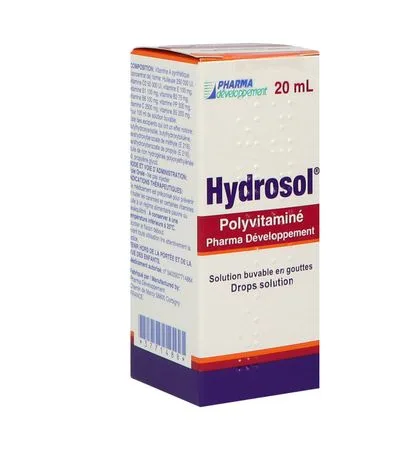
HYDROSOL POLYVITAMINÉ PHARMA DÉVELOPPEMENT
Forms and presentations
Oral solution: Dropper bottle of 20 ml (2 ml = 50 drops).Composition
| for 50 drops | |
| Retinol or synthetic vitamin A (concentrate of) - oily form*
|
5000 IU |
| Ergocalciferol or vitamin D2
|
1000 IU |
| Alpha-tocopherol acetate or vitamin E
|
2 mg |
| Thiamine hydrochloride or vitamin B1
|
2 mg |
| Pyridoxine hydrochloride or vitamin B6
|
2 mg |
| Riboflavin sodium phosphate or vitamin B2
|
1,50 mg |
| Nicotinamide or vitamin PP
|
10 mg |
| Ascorbic acid or vitamin C
|
50 mg |
| Dexpanthenol or vitamin B5
|
4 mg |
- 15 drops (0,6 ml) = 1500 IU of vitamin A and 300 IU of vitamin D.
- 20 drops (0,8 ml) = 2000 IU of vitamin A and 400 IU of vitamin D.
- 25 drops (1 ml) = 2500 IU of vitamin A and 500 IU of vitamin D.
Excipients with known effect: peanut oil (0,5 mg/ml), propylene glycol (E 1520) (200 mg/ml), polyoxyethylated hydrogenated castor oil 40 (Cremophor RH 40) (50 mg/ml), methyl parahydroxybenzoate (E 218) (1,35 mg/ml), propyl parahydroxybenzoate (E 216) (0,15 mg/ml).
* in the form of vitamin A palmitate stabilised with butylhydroxyanisole (9 mg/1 g) and butylhydroxytoluene (9 mg/1 g).Indications
Prevention or correction of disorders related to a deficient or unbalanced diet.Dosage and administration
Dosage- Adult, adolescent: 25 drops per day.
- Child aged 4 to 12 years: 20 drops per day.
- Child aged 1 to 3 years: 15 drops per day.
This product is not suitable for infants aged < 1 year.
Method of administration:
Oral use.
The drops may be diluted in water, milk or fruit juice, making sure that the entire quantity of liquid is consumed.
Contraindications
This medicine is contraindicated in cases of:- Hypersensitivity to the active substances or to any of the excipients listed in section Composition, in particular parabens.
- Lipid absorption disorders.
- Chronic malabsorption.
- Concomitant therapy interfering with the absorption of vitamin A.
- Hypercalcaemia, hypercalciuria, calcium lithiasis.
- Allergy to peanut oil or soya, due to the presence of peanut oil.
- In combination with levodopa (see Interactions).
- In combination with tetracyclines when intake of vitamin A is 10 000 IU/day and above (see Interactions).
Warnings and precautions
- To avoid any overdose, take into account the total doses of vitamin A and vitamin D when several treatments containing these vitamins are combined.
- Excessive consumption of vitamin B6 may cause peripheral neuropathy, which may occur after use of high doses and/or with prolonged use (several months or even years).
- In case of calcium intake, regular monitoring of urinary calcium excretion is essential.
This medicine contains peanut oil. If you are allergic to peanut or soya, do not use this medicine.
This medicine contains 200 mg/mL of propylene glycol.
This medicine contains polyoxyethylated castor oil 40 and may cause stomach upset and diarrhoea.
This medicine contains methyl parahydroxybenzoate and propyl parahydroxybenzoate and may cause allergic reactions (possibly delayed).
Interactions
Contraindicated combinations:
(linked to the presence of pyridoxine)
+ Levodopa
Inhibition of the activity of levodopa when used without a peripheral dopa-decarboxylase inhibitor.
Avoid any intake of pyridoxine in the absence of a dopa decarboxylase inhibitor.
(related to the presence of vitamin A)
+ Cyclines
If intake of 10 000 IU/day and more vitamin A: risk of intracranial hypertension.
Fertility, pregnancy and breastfeeding
Pregnancy:Vitamin A is teratogenic in animals across several species.
In humans, cases of malformations have been reported with high doses. However, to date, the absence of reliable epidemiological studies and the small number of isolated reports prevent a definitive conclusion on the reality of this malformation risk.
Consequently, given the daily dietary intake, it is recommended not to exceed a daily dose of 5000 IU of vitamin A provided by medicines.
Adverse effects
Any adverse effect may be a manifestation of overdose and must lead to discontinuation of treatment.
Reporting of suspected adverse reactions:Reporting suspected adverse reactions after authorisation of the medicinal product is important. It allows continuous monitoring of the benefit/risk balance of the medicinal product. Healthcare professionals should report any suspected adverse reaction via the national reporting system: National Agency for the Safety of Medicines and Health Products (ANSM) and the network of Regional Pharmacovigilance Centres. Website: https://signalement.social-sante.gouv.fr.
Overdose
The use of high doses and/or prolonged use of vitamin B6 (several months or even years) increases the risk of sensory neuropathy, reversible upon discontinuation of treatment (see section Warnings and precautions).
- Signs resulting from the administration of excessive doses of vitamin D or its metabolites:
-
- Clinical signs:
-
- headache, asthenia, anorexia, weight loss, growth arrest,
- nausea, vomiting,
- polyuria, polydipsia, dehydration,
- arterial hypertension,
- calcium lithiasis, tissue calcifications, particularly renal and vascular,
- renal insufficiency.
- headache, asthenia, anorexia, weight loss, growth arrest,
-
- Biological signs:
- Hypercalcaemia, hypercalciuria, hyperphosphataemia, hyperphosphaturia.
- Clinical signs resulting from the administration of excessive doses of vitamin A:
-
- Acute overdose (doses above 150 000 IU):
- Digestive disorders, headache, intracranial hypertension (manifesting in infants as bulging of the fontanelle), papilledema, psychiatric disorders, irritability, even convulsions, delayed generalised desquamation.
-
- Chronic overdose (risk of chronic intoxication with prolonged intake of vitamin A at supraphysiological doses in a non-deficient subject):
- Intracranial hypertension, cortical hyperostosis of long bones and premature epiphyseal fusion. Diagnosis is generally made on the finding of tender or painful subcutaneous swellings at the extremities of the limbs. Radiographs show diaphyseal periosteal thickening of the ulna, fibula, clavicles and ribs.
- Action to be taken:
- Discontinue administration of this medicine, reduce calcium intake, increase diuresis, abundant fluids.
Pharmacodynamics
Pharmacotherapeutic class: Vitamins (A: alimentary tract and metabolism), ATC code: A11BA.
Storage conditions
Shelf life 2 years.
Store at a temperature below 25 °C.
Prescription, supply and reimbursement
| Marketing authorisation (AMM) | 3400937714884 (1955/97, SmPC rev 19.01.2026). |
| Not reimbursed by Social Security. Collect. |
PHARMA DEVELOPPEMENT SA
Chemin de Marcy. 58800 Corbigny
Tel: 03 86 20 21 64
www.pharmadeveloppement.com
Source: VIDAL · Updated on 10/11/2026. This information does not replace advice from a healthcare professional.