Medicines
SmPC of the 08/06/2026
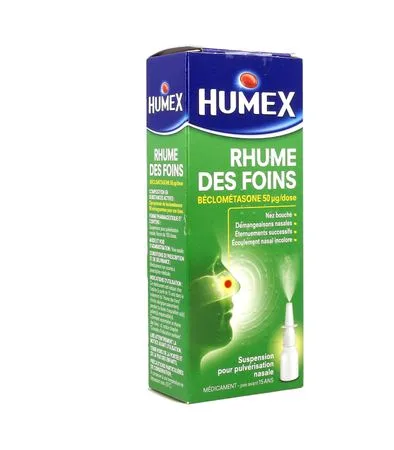
HUMEX HAY FEVER WITH BECLOMETASONE 50 micrograms/dose, nasal spray suspension in bottle
Composition
Beclometasone dipropionate........................................................................................... 50 micrograms..............
For one dose.
Excipient with known effect: benzalkonium chloride.
Glucose, microcrystalline cellulose, sodium carmellose, phenylethyl alcohol, polysorbate 80, benzalkonium chloride, purified water.
Indications
This medicine is indicated in adults (from 15 years of age) for the treatment of "hay fever" (seasonal allergic rhinitis) for the duration of exposure to the responsible pollen(s).
Dosage and administration
Dosage
RESERVED FOR ADULTS (FROM 15 YEARS OF AGE)
1 spray: 50 micrograms
The recommended dose is 400 micrograms per day, i.e. 1 spray in each nostril 4 times per day, spreading out the doses.
The initiation and duration of treatment depend on pollen exposure.
Method of administration
Nasal use.
Shake the bottle gently before use.
On first use or if the pump has not been used for several days, it is necessary to prime the pump and press the collar until a fine spray is obtained.
Contraindications
This medicine is contraindicated in cases of:
• known hypersensitivity to any of the constituents,
• haemostasis disorders, in particular nosebleeds,
• active or latent untreated pulmonary tuberculosis,
• untreated active peptic ulcer,
• oro-buccal-nasal and ophthalmic infection by herpes simplex virus.
Warnings and precautions
Special warnings
Systemic effects may appear during long-term treatment with high doses of nasal corticosteroids. The risk of systemic impact nevertheless remains lower than with oral corticosteroids and may vary depending on individual susceptibility and the composition of the corticosteroid product used. Possible systemic effects are Cushing's syndrome or Cushingoid symptoms, skin thinning, subcutaneous haematomas, adrenal insufficiency, growth retardation in children and adolescents, decreased bone density, cataract and glaucoma and, more rarely, psychological and behavioural disorders including psychomotor hyperactivity, sleep disorders, anxiety, depression or aggressiveness (particularly in children).
Concomitant administration of nasal corticosteroid in patients on oral corticosteroid therapy long-term does not dispense with the necessary precautions when reducing doses of oral corticosteroid. These will be reduced very gradually and withdrawal must be carried out under careful medical supervision (watching for the appearance of signs of acute or subacute adrenal insufficiency) extending beyond the discontinuation of systemic corticosteroid therapy.
The risk of systemic effects, adrenal suppression and impact on growth is increased in cases of concomitant administration of corticosteroid therapy by the inhaled route or, a fortiori, by the systemic route.
The occurrence of a concomitant bacterial, viral or fungal broncho-pulmonary infection requires discontinuation of the local corticosteroid therapy and initiation of an appropriate treatment.
Local intranasal administration of corticosteroids is not recommended in patients who have recently had an ulceration of the nasal septum, or who have undergone surgery or trauma to the nose, until healing is complete.
Precautions for use
Nasal patency should be ensured to allow optimal distribution of the product. Advise the patient to dry the nasal passages by blowing the nose before instillation.
In case of major nasal obstruction, a detailed examination of the ENT area should be performed.
It is necessary to warn the patient that the product is not a treatment for the attack and that a delay of a few days is necessary before its effects can be judged.
The patient is advised to seek medical advice:
• in the absence of improvement or in case of prolongation of hay fever symptoms outside the period of pollen exposure,
• in case of the appearance of other disorders suggestive of conjunctivitis or asthma.
Athletes should be made aware that this specialty contains an active substance that may induce a positive reaction in tests carried out during anti-doping controls.
Any opened bottle must be reserved for a single patient.
This medicine contains 22 µg of benzalkonium chloride per dose. Benzalkonium chloride may cause irritation or oedema of the nasal mucosa, particularly in the case of long-term use.
Fertility, pregnancy and breastfeeding
Animal studies have shown, as with all corticosteroids, a teratogenic effect that varies according to species.
In clinical practice, epidemiological studies have not demonstrated a malformative effect associated with the use of beclometasone during the first trimester of pregnancy.
Neonatal problems described with systemic corticosteroid therapy (intrauterine growth retardation, neonatal adrenal insufficiency) have not been reported to date following administration of corticosteroids by this route of administration.
Consequently, this medicine may be prescribed during pregnancy if needed.
Adverse effects
Local effects
• Possibility of drying and irritation of the nasal and throat mucosa, epistaxis, headache, unpleasant taste and smell.
• Hypersensitivity reactions have been reported (pruritus, skin rash, Quincke's oedema).
• Cases of nasal and pharyngeal Candida albicans infections have also been described during local corticosteroid treatment. In this case, nasal corticosteroid therapy should be discontinued and an appropriate treatment considered.
Rare cases of ocular hypertension have been reported with intranasally administered corticosteroids.
Systemic effects
The risk of systemic effects associated with beclometasone dipropionate administered nasally cannot be excluded (see section Warnings and precautions). This risk is increased in case of concomitant administration of inhaled corticosteroid therapy or a fortiori systemic corticosteroid therapy.
The risk of latent corticotropic insufficiency after prolonged administration should therefore be considered in cases of intercurrent infection, accident or surgical intervention.
Very rare frequency: cataract and glaucoma.
Reporting of suspected adverse reactions
Reporting suspected adverse reactions after authorisation of the medicinal product is important. It allows continued monitoring of the benefit/risk balance of the medicinal product. Healthcare professionals are asked to report any suspected adverse reaction via the national reporting system: National Agency for the Safety of Medicines and Health Products (ANSM) and the network of Regional Centres of Pharmacovigilance - Website: https://signalement.social-sante.gouv.fr/.
Overdose
It may only lead to hypothalamic-pituitary-adrenal suppression followed by clinical signs of hypercorticism. These symptoms will disappear after discontinuation of the treatment, which must be gradual.
Pharmacodynamics
Pharmacotherapeutic class: Corticosteroids, ATC code: R01AD01.
After nasal administration, beclometasone dipropionate has an anti-inflammatory activity on the nasal mucosa.
Beclometasone dipropionate exerts a local therapeutic effect at average daily doses of 400 micrograms in adults, whereas its suppressive effect on the hypothalamic-pituitary-adrenal axis via the nasal route only becomes apparent at doses equal to or greater than 8 000 micrograms (8 mg). The difference between therapeutic doses and those likely to cause hormonal effects, as well as the metabolic inactivation of this product, explain the absence of general adverse effects at the recommended dosage.
Pharmacokinetics
After nasal administration, beclometasone dipropionate is partly absorbed through the nasal mucosa and partly swallowed. It is metabolised in the liver to beclometasone monopropionate and beclometasone-alcohol, then excreted as inactive metabolites in the bile and urine.
Prescription, supply and reimbursement
| Marketing authorisation (AMM) |
|
12 RUE DAUPHINE
21000 DIJON
Tel: 03 80 54 50 00 https://urgo.fr/
Source: VIDAL · Updated on 10/11/2026. This information does not replace advice from a healthcare professional.