
Medicines
SPC of 08/01/2024
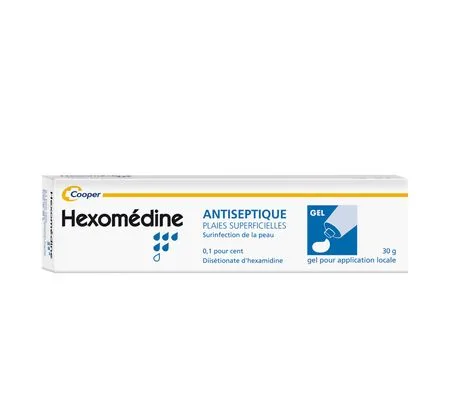
HEXOMEDINE 0,1 PERCENT, gel for cutaneous application
Composition
Hexamidine diisethionate.................................................................................................................................... 0,100 g
For 100 ml of gel for cutaneous application
Excipient with known effect: Ethanol 96 % (V/V)
Hydroxyethylcellulose, glacial acetic acid, ethanol 96 % (v/v), purified water.
Indications
Adjunctive treatment of skin conditions that are primarily bacterial or likely to become superinfected.
Remark :
Antiseptic agents are not sterilising: they temporarily reduce the number of micro-organisms on the skin and mucous membranes.
Dosage and administration
Method and route of administration
Cutaneous use.
Dosage
Do not swallow.
2 to 3 applications per day as a thin layer in the open air or as a thick layer under a protective dressing.
Duration of use after opening: (see section Warnings and precautions).
Maximum duration of treatment: 5 days.
Contraindications
Hypersensitivity to hexamidine or to the chemical class of diamidines or to any of the excipients.
This preparation must not be used:
- for antisepsis before sampling (puncture or injection)
- for any invasive procedure requiring surgical-type antisepsis (lumbar puncture, central venous route, etc.).
- for disinfection of medical and surgical equipment.
Do not apply to mucous membranes.
Warnings and precautions
Special warnings
Although transcutaneous absorption is very low, the risk of systemic effects cannot be excluded. Systemic effects are all the more to be feared when the antiseptic is used over a large surface area, under an occlusive dressing, on damaged skin (in particular burnt skin), a mucous membrane, or the skin of a premature infant or infant (due to the surface-area-to-weight ratio and the occlusive effect of nappies in the napkin area).
Risk of sensitisation to hexamidine.
As soon as the packaging of an antiseptic preparation is opened, microbial contamination is possible. Take care to use the gel in a hygienic manner.
Precautions for use
This medicine contains 7,255 g of ethanol per tube of 30 g of cream, equivalent to 241,83 mg per gram of cream. This may cause a burning sensation on damaged skin.
Interactions
No drug interaction studies have been performed.
Given the possible interactions (antagonism/inactivation), avoid the simultaneous or successive use of different antiseptics with this antiseptic (in particular, prior use of soap must be followed by thorough rinsing).
Fertility, pregnancy and breastfeeding
Pregnancy
There are no data on the use of hexamidine diisethionate in pregnant women. Animal studies evaluating reproductive toxicity are not available. However, the transcutaneous passage of hexamidine diisethionate into the systemic circulation is very limited.
It is preferable to avoid the use of HEXOMEDINE 0,1 PERCENT, gel for cutaneous application in pregnant women.
Breast-feeding
The excretion of hexamidine diisethionate (or its metabolites) into breast milk is not known. A risk to the breastfed infant or child is not expected since the systemic exposure of the mother to hexamidine diisethionate is negligible. Hexamidine diisethionate may be used during breastfeeding.
Fertility
The effects on fertility have not been evaluated.
Adverse effects
Hexamidine is likely to cause sensitization.
Its frequency varies with the dosage form and the degree of epidermal alteration: the hydro-alcoholic solution, frequently applied to eroded or damaged epidermis, is more often responsible than other dosage forms.
Contact dermatitis from hexamidine presents certain features suggestive of an Arthus phenomenon and suggesting humoral mechanisms.
Its clinical appearance usually differs from classic contact eczema: the eruption is most often infiltrated, made up of isolated or grouped hemispherical papular or papulovesicular lesions. More numerous and coalescent at the site of application of the antiseptic, they spread as isolated elements.
Regression is slow.
Mild manifestations of local intolerance may be encountered: tingling, itching, burning, cutaneous dryness. They only exceptionally lead to discontinuation of treatment.
Due to the presence of alcohol, frequent applications to the skin may cause irritation and dryness of the skin.
Reporting of suspected adverse reactions
Reporting suspected adverse reactions after authorisation of the medicinal product is important. It allows continued monitoring of the benefit/risk balance of the medicinal product. Healthcare professionals are asked to report any suspected adverse reaction via the national reporting system: National Agency for the Safety of Medicines and Health Products (ANSM) and the network of Regional Centres of Pharmacovigilance - Website: https://signalement.social-sante.gouv.fr
Overdose
In case of massive oral ingestion, perform gastric lavage. Contact a poison control centre.
Pharmacodynamics
Pharmacotherapeutic class: Antiseptics and disinfectants, ATC code: D08AC04
Hexamidine, the active ingredient of HEXOMEDINE gel, belongs to the diamidine family.
It behaves as a cationic antibacterial agent and has surface-active properties.
Slow-acting bactericidal and levuricidal activity.
The bactericidal activity of HEXOMEDINE gel is not inhibited by a standard exudate that reproduces in vitro the conditions observed in practice on contact with pus, serum and organic debris.
Pharmacokinetics
Transcutaneous absorption of hexamidine through healthy skin is very low.
The passage of hexamidine diisethionate into breast milk is not known. Since the systemic exposure of breastfeeding women to hexamidine diisethionate is very limited after topical application, passage into breast milk may be considered very low and no adverse effects in the breastfed infant/child are expected.
Preclinical safety
Available animal data are drawn from the literature. Hexamidine does not induce systemic toxicity after topical application.
The Ames tests and the in vitro chromosomal aberration study did not reveal any genotoxic risk.
No carcinogenesis data are available.
The effects of hexamidine diisethionate on fertility, reproduction and foetal development have not been evaluated in animals.
Hexamidine diisethionate may cause skin irritation.
Special storage precautions
No special precautions for storage.
Keep away from any flame or source of sparks or ignition.
Do not smoke.
SPECIAL PRECAUTIONS FOR DISPOSAL AND OTHER HANDLING
This medicine contains ethanol. Do not use this medicine near an open flame, a lit cigarette, or certain appliances (for example: hair dryers).
Prescription, supply and reimbursement
| Marketing authorisation (AMM) |
|
Collection.
PLACE LUCIEN AUVERT
77020 MELUN CEDEX
Tel: 01 64 87 20 00 https://www.cooper.fr/
Source: VIDAL · Updated on 10/11/2026. This information does not replace advice from a healthcare professional.