
Medicines
SmPC of 10/06/2022
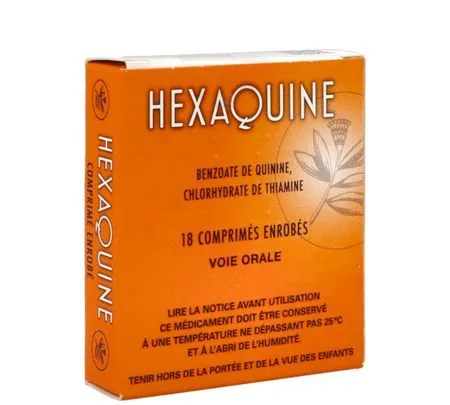
HEXAQUINE, coated tablet
Composition
Quinine benzoate..................................................................................................................... 120 mg
Equivalent to anhydrous base quinine............................................................................................ 87,2 mg
Thiamine hydrochloride .............................................................................................................. 32 mg
For one coated tablet
Excipient(s) with known effect: orange yellow (E110), carmine red A (E124), sucrose
Purified natural essential oil of selected Melaleuca viridiflora, sucrose, maize starch, povidone, anhydrous colloidal silica (Aerosil 200), potato starch, hydrated colloidal silica (Sipernat 50), talc, stearic acid, purified water.
Coating : gum arabic, hydrated colloidal silica (Levilite), shellac, colophony, gelatin, sucrose, talc, carnauba wax, orange yellow S (E110), carmine red A (E124), indigotine (E132).
Indications
Adjunctive treatment of idiopathic nocturnal leg cramps in adults after failure of non-pharmacological measures.
The decision to prescribe a medicinal product containing quinine must be made after an etiological assessment and based on the frequency of nocturnal cramps, their impact on quality of life, and the evaluation of all risks specific to each patient (see section Contraindications and Warnings and precautions).
Dosage and administration
Dosage
FOR ADULTS ONLY
1 to 3 tablets in the evening at bedtime, i.e. 87,2 mg to 261,6 mg of quinine base per day.
Do not exceed a maximum of 3 tablets per day.
Patients must be monitored during the first weeks of treatment because of undesirable effects (see section Adverse effects). A benefit should be observed within the days following the start of treatment. In the absence of benefit after 4 weeks, quinine treatment must be permanently discontinued.
Quinine treatment is not a long-term treatment for idiopathic nocturnal leg cramps.
Method of administration
Oral use
Severe renal impairment
The dose should be reduced in cases of severe renal impairment.
Contraindications
This medicine is contraindicated in the following cases:
- history of hypersensitivity to quinine or to any of the components, in particular thiamine,
- myasthenia,
- intraventricular conduction disorders,
- concomitant administration of quinine or derivatives, including consumption of beverages containing quinine.
Warnings and precautions
Special warnings
The occurrence of immuno-allergic reactions such as thrombocytopenia, hepatitis or allergy requires immediate and permanent discontinuation of this treatment and subsequent avoidance of quinine, in particular of beverages containing it.
Quinine may cause unpredictable immuno-allergic reactions that may be life-threatening. Quinine must not be used in patients who have had a history of side effects during its administration, whether as a medicine or in beverages containing it.
Cardiac disorders
Quinine has dose-dependent effects of QT interval prolongation. Caution is recommended in patients with conditions predisposing them to QT interval prolongation and in patients with atrioventricular block.
Precautions for use
Before using quinine in the treatment of idiopathic nocturnal cramps, all risks (see section Adverse effects) must be carefully considered in relation to the expected potential benefit. These risks are particularly present in elderly subjects.
Treatment with quinine should only be considered in cases of very painful and frequent cramps, when other causes of cramps have been ruled out and non-pharmacological measures have failed. Quinine must not be used for this indication during pregnancy.
Administration of quinine may lead to the onset of cinchonism, generally more severe in cases of overdose, but which may also occur at the therapeutic doses usually used.
Patients must be warned not to exceed the prescribed doses, because of the possibility of serious and irreversible adverse effects in case of overdose.
Any treatment of idiopathic nocturnal cramps with quinine must be discontinued if symptoms related to cinchonism occur. These symptoms include dizziness, tinnitus, headache, nausea and blurred vision (see sections Adverse effects and Overdose).
This medicine contains azo colouring agents (orange yellow (E110) and carmoisine red (E124)) and may cause allergic reactions.
This medicine contains sucrose. Its use is not recommended in patients with fructose intolerance, glucose-galactose malabsorption syndrome or sucrase/isomaltase deficiency.
Interactions
Caution is essential when quinine is administered with medicines that could prolong the QT interval.
Quinine may cause an increase in phenobarbital and carbamazepine levels. Patients must be closely monitored when quinine is used concomitantly with these agents.
Fertility, pregnancy and breastfeeding
Pregnancy
During pregnancy, quinine must be reserved solely for the treatment of malarial attacks.
This medicine must not be prescribed to pregnant women for the indication of idiopathic cramps.
A few cases of ocular abnormalities and hearing impairment have been reported with high doses of quinine taken during pregnancy. At therapeutic doses, no incidents have been reported.
Breast-feeding
It is advised to avoid this medicine during breastfeeding.
Adverse effects
Non-dose-dependent adverse effects:
- Hypersensitivity reactions:
- Dermatological: pruritus, erythematous rash, purpura, eczema, photosensitisation,
- General: anaphylactic shock, Quincke's oedema.
- Haematological reactions: thrombocytopenia, a few rare cases of thrombotic microangiopathy and exceptional pancytopenias,
- Hepatic reactions: cholestatic, cytolytic or mixed disorders; a few cases of granulomatous hepatitis have also been reported.
Dose-dependent adverse effects:
- Cinchonism manifested by tinnitus, hypoacusis, dizziness, visual disturbances, headache.
Reporting of suspected adverse reactions
Reporting suspected adverse reactions after authorisation of the medicinal product is important. It allows continued monitoring of the benefit/risk balance of the medicinal product. Healthcare professionals are asked to report any suspected adverse reactions via the national reporting system: National Agency for the Safety of Medicines and Health Products (ANSM) and the network of Regional Pharmacovigilance Centres - Website: www.signalement-sante.gouv.fr
Overdose
The most frequent signs of overdose are:
- Tinnitus, decreased auditory acuity and vertigo. Permanent deafness is sometimes observed after administration of toxic doses.
- Amblyopia, narrowing of the visual field, diplopia and hemeralopia. Recovery is slow but generally complete. Spasms of the central retinal artery have been described.
- Quinidine-like effect resulting in hypotension, conduction disorders, anginal symptoms and ventricular tachycardia.
- Local irritation of the digestive tract causing nausea, vomiting, abdominal pain and diarrhoea.
- Oral administration of more than 3 g in a single dose may cause, in adults, a severe or even fatal intoxication, preceded by central depression and convulsive seizures. Lower doses may be fatal in children.
Arrhythmia, hypotension and cardiac arrest may result from the cardiotoxic effect of quinine, while ocular toxicity may lead to blindness.
Management : gastric evacuation and gastric lavage. Administration of activated charcoal.
Symptomatic treatment of abnormalities in a hospital setting.
Pharmacodynamics
Pharmacotherapeutic class: OTHER DRUGS FOR MUSCULOSKELETAL DISORDERS (M: locomotor system)
Pharmacokinetics
Quinine is rapidly and almost completely absorbed via the digestive tract: the peak plasma concentration is reached within one to three hours. Approximately 70 % of plasma quinine is protein-bound. Quinine is predominantly metabolised by the liver into an inactive metabolite. Quinine is eliminated in the urine and almost completely disappears within 24 hours after treatment is stopped.
Transplacental passage and levels in milk are low. Small quantities enter the cerebrospinal fluid.
Prescription, supply and reimbursement
| Marketing authorisation (AMM) |
|
36 RUE BRUNEL
75017 PARIS
Tel: 01 44 95 14 95 infomed@ccdlab.com
https://laboratoire-ccd.fr/
Source: VIDAL · Updated on 10/11/2026. This information does not replace advice from a healthcare professional.