Medicines
Update of 27/07/2026
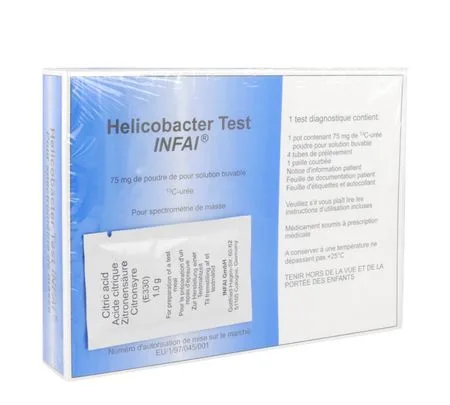
Helicobacter Test INFAI®
13C - urea
Forms and presentations
Powder (crystalline, white) for oral solution* oral solution at 75 mg: Kit** comprising 1 pot of 10 ml polystyrene with polyethylene stopper and, in particular, 2 collection tubes for the storage and transport of respiratory samples.Powder (crystalline, white) for oral solution* oral solution at 45 mg child (3 to 11 years): Kit** comprising 1 pot of 10 ml polystyrene with polyethylene stopper and, in particular, 2 collection tubes for the storage and transport of respiratory samples.
* After reconstitution, the solution is clear and colourless.
** These kits also include a straw, a documentation sheet, a leaflet and labels.
Composition
| per pot | |
| 13C - urea
|
75 mg |
| or | 45 mg |
Indications
This medicine is for diagnostic use only.- Powder for oral solution at 75 mg:
- Helicobacter Test INFAI can be used for the diagnosis in vivo of gastroduodenal infection with Helicobacter pylori in adults and adolescents likely to suffer from peptic ulcer.
- Powder for oral solution at 45 mg:
-
Helicobacter Test INFAI for children aged 3 to 11 years can be used for the diagnosis in vivo of gastroduodenal infection with Helicobacter pylori:
- to assess the efficacy of eradication treatment,
- or when invasive examinations cannot be performed,
- or when the results of invasive examinations are discordant.
- to assess the efficacy of eradication treatment,
Dosage and administration
This medicine must be administered by a healthcare professional under appropriate medical supervision.
Helicobacter Test INFAI is a single-administration breath test.
Dosage- Powder for oral solution at 75 mg: the dosage for adults and adolescents from the age of 12 years is one sachet of 75 mg.
- Powder for oral solution at 45 mg: the dosage for children aged 3 to 11 years is one sachet of 45 mg.
Method of administration:
- Powder for oral solution at 75 mg: to perform the test, the patient must swallow 200 mL of pure orange juice (100 % concentrate) or 1 g of citric acid diluted in 200 mL of water, as a test meal before the test, and tap water (used to dissolve the 13C-urea).
- Powder for oral solution at 45 mg: to perform the test, the patient must swallow 100 mL of pure orange juice (100 % concentrate), as a test meal before the test, and tap water (used to dissolve the 13C-urea).
The patient must fast for more than 6 hours, preferably overnight. The test lasts approximately 40 minutes.
If the test needs to be repeated, it must not be repeated before the following day.
Eradication ofHelicobacter pylori could give falsely negative results. This is why the test should only be performed after a minimum period of 4 weeks without systemic antibacterial treatment, and at the end of 2 weeks after the last dose of acid antisecretory agents. These two treatments could interfere with the presence ofHelicobacter pylori. This is particularly important after eradication treatment ofHelicobacter.
It is important to properly follow the instructions for use described in the section Handling and disposal instructions otherwise the validity of the result will be uncertain.
Contraindications
The test must not be performed in patients who have had or are suspected of having a gastric infection or atrophic gastritis that could interfere with the urea breath test.Refer to the section Dosage and administration.
Warnings and precautions
- A positive test alone is not an indication for eradication treatment. A differential diagnosis with invasive endoscopic methods may be necessary to detect the presence of other conditions such as ulcer, autoimmune gastritis and malignant tumours.
- Powder for oral solution at 75 mg: there are not enough data on the reliability of Helicobacter Test INFAI to recommend its use in patients who have undergone gastrectomy and in patients under the age of 12 years. For children over 3 years, the Helicobacter INFAI test for ages 3 to 11 years is available.
- Powder for oral solution at 45 mg: there are not enough data on the reliability of Helicobacter Test INFAI for children aged 3 to 11 years to recommend its use in patients who have undergone gastrectomy.
- In particular cases of type A gastritis (atrophic gastritis), the breath test may give falsely positive results; therefore other tests may be required to confirm the presence ofHelicobacter pylori.
- In case of vomiting during the test requiring it to be repeated, the test must be performed fasting but not before the following day, as specified in Dosage and administration.
Interactions
Helicobacter Test INFAI may be affected by all treatments interfering with Helicobacter pylori or urease activity.
Fertility, pregnancy and breastfeeding
- Powder for oral solution at 75 mg:
- Nothing suggests any harmfulness of this test during pregnancy or breastfeeding.
- It is recommended to consider the package leaflet of eradication treatments for their administration during pregnancy or breastfeeding.
Driving and using machines
Helicobacter Test INFAI has no influence on the ability to drive and use machines.Adverse effects
No known effect.
Reporting of suspected adverse reactions:Reporting suspected adverse reactions after authorisation of the medicinal product is important. It allows continuous monitoring of the benefit/risk balance of the medicinal product. Healthcare professionals should report any suspected adverse reaction via the national reporting system: National Agency for the Safety of Medicines and Health Products (ANSM) and the network of Regional Pharmacovigilance Centres. Website: https://signalement.social-sante.gouv.fr.
Overdose
No overdose is to be feared since only 45 mg is delivered, in children aged 3 to 11 years, or 75 mg, in patients from 12 years of age, of 13C-urea.
Pharmacodynamics
Pharmacotherapeutic class: Other diagnostic agents (ATC code: V04CX).
No pharmacological activity has been described for the quantity of 45 mg or 75 mg of 13C-urea administered orally during the breath test.
After oral administration, the labelled urea reaches the gastric mucosa. In the presence ofHelicobacter pylori, the 13C-urea is metabolised by the urease of Helicobacter pylori according to the reaction:
| 2 H2N(13CO)NH2 + 2 H2O | Urease enzyme
→ |
4NH3 + 213CO2 |
Carbon dioxide diffuses through the blood vessels. It is then transported in the form of bicarbonate to the lung and eliminated in the form of 13CO2 with the exhaled air.
In the presence of bacterial urease, the proportion of the carbon isotopes 13C/12C is significantly modified. The quantity of 13CO2 in respiratory samples is determined by mass spectrometry (IRMS) and expressed as the absolute difference (the Δδ value) between the value at 00 minute and that at 30 minutes.
Urease is produced in the stomach, only by Helicobacter pylori. Other urease-producing bacteria are rarely present in the gastric flora.
The cut-off point allowing differentiation of negative and positive tests for Helicobacter pylori is determined by a Δδ value of 4 ‰, meaning that there is an infection when the Δδ value is greater than 4 ‰. Compared with biopsy diagnoses of infection with Helicobacter pylori, the sensitivity of the breath test, in clinical studies on 457 adult patients (powder for oral solution at 75 mg), reached 96,5 % to 97,9 % (95 %-CI: 94,05 %-99,72 %) and its specificity 96,7 % to 100 % (95 %-CI: 94,17 %-103,63 %), while in clinical studies on 93 adolescents aged between 12 and 17 years, the sensitivity of the breath test reached 97,7 % (90 %-CI: 91,3 %) and its specificity 96,0 % (90 %-CI: 89,7 %), and in a clinical study on 168 patients aged between 3 and 11 years (powder for oral solution at 45 mg), the sensitivity reached 98,4 % (90 %-CI: ≥ 93,9 %) and the specificity 98,1 % (90 %-CI: ≥ 95,1 %).
In the absence of bacterial urease, the total quantity of urea administered, after absorption through the gastrointestinal tract, will be metabolised like endogenous urea. The ammonia released, as described above, by bacterial hydrolysis is incorporated into metabolism in the form of NH4+.
Pharmacokinetics
The 13Orally administered C-urea is metabolised to carbon dioxide and ammonia or incorporated into the endogenous urea cycle. Any increase in the 13CO2 will be measured by isotopic analysis.
The absorption and distribution of the 13CO2 are faster than the action of urease. Thus, the cleavage of the 13C-urea by urease ofHelicobacter pylori is the limiting step of the complete process.
It is only in patients positive for Helicobacter pylori that administration of 45 mg (children aged 3 to 11 years) or 75 mg (adults and adolescents from 12 years) of labelled urea causes a significant increase in the 13CO2 in the breath sample, within the first 30 minutes.
Preclinical safety
There are no concerns regarding the clinical use of the product.
Storage conditions
- Shelf life
- 3 years.
Store at a temperature not exceeding + 25 °C.
HANDLING/DISPOSAL INSTRUCTIONS
- The test must be performed in the presence of a qualified person.
- Each patient's data should be collected using the information sheet provided. It is recommended to perform the test on the patient in a resting position.
- The test begins with the collection of samples to determine the baseline value (00-minute value).
- Take the straw and the sampling tubes labelled "Sampling time (00-minute value)" and remove them from the test kit.
- Remove the cap from one of the sampling tubes and place the previously unwrapped straw into the tube.
- Then blow gently into the tube until the inner surface of the tube is fogged.
- While continuing to blow, remove the straw and immediately reseal the tube with its cap (if the tube remains open for more than 30 seconds, the test result may be distorted).
- Hold the tube vertically and affix the barcode label marked "00-minute value" around the tube, so that the barcode lines are horizontal.
- Take the straw and the sampling tubes labelled "Sampling time (00-minute value)" and remove them from the test kit.
- Fill the second sampling tube (label: "Sampling time: 00-minute value") in the same way.
- Then drink without delay the 200 ml of orange juice (100% concentrated) or 1 g of citric acid diluted in 200 ml of water [drinkable solution at 75 mg] or the 100 ml of orange juice (100% concentrated) [drinkable solution at 45 mg].
- Next, prepare the test solution as follows:
- Remove the pot labelled "Powder of 13C-urea" from the test kit, open it and fill it to the ¾ with tap water.
- Close the pot and shake it thoroughly until the powder is completely dissolved. Pour the contents into a glass.
- Fill the pot of powder of 13C-urea to the brim with tap water a second and a third time, then pour the contents into the glass (the total volume of tap water should be approximately 30 ml).
- Remove the pot labelled "Powder of 13C-urea" from the test kit, open it and fill it to the ¾ with tap water.
- The test solution thus prepared must be drunk immediately by the patient, and the time of ingestion must be noted.
- Thirty minutes after taking the test solution (point 7), collect the "30-minute value" samples in the two sampling tubes still in the test kit (label: "Sampling time 30-minute value"), as described in points 3 and 4. Use, for these samples, the barcode labels marked "30-minute values".
- Place the corresponding barcode label on the patient documentation sheet, then close the package using the sticker.
- The collection tubes containing the samples must be sent in their original packaging to a qualified laboratory for analysis.
- Analysis of breath samples and test specifications intended for laboratories:
- Breath samples collected in glass or plastic collection tubes of 10 ml are analysed by isotope ratio mass spectrometry (IRMS).
- The analysis of the proportion of 13C/12C in carbon dioxide is part of the Helicobacter Test INFAI diagnostic kit. The accuracy of the test is closely linked to the quality of the breath analysis.
- The specifications of the mass spectrometer parameters, such as linearity, stability (reference gas precision) and measurement precision, are essential for the accuracy of the system.
- It is necessary to ensure that the analysis is performed by qualified laboratories.
- The validated method for this use is as follows:
-
- Sample preparation for IRMS:
- To determine the proportion of 13C/12C in breath carbon dioxide by mass spectrometry, the carbon dioxide must be isolated from the breath sample and introduced into the mass spectrometer. The automatic preparation system for isotope mass spectrometers used for the breath test analysis is based on a continuous-flow gas chromatography separation technique.
- Water is extracted from the sample using a Nafion water trap or by the gas chromatography preparation system, which separates each gas in a gas chromatography column with helium as the eluent. As they pass through the column, all types of breath gases are detected by an ion detector. The carbon dioxide fraction, identified by its characteristic retention time, is introduced into the mass spectrometer.
-
- Mass spectrometry analysis:
- To analyse the carbon dioxide isolated from the sample, its molecule must be ionised, formed into a beam, accelerated by an electric field, deflected by a magnetic field and finally detected. These five steps take place in the analyser of a mass spectrometer, which consists of three separate parts: the source, the tube and the collector. Ionisation, beam formation and detection take place in the collector.
-
- Sample introduction:
- Several introduction systems exist for introducing carbon dioxide into the analyser. For the breath test analysis, individual equilibration of the sample's carbon dioxide against a standard reference gas is essential. This ensures high accuracy for this system when the calculation of the isotopic content of the carbon dioxide is made relative to an independent standard.
-
- Specifications for determining the proportion of 13C/12C:
- The concept of the breath test is based on the administration of specifically labelled urea 13C, whose metabolism is tracked by measuring the 13CO2 in the exhaled breath gases.
-
The mass spectrometer must be capable of:
- Multiple repeated analyses: a minimum of 3 repeated analyses on the same sample during operation.
- Access security: storage of operating parameters and results with protected access to prevent later manipulation.
- Adjustment: proportion of 13C/12C relative to PDB (Pee Dee Belemnite).
- Sample loop: < 200 µl.
- Multiple repeated analyses: a minimum of 3 repeated analyses on the same sample during operation.
- The tests to verify the specifications are linearity, stability (reference gas precision) and measurement precision.
-
All mass spectrometers for breath analysis must meet the following specifications:
- Linearity: ≤ 0,5 ‰ for breath samples whose CO2 concentration varies between 1 % and 7 %.
- Stability: ≤ 0,2 ‰ over 10 consecutive pulses.
- Measurement precision: ≤ 0,3 ‰ for 13C in natural abundance using a breath tube of 10 mL with a concentration of 3 % of CO2 respiratory.
- Linearity: ≤ 0,5 ‰ for breath samples whose CO2 concentration varies between 1 % and 7 %.
- There is infection with Helicobacter pylori if the difference between the proportion of 13C/12C at baseline and that at 30 minutes is greater than 4 ‰.
- Other properly validated methods may be used by objectively qualified laboratories.
Prescription, supply and reimbursement
LIST I| Marketing authorisation (AMM) | EU/1/97/045/001; CIP 3400934839504 (RCP rev 08.09.2025) 75 mg, 1 kit with tubes. |
| EU/1/97/045/003; CIP 3400938308600 (RCP rev 08.09.2025) 45 mg, 1 kit with tubes. |
| Price: | 29,64 euros (1 kit 75 mg with tubes). |
| 22,96 euros (1 kit 45 mg with tubes). | |
| Reimbursed by Social Security at 65 %. Collective. | |
Marketing authorisation holder: INFAI GmbH, An der Kohlenbahn 39, D-58135 Hagen, Germany.
Operator:
BIOPROJET Pharma
115, rue d'Aboukir. 75002 Paris
Tel: 01 47 03 66 33
Pharmacovigilance:
E-mail: pharmacovigilance@bioprojet.com
https://www.bioprojet.com/
Source: VIDAL · Updated on 10/11/2026. This information does not replace advice from a healthcare professional.