
Medicines
Update of 10/07/2025
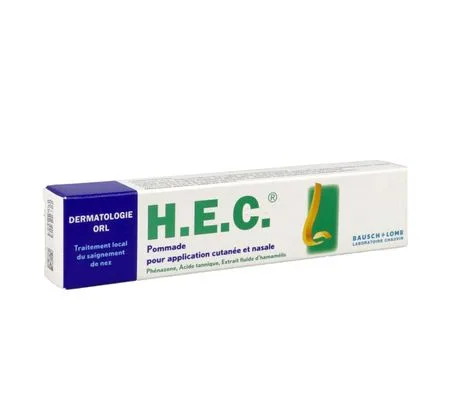
HEC®
phenazone, witch hazel, tannic acid
Forms and presentations
Ointment for cutaneous and nasal application: Tube of 25 g.Composition
| tube | |
| Phenazone
|
187,5 mg |
| Witch hazel, fluid extract
|
187,5 mg |
| Tannic acid
|
3,125 g |
Excipients with known effect: Peru balsam, wool fat (lanolin).
Indications
- Dermatology:
- Local adjunctive treatment of superficial burns of limited extent.
- Rhinology:
- Local adjunctive treatment during epistaxis.
Dosage and administration
Dosage- Dermatology:
- 1 or 2 applications per day.
- Rhinology:
- For impregnation of nasal packs.
- Paediatric population:
- There is no justified use of HEC, ointment for cutaneous and nasal application, in the pediatric population.
Contraindications
This medicine is contraindicated in the following cases:- Hypersensitivity to the active substances or to any of the excipients listed in section Composition, in particular to pyrazolones, Peru balsam, wool fat (lanolin).
- Oxygen therapy, due to the risk of burns related to the presence of fatty substances in the ointment.
- Infected lesions.
Warnings and precautions
Medicines containing phenazone may cause acute hemolysis in subjects with an enzymatic deficiency of G6PD. As a matter of principle, use should therefore take this risk into account, and the use of a therapeutic alternative, if one exists, is recommended. If use of this medicine is necessary, the occurrence of possible hemolysis should be monitored.
This medicine contains Peru balsam and may cause skin reactions.
This medicine contains wool fat (lanolin) and may cause local skin reactions (for example: contact dermatitis).
Interactions
The data available to date do not suggest the existence of clinically significant interactions.
Fertility, pregnancy and breastfeeding
Pregnancy:There is no data on use in pregnant women. Studies carried out in animals are insufficient to conclude on reproductive toxicity (see Preclinical safety).
HEC, ointment for cutaneous or nasal application, is not recommended during pregnancy and in women of childbearing potential not using contraception.
Breastfeeding:
No data is available on excretion in breast milk.
HEC, ointment for cutaneous or nasal application, must not be used during breastfeeding.
Fertility:There is no data in humans.
Adverse effects
Adverse effects are presented by system organ class, and are presented according to their frequency: very common (≥ 1/10); common (≥ 1/100 to < 1/10); uncommon (≥ 1/1000 to < 1/100); rare (≥ 1/10 000 to < 1/1000); very rare (< 1/10 000); frequency not known (cannot be estimated from the available data).
| Immune system disorders | |
| Frequency not known | Allergic reactions of the type contact eczema, urticaria, erythema multiforme, Quincke's oedema or anaphylactic reaction |
| Respiratory, thoracic and mediastinal disorders | |
| Frequency not known | Sneezing, nasal discharge, nasal congestion |
| General disorders and administration site conditions | |
| Frequency not known | Local irritation reactions such as a burning sensation |
Reporting suspected adverse reactions after authorisation of the medicinal product is important. It allows continuous monitoring of the benefit/risk balance of the medicinal product. Healthcare professionals should report any suspected adverse reaction via the national reporting system: National Agency for the Safety of Medicines and Health Products (ANSM) and the network of Regional Pharmacovigilance Centres. Website: https://signalement.social-sante.gouv.fr.
Overdose
Application of excessively high doses may lead to an exacerbation of adverse effects. In case of overdose, rinse abundantly with water.
Pharmacodynamics
Pharmacotherapeutic class: Other nasal preparations (R: respiratory system; ATC code: R01AX30).
Storage conditions
Shelf life 18 months.
Store at a temperature not exceeding 25 °C.
HANDLING/DISPOSAL INSTRUCTIONS
Unscrew the cap, then screw it back on upside down as far as it will go in order to pierce the seal with the cap's spike.
Any unused medicinal product or waste material should be disposed of in accordance with local requirements.
Prescription, supply and reimbursement
| Marketing authorisation (AMM) | 3400930470312 (1997, SmPC rev 15.04.2021). |
| Not reimbursed by Social Security. |
CHAUVIN Laboratory
416, rue Samuel-Morse. CS 99535. 34961 Montpellier
Tel: 04 67 12 30 30
Source: VIDAL · Updated on 10/11/2026. This information does not replace advice from a healthcare professional.