
Medicines
SPC of 13/03/2026
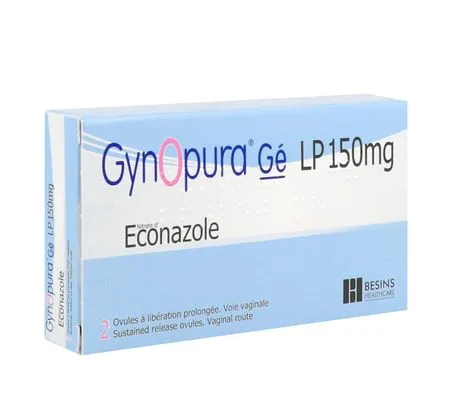
GYNOPURA L.P. 150 mg, prolonged-release vaginal ovule
Composition
For a prolonged-release vaginal ovule :
Econazole nitrate: 150 mg
Guar gum, anhydrous colloidal silica, solid hemisynthetic glycerides (type WI H15 and WE FS), stearyl heptanoate.
Indications
Local treatment of vulvovaginal mycoses, whether or not superinfected by Gram-positive bacteria.
Dosage and administration
Dosage
- In the majority of cases: 1 ovule at bedtime in a single administration, to be inserted deep into the vagina, preferably in the lying position.
- In the case of recurrent or resistant mycosis presumed to involve predisposing factors, one ovule at bedtime and one ovule the following morning.
Practical advice
Washing with a soap with neutral or alkaline pH.
Treatment will be accompanied by hygiene advice (wearing cotton underwear, avoiding vaginal douching, avoiding wearing internal tampons during treatment...) and, where possible, removal of predisposing factors.
Do not interrupt treatment during menstruation.
Treatment of the partner will be discussed on a case-by-case basis.
To treat vulvar or perianal extensions of the mycosis, it is recommended to combine the gynecological ovules with a topical antifungal application.
Pregnant women must wash their hands thoroughly before administering GYNOPURA L.P. (see section Fertility, pregnancy and breastfeeding).
Special populations
Paediatric population
Safety and efficacy have not been demonstrated in children under 16 years of age.
Elderly patients
Data on the use of GYNOPURA L.P. in elderly persons (> 65 years) are insufficient.
Contraindications
• Hypersensitivity to the active substance, to other imidazole derivatives or to any of the excipients mentioned in section Composition.
• In combination with latex condoms or diaphragms, due to the risk of rupture of latex diaphragms or condoms.
Warnings and precautions
For vaginal use only. GYNOPURA L.P. is not intended for oral use.
Special warnings
In the absence of suggestive clinical symptoms, the mere finding of Candida on the skin or mucous membranes cannot in itself constitute an indication.
Once candidiasis is confirmed, the ecological factors that allow and promote the development of Candida must be carefully investigated.
To avoid relapses, eradication and management of predisposing factors is essential.
It is advisable to treat simultaneously any associated Candida focus recognised as pathogenic.
Patients using spermicidal contraceptives should consult their doctor because any local vaginal treatment may inactivate the spermicidal contraceptive (see section Interactions).
Patients with sensitivity to imidazoles have also shown sensitivity to econazole nitrate.
Precautions for use
In case of local intolerance, significant irritation or allergic reaction, treatment should be discontinued.
The use of a soap with an acidic pH (a pH that promotes the multiplication of Candida) is not recommended (see section Dosage and administration).
Interactions
Contraindicated combinations
+ Latex male condoms / Latex diaphragms
Risk of rupture of the latex diaphragm or condom.
Combinations not recommended
+ Spermicides
Any local vaginal treatment may inactivate a local spermicidal contraception (see section Warnings and precautions).
Associations requiring precautions for use
+ Oral anticoagulants
Econazole is a known inhibitor of CYP3A4/2C9. Despite limited systemic passage after vaginal application, clinically significant interactions may occur and have been reported in patients taking oral anticoagulants such as warfarin and acenocoumarol (increased effect of the oral anticoagulant and bleeding risk).
In these patients, precautions should be taken and the INR should be monitored more frequently.
Adjustment of the oral anticoagulant dosage may prove necessary during treatment with econazole and after its discontinuation.
Fertility, pregnancy and breastfeeding
Pregnancy
Animal studies have not revealed any teratogenic effect but have shown foetotoxicity at high doses (see section Preclinical safety). It is not known whether these results are relevant to humans.
In the absence of a teratogenic effect in animals, a malformative effect in humans is not expected. Indeed, to date, substances responsible for malformations in humans have proven teratogenic in animals in well-conducted studies in two species.
In clinical practice, no particular malformative or foetotoxic effect has appeared to date. However, monitoring of pregnancies exposed to econazole is insufficient to exclude any risk.
Due to absorption through the vaginal mucosa, the use of GYNOPURA L.P. should not be considered during the 1st trimester of pregnancy unless the physician considers it necessary.
GYNOPURA L.P. may be used during the 2nd and 3rd trimesters of pregnancy if the potential benefit to the mother outweighs the potential risk to the fetus.
Breast-feeding
Absorption of econazole nitrate through the vaginal mucosa is low.
It is not known whether econazole nitrate passes into human breast milk.
Breastfeeding is possible, but caution is required when GYNOPURA L.P. is used in a breastfeeding patient.
Adverse effects
The tolerability of GYNOPURA L.P. was evaluated in 3630 patients who participated in 32 clinical trials. Based on the pooled tolerability data from these clinical trials, the most frequently reported adverse reactions (in % incidence) are skin and subcutaneous tissue disorders, such as pruritus (1,2%) and skin burning sensation (1,2%).
The table below presents the adverse reactions reported with vaginal use of GYNOPURA L.P. during clinical trials (including the adverse reactions mentioned above), as well as adverse reactions from post-marketing data (spontaneous reports).
For adverse reactions reported during clinical trials, the frequency categories presented in the table are defined as follows:
Very common (≥ 1/10); Common (≥ 1/100 to < 1/10); Uncommon (≥ 1/1 000 to < 1/100); Rare (≥ 1/10 000 to < 1/1 000); Very rare (< 1/10 000).
For adverse reactions reported from spontaneous notification data, their frequency is not determinable (cannot be estimated from the available data).
|
Classes of organ systems |
Adverse effects |
|||
|
Frequency categories |
||||
|
Common
|
Uncommon
|
Rare
|
Not known |
|
|
Immune system disorders |
Hypersensitivity |
|||
|
Skin and subcutaneous tissue disorders |
Pruritus,
|
Rash |
Erythema |
Angioedema,
|
|
Disorders of the reproductive organs and breast |
Vulvovaginal burning sensation |
|||
|
General disorders and administration site conditions |
Pain at the application site,
|
|||
Reporting of suspected adverse reactions
Reporting suspected adverse reactions after authorisation of the medicinal product is important. It allows continued monitoring of the benefit/risk balance of the medicinal product. Healthcare professionals are asked to report any suspected adverse reaction via the national reporting system: National Agency for the Safety of Medicines and Health Products (ANSM) and the network of Regional Centres of Pharmacovigilance - Website: https://signalement.social-sante.gouv.fr.
Overdose
In case of overdose with GYNOPURA L.P., the expected undesirable events are similar to the undesirable effects listed in section Adverse effects.
In case of accidental ingestion, nausea, vomiting or diarrhoea may occur. Symptomatic treatment should be carried out if necessary.
Pharmacodynamics
Pharmacotherapeutic class: ANTIINFECTIVES AND ANTISEPTICS FOR GYNECOLOGICAL USE, ATC code: G01AF05
Econazole nitrate is an imidazole derivative with antifungal and antibacterial activity.
Activity has been demonstrated in vitro and acts on the agents responsible for cutaneous and mucosal mycoses:
• candida and other yeasts (agents of vaginal mycoses),
• Gram-positive bacteria occasionally responsible for superinfection.
In vitro, attempts to select strains of Candida albicans resistant to econazole have not revealed acquired resistance; in vivo, this risk is negligible.
Mechanism of action
Different from that of antibiotics, it occurs at several levels: membrane (increased permeability), cytoplasmic (inhibition of oxidative processes at the level of the mitochondria), nuclear (inhibition of RNA synthesis).
This dosage is suitable for short-term treatment.
Pharmacokinetics
Absorption
In humans, econazole is poorly absorbed after vaginal administration.
The maximum concentrations of econazole and/or its metabolites in plasma or serum observed 1-2 days after administration are approximately 65 ng/ml for an ovule of 150 mg. For an ovule of 150 mg, approximately 5% of the econazole dose is absorbed.
Distribution
In the systemic circulation, econazole and/or its metabolites are strongly bound (> 98%) to plasma proteins.
Biotransformation and elimination
Econazole is extensively metabolised by oxidation, deamination and/or O-dealkylation, and the metabolites are eliminated via the renal and faecal routes.
On contact with the vaginal mucosa, the excipient of GYNOPURA L.P. forms a bioadhesive gel containing econazole nitrate. This gel adheres to the vaginal mucosa, thereby maintaining an effective concentration of active ingredient in the vagina for several days.
Preclinical safety
Sub-chronic toxicity
The liver has been identified as the target organ. The safety margin associated with this effect is large.
Reproductive function
The studies carried out have not revealed any impairment of fertility, nor teratogenicity, but foetotoxicity at high doses.
Breast-feeding
Following oral administration of econazole nitrate to lactating rats, econazole and/or its metabolites were excreted into the milk and found in the suckling pups.
Genotoxicity
The studies carried out suggest the induction of aneuploidy, and some studies indicate a mutagenic effect. Taken together, however, these studies indicate that the genotoxic effects are limited.
Local tolerance
The studies performed revealed no cutaneous or vaginal irritation, no phototoxicity and no sensitisation.
Prescription, supply and reimbursement
| Marketing authorisation (AMM) |
|
7 RUE AUBER
75009 PARIS
info@besins-healthcare.com
https://www.besins-healthcare.com/ - http://www.besins-healthcare.fr/
Source: VIDAL · Updated on 10/11/2026. This information does not replace advice from a healthcare professional.