
Medicines
SmPC of 21/07/2023
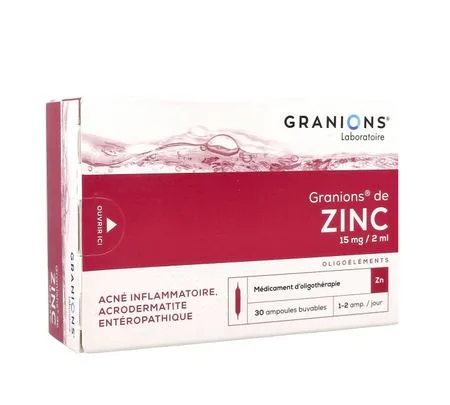
GRANIONS DE ZINC 15 mg/2 ml, oral solution in ampoule
Composition
For one ampoule:
Zinc: 15,00 mg
As zinc gluconate: 104,55 mg
Amylose, glycerol, glycine, purified water.
Dosage and administration
Dosage
Acne
The daily dosage is 2 ampoules per day (which corresponds to 30 mg of zinc metal) as a single intake.
This dosage of 2 ampoules per day is maintained for 3 months, then subsequently reduced to one ampoule per day.
Acrodermatitis enteropathica
The daily dosage to be respected, at least until puberty, is 1 ampoule: treatment must be continued very rigorously to avoid relapse.
At the time of puberty, it may be necessary to increase the dosage to 2 ampoules daily. After this growth phase, it is possible to return to one ampoule per day, under monitoring of plasma zinc levels.
Method of administration
Oral use.
GRANIONS DE ZINC must be taken with a large glass of water away from meals (more than 2 hours if possible). See sections Warnings and precautions and Interactions.
Contraindications
Hypersensitivity to the active substance or to any of the excipients listed in section Composition.
Warnings and precautions
In order to obtain maximum absorption, the medicine should be taken away from meals (more than 2 hours if possible), as the food bolus may modify intestinal absorption of the medicine (see section Interactions).
To avoid any risk of upper digestive injury, it is recommended to take the ampoule with a large glass of water in a sitting position. The lying-down position should be avoided during the 30 minutes following intake of the ampoules.
Interactions
Associations requiring precautions for use
+ Iron and calcium
Decreased digestive absorption of zinc by iron or by calcium. Take iron or calcium salts away from zinc (more than 2 hours if possible).
+ Cyclines, Fluoroquinolones
Decreased digestive absorption of cyclines or fluoroquinolones by zinc. Take zinc salts away from cyclines or fluoroquinolones (more than 2 hours if possible).
+ Strontium
Decreased digestive absorption of strontium by zinc. Take strontium away from zinc salts (more than 2 hours if possible).
Associations to be taken into account
Diet
Foods with a high phytic acid content (legumes (peas, lentils, soy...), whole grains (wheat, rye, oats...), corn, nuts...) can form complexes with zinc, which reduces its absorption and therefore its effectiveness.
Likewise, foods rich in iron or calcium can interact with zinc and reduce its absorption.
Consequently, in order to avoid an interaction through diet and obtain maximum absorption of zinc, zinc salts should be taken away from meals (more than 2 hours if possible).
Fertility, pregnancy and breastfeeding
Pregnancy
In acrodermatitis enteropathica, zinc administration is essential and must be continued during pregnancy.
In acne, in the first 1 trimester, given the available data, it is preferable as a precaution to avoid using GRANIONS DE ZINC. Indeed, clinical data are reassuring but still limited, and animal data are not relevant (see section Preclinical safety).
During the 2th and 3th trimesters, the use of GRANIONS DE ZINC may be considered, but the dosage will take into account any other zinc intake (notably "multivitamin and trace element" supplements).
Breast-feeding
In acrodermatitis enteropathica, zinc administration is essential and must be continued during breastfeeding.
In acne, the use of GRANIONS DE ZINC in a breastfeeding woman may be considered, but the dosage will take into account any other zinc intake (notably "multivitamin and trace element" supplements).
To date, no undesirable effects have been reported in children whose mothers received doses less than or equal to 30 mg of elemental zinc during breastfeeding.
Adverse effects
The following undesirable effects have been reported during treatment, classified by frequency: very common (≥ 1/10); common (≥ 1/100 to < 1/10); uncommon (≥ 1/1 000 to ≤ 1/100); rare (≥ 1/10 000 to ≤ 1/1 000); very rare (≤ 1/10 000).
Within each frequency grouping, adverse effects are presented in order of decreasing seriousness.
|
System organ class |
Frequency |
Adverse effects |
|
Blood and lymphatic system disorders |
Very rare |
Anemia, neutropenia, hyposideremia |
|
Immune system disorders |
Very rare |
Allergic reaction |
|
Gastrointestinal disorders |
Rare |
Abdominal pain, gastralgia, epigastralgia, nausea, vomiting, dyspepsia, bowel disorders (including diarrhoea and constipation) |
|
Skin and subcutaneous tissue disorders |
Very rare |
Urticaria, pruritus, skin rash, erythema |
|
Metabolism and nutrition disorders |
Frequency not known |
Reversible hypocupraemia |
Reporting of suspected adverse reactions
Reporting suspected adverse reactions after authorisation of the medicinal product is important. It allows continued monitoring of the benefit/risk balance of the medicinal product. Healthcare professionals are asked to report any suspected adverse reactions via the national reporting system: National Agency for the Safety of Medicines and Health Products (ANSM) and the network of Regional Pharmacovigilance Centres - Website: https://signalement.social-sante.gouv.fr/.
Overdose
Overdose cases reported in the literature have resulted in gastrointestinal effects, haematological effects (anaemia, neutropenia) and hypocupraemia due to decreased copper absorption. The probability of acute zinc poisoning is low, so the possible treatments with calcium EDTA salts or phytic acid are mentioned for the record only.
Pharmacodynamics
Pharmacotherapeutic class: Other preparations for systemic use, ATC code: D10BX (D: Dermatology).
Zinc gluconate acts on the inflammatory component of acne.
Sun exposure: it has been shown that zinc gluconate does not cause a phototoxic or photoallergic reaction. Treatment with zinc gluconate is compatible with sun exposure.
Pharmacokinetics
Absorption
Absorption is influenced by taking the medicine during meals, as the food bolus may modify intestinal absorption of the medicine.
Zinc gluconate is absorbed via the intestine.
Peak serum concentration is reached between the 2th and 3th hour.
Distribution
Clinical pharmacology studies have shown that zinc is found at the skin level.
Elimination
Elimination is essentially faecal.
Preclinical safety
No relevant studies have been conducted in animals to evaluate the toxicity of zinc gluconate with respect to reproductive functions.
SPECIAL PRECAUTIONS FOR DISPOSAL AND OTHER HANDLING
No special requirements for disposal.
Any unused medicinal product or waste material should be disposed of in accordance with local requirements.
Prescription, supply and reimbursement
| Marketing authorisation (AMM) |
|
| Price: |
|
Collection.
GRANIONS EA-PHARMA Laboratory
Le Parador II
5, allée Crovetto-Frères. 98000 Monaco
Tel: 00 377 92 05 76 30
Source: VIDAL · Updated on 10/11/2026. This information does not replace advice from a healthcare professional.