Medicines
SmPC of 09/12/2022
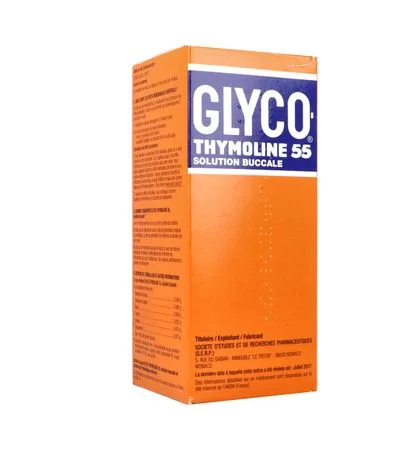
GLYCO-THYMOLINE 55, buccal solution
Composition
Sodium benzoate......................................................................................................................2.040 g
Sodium salicylate......................................................................................................................0.090 g
Borax .............................................................................................................................................2.000 g
Thymol...........................................................................................................................................0.037 g
Cineole...........................................................................................................................................0.075 g
Levomenthol..................................................................................................................................0.037 g
For 100 g of buccal solution
Excipients with known effect: 100 g of buccal solution contains 0,010 g of carmine red A (E 124) and 3,612 g of ethanol (alcohol).
Scots pine essential oil, sodium bicarbonate, glycerol, ethanol (alcohol), polysorbate 80, carmine red A (E 124), purified water.
Dosage and administration
Dosage
FOR ADULTS AND CHILDREN OVER 6 YEARS OF AGE ONLY
Buccal use, 2 to 3 times a day.
Method of administration
Do not swallow, do not apply to skin or mucous membranes other than the oral mucosa.
- Apply the undiluted product to the areas to be treated, using compresses or cotton wool.
- This product may be used as a mouthwash: use the product diluted by half with warm water.
Contraindications
- Child under 6 years, given the pharmaceutical form,
- Hypersensitivity to salicylates, or to any of the other constituents.
Warnings and precautions
Special warnings
The indication does not justify prolonged treatment. If symptoms persist beyond 5 days and/or associated fever occurs, the course of action should be reassessed.
Precautions for use
In case of a history of epilepsy, take into account the presence of terpenes.
Once the container is opened, microbial contamination is possible.
Paediatric population
This specialty contains terpene derivatives (menthol, eucalyptol, thymol) which may have caused, at excessive doses, neurological adverse events of the convulsion type, in infants and children.
Follow the administration advice and dosage.
Excipients
This medicine contains 9,510 g of alcohol (ethanol) per bottle of 250 mL of mouthwash solution, which is equivalent to 0,04 g/mL. This may cause a burning sensation on damaged skin.
Since this medicine is a mouthwash solution and is therefore not swallowed, the small amount of alcohol contained in this medicine is not likely to cause any noticeable effect in usual clinical practice. However, it is necessary to ensure that children using the product do not swallow it.
This medicine contains carmoisine A (E124) and may cause allergic reactions.
Interactions
Combinations not recommended
Simultaneous or successive use of other antiseptics should be avoided given possible interferences (antagonism, inactivation...).
Associations to be taken into account
Concomitant use of proconvulsant medicines, or medicines lowering the epileptogenic threshold, should be carefully weighed given the severity of the risk incurred. These medicines include in particular most antidepressants (imipramines, selective serotonin reuptake inhibitors), neuroleptics (phenothiazines and butyrophenones), mefloquine, chloroquine, bupropion, tramadol (see section Warnings and precautions).
Fertility, pregnancy and breastfeeding
Pregnancy
Inhibition of prostaglandin synthesis by NSAIDs may affect the course of pregnancy and/or the development of the embryo or foetus.
Risks associated with use during the 1st trimester:
Data from epidemiological studies suggest an increased risk of miscarriage, cardiac malformations and gastroschisis after treatment with a prostaglandin synthesis inhibitor in early pregnancy. The absolute risk of cardiovascular malformation increased from less than 1% in the general population to approximately 1,5% in those exposed to NSAIDs. The risk appears to increase with dose and duration of treatment. In animals, administration of a prostaglandin synthesis inhibitor has been shown to cause increased pre- and post-implantation loss and increased embryofetal lethality. In addition, a higher incidence of certain malformations, including cardiovascular ones, has been reported in animals that received a prostaglandin synthesis inhibitor during the organogenesis phase of gestation.
Risks associated with use from the 12th week of amenorrhea until birth:
From the 12th week of amenorrhea until birth, all NSAIDs, through inhibition of prostaglandin synthesis, may expose the fetus to renal functional impairment :
-
- in utero which may be observed as early as 12 weeks of amenorrhea (onset of fetal diuresis): oligohydramnios (may occur shortly after starting treatment and is generally reversible on stopping treatment), or even anhydramnios, in particular with prolonged exposure.
- at birth, renal failure (reversible or not) may persist, particularly in cases of late and prolonged exposure (with a risk of delayed severe hyperkalaemia).
Constriction of the ductus arteriosus may occur during the second trimester (most often reversible on stopping treatment).
Risks associated with use from the 24th week of amenorrhea:
From the 24th week of amenorrhea, NSAIDs may expose the fetus to cardiopulmonary toxicity (premature closure of the ductus arteriosus and pulmonary arterial hypertension) and may lead to fetal or neonatal right heart failure or even fetal death in utero. This risk is greater the closer the intake is to term (less reversibility). This effect exists even for a single intake.
At the end of pregnancy, the mother and the newborn may present:
- prolongation of bleeding time due to an anti-aggregant action, which may occur even after administration of very low doses of the medicinal product;
- inhibition of uterine contractions resulting in delayed labour or prolonged delivery.
Consequently:
Unless absolutely necessary, this medicine must not be prescribed to a woman planning a pregnancy or during the first 5 months of pregnancy (24 first weeks of amenorrhea). If this medicine is administered to a woman wishing to become pregnant or who is pregnant for less than 6 months, the dose must be as low as possible and the duration of treatment as short as possible. Prolonged use is strongly discouraged.
Intake from the 20th week of amenorrhea warrants cardiac and renal monitoring. If oligohydramnios or constriction of the ductus arteriosus occurs, treatment with GLYCO-THYMOLINE 55, mouthwash solution must be discontinued.
From the beginning of the 6th month (beyond 24 weeks of amenorrhea): any intake of this medicine, even a single one, is contraindicated. Accidental intake from this date warrants cardiac and renal, fetal and/or neonatal monitoring depending on the timing of exposure. The duration of this monitoring will be adapted to the elimination half-life of the molecule.
Breast-feeding
To be avoided during breastfeeding due to a lack of usable clinical and experimental data.
Adverse effects
- Risk of sensitization to salicylic acid.
- Due to the presence of terpenes (eucalyptol, menthol, thymol) and in case of non-compliance with recommended doses: possibility of agitation and confusion in elderly subjects, risk of convulsions in children.
- Possible local irritation (ethanol).
Reporting of suspected adverse reactions
Reporting suspected adverse reactions after authorisation of the medicinal product is important. It allows continued monitoring of the benefit/risk balance of the medicinal product. Healthcare professionals are asked to report any suspected adverse reactions via the national reporting system: National Agency for the Safety of Medicines and Health Products (ANSM) and the network of Regional Pharmacovigilance Centres - Website: www.signalement.social-sante.gouv.fr.
Pharmacodynamics
Pharmacotherapeutic class: STOMATOLOGY/LOCAL TREATMENT WITH ANTISEPTIC INTENT (A: alimentary tract and metabolism)
Terpene derivatives (eucalyptol, menthol, thymol) may lower the epileptogenic threshold.
Prescription, supply and reimbursement
| Marketing authorisation (AMM) |
|
IMMEUBLE LE TRITON 5 RUE DU GABIAN
98000 MC MONACO
Tel: 377 97 77 87 05 contact@serp.mc
https://serp.mc/
Source: VIDAL · Updated on 10/11/2026. This information does not replace advice from a healthcare professional.