
Medicines
SmPC of 23/01/2025
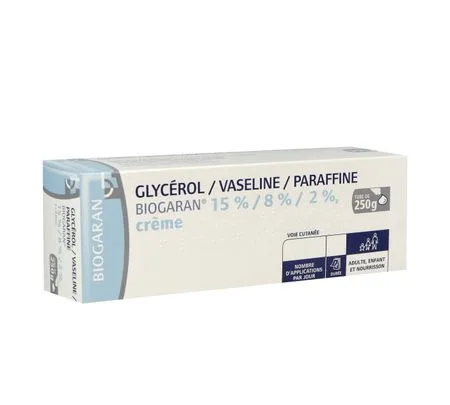
GLYCEROL/VASELINE/PARAFFINE BIOGARAN 15 %/8 %/2 %, cream
Composition
Glycerol..............................................................................................................................................................15 g
Petroleum jelly................................................................................................................................................................8 g
Liquid paraffin...................................................................................................................................................2 g
For 100 g of cream.
Excipient with known effect: propyl parahydroxybenzoate.
Glyceryl monostearate, stearic acid, macrogol 600, cyclomethicone, silicone oil, trolamine, propyl parahydroxybenzoate (E216), purified water.
Indications
Adjunctive treatment of dry skin states associated with certain dermatoses such as atopic dermatitis, ichthyotic conditions, psoriasis in adults and children including infants.
Adjunctive treatment of superficial burns of small extent.
Dosage and administration
Dosage
For adults and children, including infants, apply the cream in a thin layer to the areas to be treated once or twice a day, or more if necessary.
Paediatric population
The safety and efficacy of GLYCEROL/VASELINE/PARAFFINE BIOGARAN have not been established in premature infants.
Method of administration
Cutaneous use.
Contraindications
Hypersensitivity to the active substances or to any of the excipients listed in section Composition.
Warnings and precautions
Do not swallow.
It is recommended not to apply to an infected lesion or under an occlusive dressing.
This medicine contains propyl parahydroxybenzoate and may cause allergic reactions (possibly delayed).
Fertility, pregnancy and breastfeeding
Pregnancy
No effect is expected on pregnancy because systemic exposure to glycerol, vaseline and paraffin is negligible. GLYCEROL/VASELINE/PARAFFINE BIOGARAN can be used during pregnancy.
Breast-feeding
No effect on the breastfed newborn/infant is expected because systemic exposure of the breastfeeding mother to glycerol, vaseline and paraffin is negligible.
GLYCEROL/VASELINE/PARAFFINE BIOGARAN can be used during breastfeeding. It is only recommended not to apply GLYCEROL/VASELINE/PARAFFINE BIOGARAN to the breast during breastfeeding.
Fertility
No effect on fertility is expected because systemic exposure to glycerol, vaseline and paraffin is negligible.
Driving and using machines
GLYCEROL/VASELINE/PARAFFINE BIOGARAN has no effect or negligible effect on the ability to drive vehicles and use machines.
Adverse effects
Adverse effects are classified below according to the MedDRA database by System Organ Classes and by frequency, according to the following convention: very common (≥ 1/10), common (≥ 1/100 to < 1/10), uncommon (≥ 1/1 000 to < 1/100), rare (≥ 1/10 000 to < 1/1 000), very rare (< 1/10 000), frequency not known (cannot be estimated from the available data).
The following adverse effects have been reported during clinical studies and since the marketing of this medicine:
|
System organ class |
Undesirable effects by frequency |
|
|
Uncommon |
Frequency not known |
|
|
Skin and subcutaneous tissue disorders |
Urticaria, dermatitis, eczema, erythema, pruritus, rash |
Skin burning sensation |
|
General disorders and administration site conditions |
Application site reactions* |
Application site eczema |
* irritation, redness, pain or itching at the application site
Reporting of suspected adverse reactions
Reporting suspected adverse reactions after authorisation of the medicinal product is important. It allows continued monitoring of the benefit/risk balance of the medicinal product. Healthcare professionals are asked to report any suspected adverse reaction via the national reporting system: National Agency for the Safety of Medicines and Health Products (ANSM) and the network of Regional Centres of Pharmacovigilance - Website: https://signalement.social-sante.gouv.fr/.
Pharmacodynamics
Pharmacotherapeutic class: OTHER EMOLLIENTS and SKIN PROTECTANTS, ATC code: D02AX.
Emollient and moisturising cream.
The mechanisms of action of this medicine are as follows:
• reduction of insensible water loss from the skin: vaseline and paraffin form a lipid layer limiting water loss from the stratum corneum and allowing water-soluble and hygroscopic substances to be retained within it;
• increase in hydration of the superficial layers of the skin due to the hygroscopic power of glycerol and its penetration into the epidermis.
The skin protective effect has also been demonstrated by tests ex vivo performed on delipidated tissue implants. These tests showed rapid restructuring of the lipid barrier, demonstrating the emollient activity of glycerol/vaseline/paraffin involving restoration of corneodesmosomal junction homeostasis.
A study ex vivo performed on isolated human stratum corneum showed an improvement in the ceramide content, lipid components of stratum corneum.
These properties, demonstrated in pharmaco-clinical studies on validated models, promote the restoration of skin hydration and barrier function, which is likely to reduce phenomena of irritation, pruritus and scratching.
Clinical studies representative of a state of cutaneous dryness such as ichthyosis or atopic dermatitis in children have confirmed these properties:
• ichthyosis: double-blind study versus placebo for 28 days followed by an open-label period of 2 months;
Glycerol/petrolatum/paraffin significantly improves symptoms assessed by the SRRC (Scaling, Roughness, Redness, Cracks fissures) score: 65% of responders on this medicine, versus 50% on vehicle, response being defined as a decrease in the SRRC score of at least 50%.
The decrease in the SRRC score and pruritus was significantly greater (p< 0,05) on days 14 and 28 in patients treated with glycerol/petrolatum/paraffin compared with the placebo group (double-blind period). During the open-label period, a significant decrease (p< 0,01) in the SRRC score as well as in pruritus was observed up to day 84 in patients treated with glycerol/petrolatum/paraffin.
• atopic dermatitis in children: double-blind study versus placebo for 28 days followed by an open-label period for 2 months with re-introduction of glycerol/petrolatum/paraffin in patients who relapse on day 56.
Glycerol/petrolatum/paraffin significantly improves skin dryness in patients presenting with moderate to severe xerosis (glycerol/petrolatum/paraffin 43% versus placebo 29%, p< 0,001) during the double-blind period (D1 to D28). The significant improvement in atopic dermatitis in patients presenting with moderate to severe xerosis is observed from day 7. The difference observed in xerosis increases over time from day 7 to day 28.
When glycerol/petrolatum/paraffin is applied to xerotic skin, the hydration index measured with the corneometer reaches normal hydration values (>28 corneometer units) on day 40.
The results observed during the open-label period (D29 to D84) show that in responder patients, stopping the emollient leads to a relapse of xerosis, and in non-responder patients, introducing or continuing the emollient treatment after day 28 leads to an improvement of xerosis.
The results of these clinical studies highlight the benefit of long-term treatment with glycerol/petrolatum/paraffin:
• in responder patients, stopping treatment leads to worsening of xerosis and dermatosis;
• resuming treatment leads to an improvement of xerosis and dermatosis.
Preclinical safety
Preclinical data show good skin tolerability of this medicine, also confirmed in humans. The cream is shown to be non-irritating to the eyes. Devoid of phototoxic potential, it shows, in animals, a low sensitizing and photosensitizing potential, but the risk is considered negligible in humans due to the absence of UV absorption beyond 290 nm.
SPECIAL PRECAUTIONS FOR DISPOSAL AND OTHER HANDLING
No special requirements.
Any unused medicinal product or waste material should be disposed of in accordance with local requirements.
Prescription, supply and reimbursement
| Marketing authorisation (AMM) |
|
| Price: |
|
- Dry skin
Collection.
15 BOULEVARD CHARLES DE GAULLE
92707 COLOMBES CEDEX
Tel: 01 55 72 41 00 contact@biogaran.fr
https://www.biogaran.fr
Source: VIDAL · Updated on 10/11/2026. This information does not replace advice from a healthcare professional.