
Medicines
SmPC of 01/12/2023
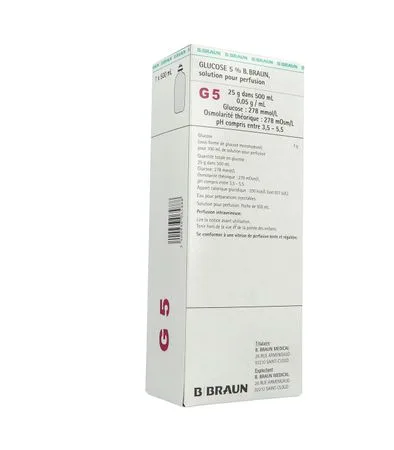
GLUCOSE 5 % B.BRAUN, solution for infusion
Forms and presentations
Solution for infusion.
Clear, colourless or slightly yellowish aqueous solution.
Glucose: 278 mmol/L
Theoretical osmolarity: 278 mOsm/L.
pH between 3,5 - 5,5
Composition
Glucose..................................................................................................................................................................... 5g
(in the form of glucose monohydrate)
For 100 mL of infusion.
A pouch of 50 mL contains 2,5 g of glucose
A pouch of 100 mL contains 5 g of glucose
A pouch of 250 mL contains 12,5 g of glucose
A pouch of 500 mL contains 25 g of glucose
A pouch of 1000 mL contains 50 g of glucose
Carbohydrate caloric intake: 200 kcal/L (i.e. 837 kJ/L)
Water for injections.
Indications
• Moderate carbohydrate caloric intake (200 kcal/L) ;
• Prevention of intra and extracellular dehydrations ;
• Rehydration when there is a water loss greater than the electrolyte loss ;
• Prophylaxis and treatment of ketosis in malnutritions ;
• Vehicle or diluent for therapeutic supply in the preoperative, perioperative and immediate postoperative period.
Dosage and administration
Dosage
The dosage and the dosage of a glucose solution for intravenous use depend on several factors including the age, weight and clinical condition of the patient. Serum glucose concentrations may require close monitoring.
The recommended dosage for the treatment of water and carbohydrate depletion is as follows:
Adults : 500 mL to 3 litres/24 h.
Paediatric population
The infusion rate and volume depend on the age, weight, clinical and metabolic status of the patient, and concomitant treatment. The solution must be administered by experienced personnel.
• 0-10 kg body weight: 100 mL/kg/24 h.
• 10-20 kg body weight: 1000 mL + 50 mL /kg above 10 kg / 24 h.
• > 20 kg body weight: 1500 mL + 20 mL / kg above 20 kg / 24 h.
The infusion rate must not exceed the patient's glucose oxidation capacities (ex., disturbance of oxidative glucose metabolism in the early postoperative or post-traumatic period or in the presence of hypoxia or organ failure), in order to avoid hyperglycemia. Therefore, the maximum doses range from 5 mg/kg/min for adults and 10-18 mg/kg/min for newborns, infants and children, depending on age and total body mass.
When the GLUCOSE 5 % B.BRAUN infusion solution is used as a vehicle or diluent for injectable preparations of other medicines, the dosage and infusion rate will mainly depend on the nature and dosage of the medicine to be administered.
Fluid balance, serum glucose, serum sodium and other electrolytes may be monitored before or during administration, particularly in patients with excessive non-osmotic release of vasopressin (syndrome of inappropriate antidiuretic hormone secretion, SIADH) and in patients treated concomitantly with vasopressin agonist medicines, due to the risk of hyponatremia.
Monitoring of serum sodium is particularly important for physiologically hypotonic solutions. GLUCOSE 5 % B.BRAUN may become extremely hypotonic after administration due to the metabolism of glucose in the body (see sections Warnings and precautions, Interactions and Adverse effects).
Method of administration
Intravenous infusion.
When the solution is used for the dilution and administration of additional medicines by intravenous infusion, the instructions for use of the added substances will determine the appropriate volumes for each treatment.
For the precautions to be taken before handling or administering the medicine, see section Disposal and handling.
Contraindications
• Hypersensitivity to maize (see sections Warnings and precautions and Adverse effects),
• Uncontrolled hyperglycemia,
• Decompensated diabetes,
• Other known glucose intolerances (ex., situations of metabolic stress, acute shock states, collapse),
• Hyperosmolar coma,
• Hyperlactatemia,
• Metabolic acidosis,
• Fluid overload. The administration of large volumes may in particular give rise, due to fluid overload, to the following contraindications:
- Hyperhydration,
- Acute heart failure,
- Pulmonary edema.
The solution must not be used alone for fluid supply or rehydration as it does not contain electrolytes (see section Warnings and precautions).
Warnings and precautions
Observe a slow infusion rate to avoid the occurrence of undesirable osmotic diuresis. Particular clinical monitoring is necessary at the start of any intravenous infusion. Administration must be performed under regular and attentive monitoring.
GLUCOSE 5 % B.BRAUN, solution for infusion is an isotonic solution. However, in the body, solutions containing glucose may become extremely hypotonic from a physiological standpoint due to the rapid metabolism of glucose (see section Dosage and administration).
The infusion must be stopped immediately in case of appearance of abnormal signs or symptoms of an allergic reaction (such as sweating, fever, chills, headaches, skin rashes or dyspnea). GLUCOSE 5 % B.BRAUN, solution for infusion contains glucose derived from maize, which causes hypersensitivity reactions in patients allergic to maize.
GLUCOSE 5 % B.BRAUN, solution for infusion must not be used for fluid substitution without appropriate electrolyte supply, particularly in rehydration treatments, as its administration may lead to a significant decrease in serum electrolytes (severe hyponatremia and hypokalemia) (see sections Contraindications and Adverse effects), as well as the occurrence of adverse effects such as brain damage or cardiac impairment.
Depending on the tonicity of the solution, the volume and the rate of infusion, as well as the patient's underlying clinical condition and ability to metabolize glucose, intravenous administration of glucose may cause electrolyte imbalances, the most important of which is hypo-osmotic or hyperosmotic hyponatremia.
Due to the risk of severe lactic acidosis and/or Wernicke's encephalopathy, any pre-existing thiamine (vitamin B1) deficiency must be corrected prior to intravenous administration of solutions containing glucose.
Hyponatremia
Patients with non-osmotic release of vasopressin (e.g. in cases of acute conditions, pain, postoperative stress, infections, burns, and central nervous system disorders), patients with cardiac, hepatic and renal disorders as well as patients exposed to vasopressin agonists (see section Interactions) are at particularly high risk of acute hyponatremia related to infusion of hypotonic solutions.
Acute hyponatremia may lead to acute hyponatremic encephalopathy (cerebral edema) characterized by headache, nausea, convulsions, lethargy and vomiting. Patients with cerebral edema are at particularly high risk of severe, irreversible and life-threatening brain injury.
Children, women of childbearing potential and patients with reduced cerebral compliance (e.g. following meningitis, intracranial bleeding or cerebral contusion) are at particularly high risk of severe and life-threatening cerebral edema due to acute hyponatremia.
Infusion of large volumes must be performed under particular monitoring in patients with water intoxication, severe cardiac, pulmonary or renal failure, and/or oliguria/anuria.
Administration of the infusion solution GLUCOSE 5 % B.BRAUN may cause hyperglycemia. In this context it is recommended not to use this solution after an ischemic stroke as hyperglycemia has been implicated in increased brain injury and deterioration of recovery.
Infusion of glucose solution is not recommended within the 24 hours following head trauma and blood glucose concentration must be monitored closely during episodes of intracranial hypertension. Administration of glucose solutions to patients with impairment of the blood-brain barrier may result in increased intracranial/intramedullary pressure.
Biological and clinical parameters, in particular blood glucose, must be monitored.
If hyperglycemia occurs, adjust the infusion rate and/or administer insulin. If necessary, provide parenteral potassium supplements.
Glucose tolerance may deteriorate in patients with renal failure or diabetes.
In diabetic or renal failure patients, monitor blood glucose and glycosuria closely and adjust the dosage of hypoglycemic treatment and/or potassium if necessary.
Addition of a medicinal product or use of an incorrect administration technique may result in febrile reactions due to possible introduction of pyrogenic substances. In case of an adverse effect, the infusion must be stopped immediately.
In case of addition of a medicinal product, check compatibility, clarity and color before use (see section Incompatibilities).
Do not store the mixture (see section Disposal and handling)
Extravasation
The catheter site must be checked regularly for signs of extravasation. In case of extravasation, administration must be stopped immediately while keeping the cannula or inserted catheter in place for immediate patient management. If possible, aspiration must be performed through the inserted cannula/catheter in order to reduce the amount of fluid present in the tissues before removing the cannula/catheter. If an extremity is affected, the affected limb must be elevated.
Depending on the extravasated product (including products mixed with GLUCOSE 5 % B.BRAUN, if applicable) and the stage/extent of any lesions, appropriate specific measures must be taken. Therapeutic options may include non-pharmacological, pharmacological and/or surgical interventions. In case of deterioration of the affected area (persistent pain, necrosis, ulceration), a plastic surgeon must be consulted immediately (see section Adverse effects).
The extravasation site must be checked at least every 4 hours during the first 24 hours, then once daily.
Refeeding syndrome
Refeeding of severely malnourished patients may result in refeeding syndrome which is characterized by the shift of potassium, phosphorus and magnesium into the intracellular space as the patient becomes anabolic. Thiamine deficiency and water retention may also develop. Implementation of close monitoring and gradual increase in nutrient intakes while avoiding overfeeding may prevent these complications.
Risk of air embolism (see section Disposal and handling)
Geriatric population
When selecting the type of infusion solution and the volume/infusion rate for an elderly patient, it is necessary to take into consideration the susceptibility of these patients to cardiac, renal, hepatic or other diseases, as well as their concomitant medicinal treatments.
Paediatric population
The infusion rate and volume depend on the age, weight, metabolic and clinical condition of the patient, associated treatment, and must be determined by an experienced physician.
Newborns, particularly premature infants and those with low birth weight, are at high risk of developing hypo- or hyperglycemia and therefore require close monitoring throughout treatment with intravenous glucose solutions, in order to ensure appropriate glycemic control and avoid possible long-term adverse effects.
Hypoglycemia in newborns may result in convulsions, coma, and brain injury.
Hyperglycemia in newborns has been associated with cases of intraventricular hemorrhage, late-onset bacterial and fungal infection, retinopathy of prematurity, necrotizing enterocolitis, bronchopulmonary dysplasia, prolonged hospitalization and death.
Children, infants and newborns are at increased risk of developing hypo-osmotic hyponatremia as well as hyponatremic encephalopathy. Thus, plasma electrolyte concentrations must be closely monitored in the pediatric population.
Rapid correction of hypoosmotic hyponatremia is potentially dangerous (risk of serious neurological complications). The dosage, rate and duration of administration must be determined by an experienced physician.
In order to avoid excessive infusion of intravenous solutions that is potentially fatal in the newborn, particular attention must be paid to the mode of administration. When using a syringe pump for the administration of solutions or medications intravenously to newborns, the fluid bag must not remain connected to the syringe.
When using an infusion pump, all clamps of the intravenous administration set must be closed before removing the administration set or before turning off the pump. This is necessary whether or not the administration set has an anti-free flow device.
The intravenous infusion device and administration equipment must be checked regularly.
Interactions
Medicines increasing the effect of vasopressin
The medicines listed below increase the effect of vasopressin, which leads to a decrease in renal excretion of water without electrolyte and an increase in the risk of nosocomial hyponatremia following treatment with incorrectly balanced intravenous fluids (see sections Dosage and administration, Warnings and precautions and Adverse effects).
• Medicines stimulating the release of vasopressin, ex.: chlorpropamide, clofibrate, carbamazepine, vincristine, selective serotonin reuptake inhibitors, 3,4-methylenedioxy-N-methamphetamine, ifosfamide, antipsychotics, narcotics.
• Medicines potentiating the release of vasopressin, ex.: chlorpropamide, non-steroidal anti-inflammatory drugs (NSAIDs), cyclophosphamide.
• Vasopressin analogues, ex.: desmopressin, oxytocin, vasopressin, terlipressin.
Among other medicines that also increase the risk of hyponatremia are diuretics in general and antiepileptics such as oxcarbazepine.
Do not administer blood simultaneously, by means of the same infusion device, due to the risk of pseudo-agglutination and hemolysis.
As with all parenteral solutions, the compatibility of additives with the solution must be verified before administration of this medicine (see section Incompatibilities).
Fertility, pregnancy and breastfeeding
In view of the available data, use in pregnant or breastfeeding women is possible.
The risks and benefits for each patient must be carefully considered before administering the glucose solution.
Intravenous glucose infusion during delivery may lead to fetal insulin production, with an associated risk of fetal hyperglycemia and metabolic acidosis as well as rebound hypoglycemia in the newborn.
Particular precautions are required when administering GLUCOSE 5 % B.BRAUN to pregnant women during labor, especially if administered in combination with oxytocin, due to the risk of hyponatremia (see sections Warnings and precautions, Interactions and Adverse effects).
Driving and using machines
GLUCOSE 5 % B.BRAUN, solution for infusion has no effect or only a negligible effect on the ability to drive vehicles and use machines.
Adverse effects
The adverse effects that may occur in patients treated with GLUCOSE 5 % B.BRAUN by intravenous infusion are indicated below.
The adverse effects listed in this section are mentioned according to the following convention: very common (≥1/10), common (≥1/100 and <1/10), uncommon (≥1/1 000 and <1/100), rare (≥1/ 10 000 and <1/1 000), very rare (<1/10 000) and frequency indeterminate (cannot be estimated from the available data).
|
System organ class (SOC) |
Adverse effect (MedDRA Term) |
Frequency
|
|
Immune system disorders |
Anaphylactic reaction* Hypersensitivity* |
Indeterminate |
|
Metabolism and nutrition disorders |
Electrolyte imbalance Nosocomial hyponatremia*** Hypokalemia Hypomagnesemia Hypophosphatemia Hyperglycaemia Dehydration Hypervolaemia Hyperlactataemia |
Indeterminate |
|
Nervous system disorders |
Hyponatraemic encephalopathy*** |
Indeterminate |
|
Vascular disorders |
Venous thrombosis Thrombophlebitis |
Indeterminate |
|
Renal and urinary disorders |
Polyuria Glycosuria |
Indeterminate |
|
General disorders and administration site conditions |
Chills* Fever* Infusion site infection Infusion site irritation Extravasation Local reaction Local pain** Necrosis / ulcer** |
Indeterminate |
* Potential manifestation in patients with a corn allergy (see sections Contraindications and Warnings and precautions).
** Adverse reactions that may be associated in particular with extravasation.
*** Nosocomial hyponatraemia may cause irreversible brain damage and lead to death due to the development of acute hyponatraemic encephalopathy (see sections Dosage and administration and Warnings and precautions).
When GLUCOSE 5 % B.BRAUN, solution for infusion is used as a vehicle or diluent for injectable preparations of other medicinal products, other adverse reactions associated with the medicinal product added to the solution may occur.
Reporting of suspected adverse reactions
Reporting suspected adverse reactions after authorisation of the medicinal product is important. It allows continued monitoring of the benefit/risk balance of the medicinal product. Healthcare professionals report any suspected adverse reaction via the national reporting system: Agence nationale de sécurité du médicament et des produits de santé (ANSM) and network of Regional Pharmacovigilance Centres - Website: https://signalement.social-sante.gouv.fr/.
Overdose
Symptoms
Prolonged administration or rapid infusion of large volumes of GLUCOSE 5 % B.BRAUN infusion solution may cause two types of life-threatening adverse reactions (see sections Warnings and precautions and Adverse effects) :
- due to hyperglycaemia: hyperosmolarity leading to hyponatraemia, cellular dehydration, hyperglycaemia, glycosuria, osmotic diuresis, which may progress to extracellular dehydration, hyperosmolar hyperglycaemic coma and electrolyte imbalances, including losses of sodium and potassium (see section Warnings and precautions) and acid-base disturbances.
- due to the amount of free water (once glucose has been metabolised): fluid overload with oedema or water intoxication, leading to severe acute hypoosmotic hyponatraemia, resulting in cellular hyperhydration, and potentially life-threatening cerebral oedema (hyponatraemic encephalopathy). Symptoms include convulsions, nausea, lethargy and vomiting (see sections Warnings and precautions and Adverse effects).
Severe hyperglycemia and hyponatremia can be fatal.
Treatment
A clinically significant overdose of glucose solutions therefore constitutes a medical emergency.
Depending on the type and severity of the disorders: immediate discontinuation of the infusion, initiate symptomatic and supportive treatment adapted as needed (including administration of electrolytes, diuretics or insulin).In case of use as a diluent for injectable preparation other medicines, other overdose symptoms related to this medicine may occur. Also refer to the summary of product characteristics for this medicine.
Rapid correction of hyponatremia can be life-threatening due to the risk of osmotic demyelination and serious neurological complications. Treatment and monitoring must be determined by an experienced physician.
Pharmacodynamics
Pharmacotherapeutic class: INTRAVENOUS SOLUTIONS
ATC code: B05BA03
(B: blood and blood-forming organs)
Isotonic glucose solution (osmolarity: 278 mOsm/L).
The pharmacological properties are those of glucose with a carbohydrate caloric intake of 200 kcal/L.
Glucose, a substrate of the body's cells, is metabolized ubiquitously. Under physiological conditions, glucose is the main source of energy with a caloric value of approximately 17 kJ/g or 4 kcal/g.
In case of addition of a medicine, the pharmacodynamics of the preparation will also depend on the added medicine.
Pharmacokinetics
Absorption
Bioavailability
As the solution is administered intravenously, its bioavailability is 100 %.
Distribution
After administration, glucose first passes into the intravascular compartment, then into the intracellular compartment.
Biotransformation
During glycolysis, glucose is metabolized to pyruvate. Under aerobic conditions, pyruvate is completely oxidized to give carbon dioxide and water. In case of hypoxia, pyruvate is converted to lactate.
Elimination
The final metabolites from the complete oxidation of glucose are eliminated by the lungs as carbon dioxide and by the kidneys as water.
In healthy subjects, glucose is practically not eliminated by the kidneys.
In pathological metabolic states associated with hyperglycemia (e.g. diabetes or post-aggression syndrome), glucose is excreted by the kidneys.
In case of addition of a medicine, the pharmacokinetics of the preparation will also depend on the added medicine.
Preclinical safety
Safety data concerning glucose in animals are not applicable to humans, given that glucose is a normal component of plasma both in animals and in humans.
The safety data of the additive must be considered separately.
INCOMPATIBILITIES
As with all parenteral solutions, the compatibility of medicines with the solution must be verified before addition.
The incompatibility of the medicine with respect to the GLUCOSE 5 % B.BRAUN solution must be determined by checking for any possible color change and/or any possible formation of precipitate, insoluble complex or crystals. Also refer to the package insert accompanying the medicine to be added.
In case of addition of a medicine, check if the medicine is compatible with the pH range of the GLUCOSE 5 % B.BRAUN solution.
When a compatible medicinal product is added to the GLUCOSE 5 % B.BRAUN solution, the mixture must be administered immediately.
Medicinal products known to be incompatible must not be used.
Do not administer blood simultaneously, using the same infusion device, due to the risk of pseudo-agglutination and haemolysis (see section Interactions).
Shelf life
Before opening
ECOFLAC bags
3 years.
ECOBAG bags of 50 mL
11 months.
ECOBAG bags of 100 mL
20 months.
ECOBAG bags of 250 mL, 500 mL and 1 000 mL
2 years.
In-use shelf life
After opening/dilution, the product must be used immediately.
Special storage precautions
For ECOBAG bags of 50 mL
Store at a temperature not exceeding 25°C.
For ECOFLAC, SOLUFLEX, ECOBAG bags of 100 mL, 250 mL, 500 mL and 1000 mL
This medicinal product does not require any special storage precautions.
For the storage conditions of the medicinal product after first opening/dilution, see section Shelf life.
SPECIAL PRECAUTIONS FOR DISPOSAL AND HANDLING
Do not use if the packaging/bag is damaged.
Do not reuse: single use.
Discard any partially used bag.
Do not reconnect a partially used bag.
Remove the overwrap just before use (ECOBAG bag). The primary packaging maintains the sterility of the product.
In case of addition of a medicinal product, mix the solution well before use.
The solution must be visually inspected to detect any particles, any damage to the bag and any visible signs of deterioration before administration.
In case of addition of a medicinal product, the solution must be administered with sterile equipment and using an aseptic technique.
Any unused product or waste must be disposed of in accordance with current regulations.
Risk of air embolism
• Do not use plastic bags for serial connections. This use could lead to gas embolism due to aspiration of residual air from the first bag before the end of administration of solution from the second bag.
• Applying pressure to the flexible plastic container containing the intravenous solution to increase the flow rate may lead to gas embolism if the residual air contained in the container is not completely evacuated before administration.
• The use of an intravenous administration set with an air inlet in the open position could lead to gas embolism. Intravenous administration sets with an air inlet in the open position must not be used with flexible plastic containers.
Prescription, supply and reimbursement
| MA |
|
| Price: |
|
Hospital model(s) (ECOFLAC bag/50ml, 20Bag/100ml, 20Bag/250ml, 10Bag/500ml, 10Bag/1000ml).
Collect.
26 ARMENGAUD STREET
92210 SAINT-CLOUD
Tel: 01 41 10 53 00 infofrance@bbraun.fr
https://www.bbraun.fr/
Source: VIDAL · Updated on 10/11/2026. This information does not replace advice from a healthcare professional.