
Medicines
SmPC of 22/04/2025
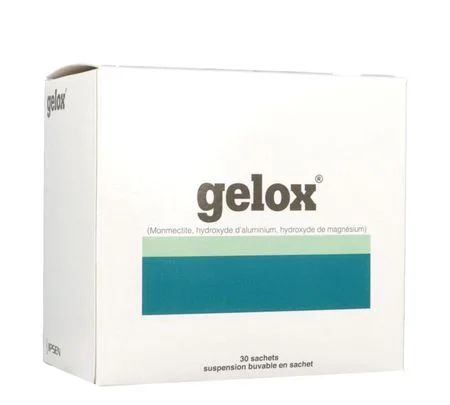
GELOX, oral suspension in sachet
Composition
Montmorillonite................................................................................................................................. 2,5000 g
Aluminium hydroxide (expressed as Al2O3) ............................................................................... 0,4250 g
Magnesium hydroxide (expressed as MgO)............................................................................ 0,4500 g
Per sachet.
Excipients with known effect: one sachet contains sucrose (2,5000 g), sorbitol (0,5000 g), alcohol (0,2300 g), methyl parahydroxybenzoate (E218) (0,0190 g), propyl parahydroxybenzoate (E216) (0,0047 g).
Sucrose, sorbitol at 70 % crystallizable (expressed as sorbitol), flavouring*, alcohol, methyl parahydroxybenzoate (E218), propyl parahydroxybenzoate (E216), levomenthol, purified water.
* Composition of the flavouring : artificial aromatic composition containing a mixture of fruit alcoholates, mainly that of mirabelle plum.
Indications
Symptomatic treatment of painful manifestations during oesophago-gastro-duodenal disorders in adults.
Dosage and administration
Dosage
Oral use.
1 sachet at the time of pain, without exceeding 6 intakes per day.
The duration of treatment should not exceed 7 days without medical advice.
Method of administration
Shake well before opening the sachet. The contents of the sachet may be swallowed neat or diluted in half a glass of water.
Contraindications
Hypersensitivity to the active substances or to any of the excipients listed in section Composition.
Linked to the presence of magnesium: severe renal impairment.
Linked to the presence of clay: stenosing disorders of the digestive tract.
Warnings and precautions
In renally impaired patients and chronic dialysis patients, take into account the aluminium content (risk of encephalopathy).
This medicine contains 2,4 % vol of ethanol (alcohol), i.e. up to 230 mg per sachet, equivalent to 7,2 ml of beer, 3 ml of wine per sachet. The use of this medicine is dangerous in alcoholic subjects and should be taken into account in pregnant or breastfeeding women, children and high-risk groups such as patients with hepatic impairment or epileptics.
This medicine contains sucrose. Its use is not recommended in patients with fructose intolerance, glucose-galactose malabsorption syndrome or sucrase/isomaltase deficiency.
This medicine contains 2,5 g of sucrose per dose, which must be taken into account in the daily ration in case of a low-sugar diet or diabetes.
This medicine contains sorbitol. Its use is not recommended in patients with fructose intolerance (a rare hereditary disease).
This medicine contains "methyl parahydroxybenzoate (E218) and propyl parahydroxybenzoate (E216) and may cause allergic reactions (possibly delayed).
Interactions
Antacids interact with certain other medicines taken orally.
Combinations not recommended
Quinidine-type drugs: Increase in plasma levels of quinidine and risk of overdose (decreased renal excretion of quinidine due to urinary alkalinization). Use another antacid.
Associations requiring precautions for use
A decrease in the digestive absorption of concomitantly administered medicines is observed.
As a precaution, antacids should be taken apart from other medicines.
Space the intake of this medicine by more than 2 hours, if possible, from:
- Acetylsalicylic acid
- H2 antihistamine antisecretories
- Atenolol
- Bisphosphonates
- Sodium sulfonate cation exchange resin (reduced capacity of the resin to bind potassium, with risk of metabolic alkalosis in patients with renal insufficiency).
- Chloroquine
- Cyclines
- Digitalis glycosides
- Ethambutol
- Iron
- Fexofenadine
- Fluorine
- Fluoroquinolones
- Glucocorticoids except hydrocortisone in replacement therapy (described for prednisolone and dexamethasone)
- Thyroid hormones
- Indomethacin
- Isoniazid
- Ketoconazole (decreased digestive absorption due to increased gastric pH)
- Lansoprazole
- Lincosamides
- Metoprolol
- Phenothiazine neuroleptics
- Penicillamine
- Phosphorus
- Propranolol
- Sulpiride
Associations to be taken into account
- Ulipristal
Risk of decreased effect of ulipristal due to decreased absorption.
Fertility, pregnancy and breastfeeding
Pregnancy
There are no data or there are limited data (fewer than 300 pregnancies) on the use of GELOX in pregnant women.
Studies performed in animals are insufficient to allow a conclusion regarding reproductive toxicity.
GELOX is not recommended during pregnancy.
Breast-feeding
There are limited data on the use of GELOX during breastfeeding.
GELOX is not recommended during breastfeeding.
Fertility
The effect on human fertility has not been studied.
Driving and using machines
No effect on the ability to drive vehicles or use machines has been observed.
Adverse effects
Related to aluminium: phosphate depletion with prolonged use or high doses.
Reporting of suspected adverse reactions
Reporting suspected adverse reactions after authorisation of the medicinal product is important. It allows continued monitoring of the benefit/risk balance of the medicinal product. Healthcare professionals are asked to report any suspected adverse reactions via the national reporting system: National Agency for the Safety of Medicines and Health Products (ANSM) and the network of Regional Pharmacovigilance Centres - Website: https://signalement.social-sante.gouv.fr/.
Pharmacodynamics
Pharmacotherapeutic class: Antacid, other combination, ATC code: A02AX.
GELOX results from the combination of 3 active ingredients, aluminium hydroxide, magnesium hydroxide and montmectite:
- The presence of aluminium and magnesium hydroxides gives it an antacid action,
- The presence of montmectite gives it an adsorbent and coating action.
Study in vitro of a unit dose according to the Vatier method:
- Total antacid capacity (titration to pH 1): 44,9 mmol/sachet
- Mechanism of action:
- neutralising capacity (rise in pH) = 15 %
- buffering capacity (maintenance around a fixed pH) = 85 %
- Theoretical protection capacity:
- from pH 1 to pH 2: 26,7 mmol/sachet
- from pH 1 to pH 3: 31,1 mmol/sachet
Prescription, supply and reimbursement
| Marketing authorisation (AMM) |
|
| Price: |
|
Collection.
3 PLACE RENAULT
92500 RUEIL-MALMAISON
Source: VIDAL · Updated on 10/11/2026. This information does not replace advice from a healthcare professional.