
Medicines
Update of the 19/03/2024
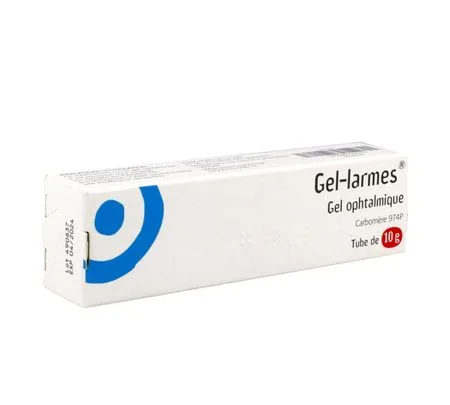
GEL-LARMES®
carbomer
Forms and presentations
Ophthalmic gel:Tube of 10 g, with cannula.
Single-dose containers, box of 30.
Composition
| tube | single-dose p | |
| Carbomer (Carbopol 974 P)*
|
30 mg | 1,5 mg |
Excipient with known effect (tube): benzalkonium chloride (0,5 mg/tube of 10 g).
This medicine (tube) contains 0,0023 mg of benzalkonium chloride per drop of gel, equivalent to 0,05 mg/g.
* Synthetic polymer of high molecular weight of cross-linked acrylic acid.Indications
Symptomatic treatment of dry eye syndrome.Dosage and administration
DosageBy instillation into the conjunctival sac at a rate of one drop 2 to 4 times per day, and whenever eye disorders related to hypolacrimation are felt.
- Paediatric population:
-
- Children and adolescents up to the age of 18 years:
- The safety and efficacy of Gel-Larmes ophthalmic gel at the dosage recommended in adults has been established by clinical experience, but no clinical study data are available.
Contraindications
- Hypersensitivity to the active substance or to any of the excipients listed in section Composition.
- Soft contact lens wearers (Gel-Larmes in tube).
Warnings and precautions
- Single-dose containers:
-
- Do not inject, do not swallow.
- The ophthalmic gel must not be administered by peri- or intraocular injection.
- The single-dose container must be discarded immediately after use and must not be kept for later use.
- Avoid touching the eye with the tip of the single-dose container.
- The single-dose container contains sufficient ophthalmic gel for the treatment of 2 eyes.
- Do not inject, do not swallow.
- Tube:
-
- Related to benzalkonium chloride:
- This medicine contains 0,0023 mg of benzalkonium chloride per drop of gel, equivalent to 0,05 mg/g.
- Benzalkonium chloride is known to cause eye irritation, symptoms of dry eye syndrome, and may affect the tear film and the corneal surface. It should be used with caution in patients with dry eye and those at risk of corneal damage.
- Patients should be monitored in case of prolonged use.
- Benzalkonium chloride may be absorbed by soft contact lenses and change their colour. Patients must be informed that they should remove contact lenses before using this medicine and wait at least 15 minutes before reinserting them.
Interactions
If concomitant treatment with another eye drop is used, space the instillations by 15 minutes.
Gel-Larmes, ophthalmic gel must be the last product instilled.
Fertility, pregnancy and breastfeeding
Given the available data, use in pregnant or breastfeeding women is possible.
Driving and using machines
Brief visual disturbance may occur after instillation of the product.Adverse effects
Brief visual disturbance may occur after instillation of the product until the gel spreads evenly over the surface of the eye.
Reporting of suspected adverse reactions:Reporting suspected adverse reactions after authorisation of the medicinal product is important. It allows continuous monitoring of the benefit/risk balance of the medicinal product. Healthcare professionals should report any suspected adverse reaction via the national reporting system: National Agency for the Safety of Medicines and Health Products (ANSM) and the network of Regional Pharmacovigilance Centres. Website: https://signalement.social-sante.gouv.fr.
Overdose
In case of overdose, rinse with sterile physiological saline.
Pharmacodynamics
Pharmacotherapeutic class: Other ophthalmological preparations, ATC code: S01XA20.
- Mechanism of action:
- Gel-Larmes, an ophthalmic gel based on a high molecular weight hydrophilic polymer (carbomer 974 P), forms a transparent, lubricating and wetting film on the surface of the eye. Its pH and osmolality are similar to those of normal tear film. Gel-Larmes relieves irritation symptoms associated with dry eye syndrome and protects the cornea against drying out.
- Clinical efficacy and safety:
- The use of vital dyes showed, under treatment with Gel-Larmes, a regression of corneal and conjunctival epithelial lesions associated with dry eye. The persistence of the gel on the surface of the eye is longer than that of a low-viscosity artificial tear, which translates into a prolonged duration of efficacy on symptoms and therefore a lower frequency of administration.
Preclinical safety
In animals, toxicology studies of carbomer under repeated administration did not reveal any particular risk for humans. No data on carcinogenicity, mutagenicity or reproductive toxicity are available.
Ocular toxicity: ocular administration of one drop of Gel-Larmes, 4 times daily for 5 weeks in animals, had no local or systemic toxic effect.
Storage conditions
- Tubes:
-
- Shelf life of tubes before opening:
- 3 years.
- Store at a temperature not exceeding 25 °C.
- After opening : the product must not be kept for more than 4 weeks.
- Single-dose containers:
-
- Shelf life of single-dose containers:
- 2 years.
- Store at a temperature not exceeding 25 °C.
- After first opening of the sachet : use the single-dose containers within 30 days of opening.
- After opening a single-dose container : use immediately and discard after use.
HANDLING/DISPOSAL INSTRUCTIONS
No special requirements.
Prescription, supply and reimbursement
| Marketing authorisation (AMM) | 3400933194819 (1989, SmPC rev 08.06.2020) tube 10 g. |
| 3400935650627 (1992, SmPC rev 09.04.2019) 30 single-doses. |
| Price: | 2,99 euros (tube of 10 g). |
| 3,37 euros (30 unit-dose vials). | |
| Reimbursed by Social Security at 65 %. Collective. | |
THÉA PHARMA
37, rue Georges-Besse
63100 Clermont-Ferrand
http://www.theapharma.fr
Source: VIDAL · Updated on 10/11/2026. This information does not replace advice from a healthcare professional.