
Medicines
SmPC of 28/12/2023
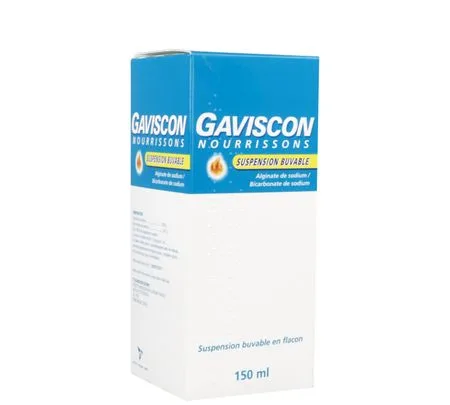
GAVISCON INFANTS, oral suspension in bottle
Composition
For 100 ml :
Sodium alginate: 5,00 g
Sodium bicarbonate: 2,67 g
The sodium content is 71,5 mg per 5 ml.
Excipients with known effect:
One dose of 5 ml contains: 20 mg of methyl parahydroxybenzoate, 3 mg of propyl parahydroxybenzoate, 71,5 mg of sodium and 9,2 mg of propylene glycol.
Calcium carbonate, carbomer, sodium saccharin, banana flavouring*, sodium hydroxide, methyl parahydroxybenzoate (E218), propyl parahydroxybenzoate (E216), purified water.
*Composition of banana flavouring: acetaldehyde, hexyl acetate, isoamyl acetate, isobutyl acetate, benzyl acetate, trans-hex-2-enyl acetate, acetoin, acetic acid, isovaleric acid, methyl-2 butyric acid, amyl alcohol (mixture of isomers), isopropyl alcohol, isoamyl alcohol, phenylethyl alcohol, propionaldehyde, n-butanol, butyraldehyde, amyl/isoamyl butyrate, ethyl butyrate, isoamyl butyrate, isobutyl butyrate, butyl butyrate, methyl cinnamate, eugenol, butyl formate, trans-hexen-2-al, cis-3-hexenol, 4-hydroxy-2,5-dimethyl-3(2H)-furanone, linalyl isobutyrate, isoamyl isovalerate, octanol-2, isobutyl propionate, propylene glycol, vanillin.
Dosage and administration
Dosage
This medicine is intended for infants and children (up to 6 years).
Oral suspension (bottle with dosing pipette graduated in ml): from 1 to 2 ml/kg/day, to be divided according to the number of meals, administration being given after each bottle or meal.
In practice:
- from 0 to 1 month: 1 ml after each of the 6 meals
- from 1 to 2 months: 1,5 ml after each of the 5 meals
- from 2 to 4 months: 2 ml after each of the 5 meals
- from 4 to 18 months: 2,5 ml after each of the 4 meals
- beyond 18 months: 5 ml after each of the 4 meals.
1 ml of GAVISCON INFANTS = 50 mg of sodium alginate.
Renal impairment : this medicine must not be used to treat children who suffer from known or suspected renal dysfunction (see section Contraindications).
Method of administration
Oral route only.
The dose of GAVISCON INFANTS should be taken after the meal and not mixed with milk or food.
Shake the bottle well before use.
Instructions for using the pipette:
Disassemble the plunger from the syringe barrel. Rinse and then thoroughly dry the pipette after each use. Once dry, reinsert the plunger into the syringe barrel.
Treatment will be continued until the symptoms disappear. In parallel with the use of this medicine, it is recommended to advise certain hygienic and dietary measures: thickening of the diet, splitting of meals.
Contraindications
Hypersensitivity to the active substances or to any of the excipients listed in section Composition.
This medicine must not be used in children who suffer from known or suspected renal dysfunction because the sodium it contains may increase the risk of hypernatraemia.
Warnings and precautions
If there is no improvement in symptoms after 7 days, the clinical situation should be reconsidered.
This medicine contains 71,5 mg of sodium per 5 ml, which is equivalent to 3,6 % of the maximum daily dietary intake of sodium recommended by the WHO of 2 g of sodium for adults.
To be taken into account in patients following a strict low-sodium diet.
This medicine contains calcium: 16 mg of calcium carbonate per ml. Particular attention should be paid when treating children with known or suspected hypercalcaemia, nephrocalcinosis or recurrent renal calcium lithiasis.
Medical advice is required before simultaneous use with thickeners or infant milks containing thickeners, and it is necessary to strictly observe the recommended dosages for each product.
This medicine contains propyl parahydroxybenzoate and methyl parahydroxybenzoate and may cause allergic reactions (possibly delayed).
A significant or lasting change in intestinal transit or stool consistency, such as diarrhoea or constipation, should be investigated.
This medicine contains 9,2 mg of propylene glycol per 5 ml. Concomitant administration of any substrate for alcohol dehydrogenase, such as ethanol, may induce serious adverse effects in newborns.
Interactions
Associations requiring precautions for use
Simultaneous use with thickeners or infant milks containing thickeners may lead to excessive thickening of the gastric contents. See section Warnings and precautions.
An interval of 2 hours should be considered between taking GAVISCON NOURRISSONS and other medicines, such as tetracyclines, fluoroquinolones, iron salts, thyroid hormones, chloroquine, bisphosphonates and estramustine. See also section Warnings and precautions.
Fertility, pregnancy and breastfeeding
This medicine is intended for infants and children (up to 6 years). However, if used in exceptional circumstances in women of childbearing potential, the following points should be recalled:
Given the available data, use in pregnant or breastfeeding women is possible.
It is recommended to limit the daily dose and, if possible, the duration of treatment.
Adverse effects
Related to calcium carbonate:
- with prolonged use, possible occurrence of hypercalcaemia with risk of nephrolithiasis and renal failure.
Adverse effects have been classified under frequency headings according to the following convention: very common (≥ 1/10), common (≥ 1/100 to < 1/10), uncommon (≥ 1/1 000 to < 1/100), rare (≥ 1/10 000 to < 1 000), very rare (< 1/10 000), not known (cannot be estimated from the available data).
|
System Organ Classes |
Frequency |
Adverse reaction |
|
Immune system disorders |
Unknown |
Hypersensitivity reactions1 |
|
Gastrointestinal disorders |
Unknown |
Constipation2, nausea, diarrhoea, intestinal obstruction, flatulence, abdominal distension. |
Description of certain adverse effects:
1 Allergic manifestations such as urticaria, pruritus, rash, bronchospasm, anaphylactic or anaphylactoid reactions have been reported.
2 Possible constipation, which is exceptional thanks to the presence of alginate.
Reporting of suspected adverse reactions
Reporting suspected adverse reactions after authorisation of the medicinal product is important. It allows continued monitoring of the benefit/risk balance of the medicinal product. Healthcare professionals are asked to report any suspected adverse reactions via the national reporting system: National Agency for the Safety of Medicines and Health Products (ANSM) and the network of Regional Pharmacovigilance Centres - Website: https://signalement.social-sante.gouv.fr/.
Overdose
Symptoms
An overdose of GAVISCON NOURRISSONS may lead to the formation of an intragastric mass (bezoar).
Management
In case of overdose, treatment must be stopped and symptomatic treatment given.
Pharmacodynamics
Pharmacotherapeutic class: OTHER MEDICINES FOR PEPTIC ULCER AND GASTRO-OESOPHAGEAL REFLUX DISEASE (G.O.R.D), ATC code: A02BX.
The physico-chemical characteristics of the Gaviscon gel, formed on contact with acidic gastric fluid, give it the 3 following properties:
- its lightness allows it to float above the gastric contents at the gastro-oesophageal junction,
- its viscosity and consistency form a physical barrier that opposes reflux (reduction in the number of reflux episodes). In case of severe reflux, the gel regurgitates first into the oesophagus and interposes itself between the oesophageal wall and the irritating gastric fluid,
- its alkaline pH replaces the acidic pH of the refluxed fluid. Gastric pH-metry shows that administration of Gaviscon increases the pH by 2 units at the cardia but does not modify the pH in the rest of the stomach.
Its pharmacological efficacy is confirmed by oesophageal pH-metry studies which show that Gaviscon significantly reduces the overall percentage of time spent at acidic pH in the oesophagus (pH < 4), as well as the number and mean duration of reflux episodes.
Pharmacokinetics
GAVISCON NOURRISSONS immediately transforms in the stomach on contact with acidic fluid into a light, foamy (release of carbon dioxide bubbles), viscous (alginate precipitate) gel, with a pH close to neutral.
This gel persists durably (2 to 4 hours) in the upper part of the stomach and is evacuated progressively as gastric emptying occurs. It does not modify transit.
Alginates (non-absorbable polysaccharides) are completely eliminated via the digestive tract.
Special storage precautions
Store at a temperature not exceeding 25 °C.
For storage conditions of the medicine after first opening, see section Shelf life.
SPECIAL PRECAUTIONS FOR DISPOSAL AND OTHER HANDLING
No special requirements.
Any unused medicinal product or waste material should be disposed of in accordance with local requirements.
Prescription, supply and reimbursement
| Marketing authorisation (AMM) |
|
| Price: |
|
Collection.
RECKITT BENCKISER HEALTHCARE France
38, Victor-Basch Street. CS 11018. 91305 Massy cdx
Tel: 01 69 93 19 00. Fax: 01 69 93 18 71
Pharmacovigilance and medical information:
Tel: 01 69 93 19 00
Source: VIDAL · Updated on 10/11/2026. This information does not replace advice from a healthcare professional.