
Medicines
Update of 13/10/2023
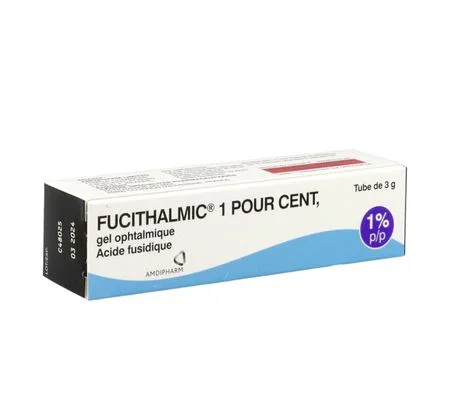
FUCITHALMIC®
fusidic acid
Forms and presentations
Ophthalmic gel at 1 %: Tube of 3 g.Composition
| per tube | |
| Fusidic acid
|
30 mg |
Excipient(s) with known effect: benzalkonium chloride 0,10 mg/g.
Indications
Local antibacterial treatment of conjunctivitis, keratitis, corneal ulcers, blepharitis and stye due to germs sensitive to fusidic acid.Official recommendations concerning the appropriate use of antibacterial agents should be taken into account.
Dosage and administration
DosageOne drop in the lower conjunctival sac morning and evening.
Method of administration:
For ophthalmic use only.
Contraindications
Hypersensitivity to the active substance or to any of the excipients listed in section Composition.Warnings and precautions
Cases of bacterial resistance have been reported with the use of fusidic acid. As with all antibiotics, prolonged or recurrent use of fusidic acid may increase the risk of developing antibiotic resistance.
Contact lenses must not be worn during treatment with Fucithalmic, as the product contains fine particles that may cause corneal damage when lenses are worn.
Contact lenses may be used 12 hours after the end of treatment.
Fucithalmic contains benzalkonium chloride, which may cause eye irritation and discoloration of contact lenses.
Interactions
No interaction studies have been performed. Systemic interactions are unlikely because systemic exposure after application of Fucithalmic is negligible.
Fertility, pregnancy and breastfeeding
Pregnancy:Animal studies have shown no direct or indirect deleterious effect on reproduction. There are limited data on the use of fusidic acid in pregnant women.
Given the expected therapeutic benefit, the use of fusidic acid may be considered during pregnancy if necessary, despite limited clinical data.
Breastfeeding:
Data suggest that fusidic acid passes into breast milk. As a precaution, it is preferable to avoid using fusidic acid during breastfeeding.
Fertility:No clinical studies on the effects of fusidic acid on fertility have been conducted. Preclinical studies in rats showed no effect of fusidic acid on fertility.
Driving and using machines
Fucithalmic has no or negligible effect on the ability to drive vehicles and use machines.However, Fucithalmic may cause blurred vision after application and patients should take this into account.
Adverse effects
The estimation of the frequency of adverse reactions is based on a pooled analysis of data from clinical trials and spontaneous reports.
Based on pooled data from clinical trials including 2499 patients with eye infections, including acute conjunctivitis, who received Fucithalmic, the frequency of adverse reactions was 11,3 %.
The adverse reactions most frequently reported during treatment are application site reactions such as pain, pruritus and irritation/discomfort, occurring in approximately 8,5 % of patients, followed by blurred vision, reported in approximately 1,2 % of patients. Angioedema was reported in a few patients after marketing.
Adverse reactions are classified by system organ class (SOC) according to the MedDRA convention, starting with the most frequently reported. Within each frequency group, adverse reactions are presented in order of decreasing seriousness.
Very common (≥ 1/10), common (≥ 1/100 to < 1/10), uncommon (≥ 1/1000 to < 1/100), rare (≥ 1/10 000 to < 1/1000), very rare (< 1/10 000), frequency not known (cannot be estimated from the available data).
| System organ class | Frequency | Adverse effects |
| Immune system disorders | Uncommon | Hypersensitivity (including rash, angioedema and urticaria) |
| Eye disorders | Common | Blurred vision (transient) |
| Uncommon | Eyelid oedema, increased lacrimation | |
| Rare | Worsening of conjunctivitis | |
| General disorders and application site conditions | Common | Pain at the application site (including burning, stinging) |
| Pruritus at the application site, discomfort/irritation at the application site |
- Paediatric population:
- The observed safety profile is the same in children and adults.
Reporting suspected adverse reactions after authorisation of the medicinal product is important. It allows continuous monitoring of the benefit/risk balance of the medicinal product. Healthcare professionals should report any suspected adverse reaction via the national reporting system: National Agency for the Safety of Medicines and Health Products (ANSM) and the network of Regional Pharmacovigilance Centres. Website: https://signalement.social-sante.gouv.fr.
Overdose
The total amount of fusidic acid contained in a tube of 5 g of Fucithalmic (50 mg) does not exceed the total daily dose approved for products containing fusidic acid taken orally. The concentration of excipients is too low to pose a safety risk. Therefore, overdose is unlikely.
Pharmacodynamics
Pharmacotherapeutic class: Antibiotics (ATC code: S01AA13).
Antibiotics with a steroid structure, from the fusidane family.
- Mechanism of action:
- Antibiotic active on protein synthesis.
- Critical concentrations separate susceptible strains from strains of intermediate susceptibility and the latter from resistant ones: S ≤ 2 mg/l and R > 16 mg/l.
- The prevalence of acquired resistance can vary according to geography and time for certain species. It is therefore useful to have information on local resistance prevalence, especially for the treatment of severe infections. These data can only provide guidance on the probabilities of the susceptibility of a bacterial strain to this antibiotic.
- When the variability of resistance prevalence in France is known for a bacterial species, the frequency of acquired resistance in France (> 10 %) (extreme values) is indicated in parentheses:
-
Susceptible species:
- Aerobic Gram-positive: Staphylococcus aureus, Staphylococcus no aureus (5 - 20 %).
- Anaerobes: Clostridium difficile, Clostridium perfringens, Peptostreptococcus, Propionibacterium acnes.
- Aerobic Gram-positive: Staphylococcus aureus, Staphylococcus no aureus (5 - 20 %).
-
Moderately susceptible species (in vitro of intermediate susceptibility):
- Aerobic Gram-positive: Streptococcus.
- Aerobic Gram-positive: Streptococcus.
-
Resistant species:
- Aerobic Gram-negative: Acinetobacter, enterobacteria, Pseudomonas.
- Aerobic Gram-negative: Acinetobacter, enterobacteria, Pseudomonas.
- This spectrum corresponds to that of the systemic forms of fusidic acid. With the local pharmaceutical presentations, the concentrations obtained in situ are much higher than plasma concentrations. Some uncertainties remain regarding the kinetics of in situ concentrations, the local physicochemical conditions that may modify the activity of the antibiotic, and the stability of the product in situ.
- Fucithalmic has antibacterial activity against most of the germs encountered in external eye infections.
Pharmacokinetics
The gel form of Fucithalmic ensures a prolonged contact time with the eye of at least 12 hours.
Pharmacokinetic studies have shown, after instillation of one drop, that fusidic acid concentrations are therapeutic until the 12e hour.
Consequently, instillation twice a day is sufficient to obtain therapeutic concentrations of fusidic acid.
Fusidic acid penetrates well into the aqueous humour.
Storage conditions
- Shelf life before opening:
- 3 years.
- After opening:
- To be used within 15 days.
HANDLING/DISPOSAL INSTRUCTIONS
No special requirements.
Any unused product or waste must be disposed of in accordance with the regulations in force.
Prescription, supply and reimbursement
LIST I| Marketing authorisation (AMM) | 3400933191337 (1989, SmPC rev 06.04.2023). |
| Price: | 2,58 euros (tube of 3 g). |
| Reimbursed by Social Security at 65 %. Collective. | |
Marketing authorisation holder: Amdipharm Limited, Temple Chambers, 3 Burlington Road, Dublin 4, Ireland.
CSP
76-78, avenue du Midi. CS 30077
63808 Cournon d'Auvergne cdx
Tel: 04 73 69 28 28. Fax: 04 73 69 93 15
Medical information and pharmacovigilance: Tel: 01 47 04 80 46
Source: VIDAL · Updated on 10/11/2026. This information does not replace advice from a healthcare professional.