
Medicines
SmPC of 30/04/2024
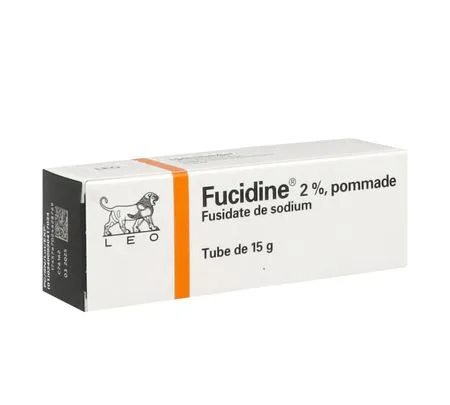
FUCIDINE 2 PERCENT, ointment
Composition
Sodium fusidate ....................................................................................................................... 2,000 g
For 100 g of ointment.
Excipient(s) with known effect: butylhydroxytoluene (E321), cetyl alcohol and lanolin.
Lanolin (contains butylhydroxytoluene (E321)), official white petrolatum (contains tocopherol all-rac-alpha), liquid paraffin (contains tocopherol all-rac-alpha), cetyl alcohol.
Indications
Skin infections due to staphylococcus and streptococcus:
- impetigo and impetiginised dermatoses:
- by local treatment only in localized forms with a small number of lesions;
- as adjunctive topical treatment in association with appropriate systemic antibiotic therapy in the most extensive forms;
- disinfection of cutaneous and mucosal microbial carriage sites, in healthy carriers of staphylococci, and after staphylococcal infection, notably furunculosis.
Official recommendations concerning the appropriate use of antibacterial agents should be taken into account.
Dosage and administration
Dosage
- Topical applications with or without a dressing, once or twice a day after cleansing of the infected surface. Avoid application in a thick layer. Limit treatment to one week, as a guide.
- The cream form is more particularly suited to weeping, macerated lesions and skin folds.
- Do not use the ointment form on weeping or macerated lesions, nor in skin folds, nor on leg ulcers.
Contraindications
Hypersensitivity to the active substance or to any of the excipients listed in section Composition.
Warnings and precautions
Bacterial resistance of Staphylococcus aureus has been reported with the topical use of Fucidine. As with all antibiotics, prolonged or recurrent use of fusidic acid may increase the risk of developing antibiotic resistance.
This medicine contains cetyl alcohol and lanolin and may cause local skin reactions (for example: eczema).
This medicine contains butylhydroxytoluene (E321) and may cause local skin reactions (for example: eczema) or irritation of the eyes and mucous membranes.
If Fucidine is used on the face, the area close to the eye should be avoided, as the excipients present in the ointment form may cause conjunctival irritation.
Interactions
No interaction studies have been performed. Interactions with systemically administered pharmaceutical products are considered minimal, as the systemic absorption of topical Fucidine is negligible.
Fertility, pregnancy and breastfeeding
Pregnancy
No effect during pregnancy is expected as systemic exposure to fusidic acid is negligible.
Topical Fucidine may be used during pregnancy.
Breast-feeding
No effect on breastfed newborns/infants is expected as systemic exposure of the breastfeeding woman to fusidic acid is negligible.
Topical Fucidine may be used during breastfeeding, but it is recommended to avoid applying it to the breast.
Fertility
No clinical studies on the effects of topical Fucidine on fertility have been conducted.
Driving and using machines
Topical Fucidine has no or negligible effect on the ability to drive vehicles and use machines.
Adverse effects
The estimate of the frequency of adverse effects is based on a pooled analysis of data from clinical trials and spontaneous reports.
According to the pooled data obtained in clinical studies including 4 724 patients who were administered Fucidine cream or Fucidine ointment, the frequency of adverse effects amounts to 2,3 %.
The most frequently reported adverse effects are various skin reactions such as pruritus and rash, as well as various reactions limited to the application site, such as pain and irritation; these effects were observed in fewer than 1 % of patients.
Cases of hypersensitivity and Quincke's edema have been reported.
Adverse effects are presented by System Organ Class (SOC) according to the MedDRA classification, and each individual adverse effect is listed in decreasing order of frequency and severity
Very common (≥ 1/10)
Frequent (≥ 1/100 and < 1/10)
Uncommon (≥ 1/1 000 and < 1/100)
Rare (≥ 1/10 000 and < 1/1 000)
Very rare (< 1/10 000)
|
Immune system disorders |
|
|
Rare: (≥ 1/10 000 and < 1/1 000) |
Hypersensitivity |
|
Eye disorders |
|
|
Rare: (≥ 1/10 000 and < 1/1 000) |
Conjunctivitis |
|
Skin and subcutaneous tissue disorders |
|
|
Uncommon: (≥ 1/1 000 and < 1/100) |
Dermatitis (including contact dermatitis, eczema)
|
|
Rare: (≥ 1/10 000 and < 1/1 000) |
Quincke's oedema
|
|
General disorders and administration site conditions |
|
|
Uncommon: (≥ 1/1 000 and < 1/100) |
Pain at the application site (including skin burning sensation), irritation at the application site |
* Different types of rash have been observed, including erythematous, pustular, vesicular, maculo-papular, papular and generalised rashes.
Paediatric population
The frequency, nature and severity of adverse effects in children should be the same as in adults.
Reporting of suspected adverse reactions
Reporting suspected adverse reactions after authorisation of the medicinal product is important. It allows continued monitoring of the benefit/risk balance of the medicinal product. Healthcare professionals are asked to report any suspected adverse reactions via the national reporting system: National Agency for the Safety of Medicines and Health Products (ANSM) and the network of Regional Pharmacovigilance Centres - Website: https://signalement.social-sante.gouv.fr/
Pharmacodynamics
Pharmacotherapeutic class: Topical antibiotic therapy, ATC code: D06AX01.
Sodium fusidate is an antibiotic with a steroid structure, belonging to the fusidane family.
ANTIBACTERIAL ACTIVITY SPECTRUM
Critical concentrations separate susceptible strains from strains of intermediate susceptibility, and the latter from resistant ones:
S ≤ 2 mg/L and R > 16 mg/L
The prevalence of acquired resistance can vary according to geography and time for certain species. It is therefore useful to have information on local resistance prevalence, especially for the treatment of severe infections. These data can only provide guidance on the probabilities of the susceptibility of a bacterial strain to this antibiotic.
Where the variability of resistance prevalence in France is known for a bacterial species, it is indicated in the table below:
|
Categories |
Frequency of acquired resistance in France
|
|
SUSCEPTIBLE SPECIES |
|
|
Gram-positive aerobes |
|
|
Staphylococcus aureus |
|
|
Non-aureus Staphylococcus |
5-20 % |
|
Anaerobes |
|
|
Clostridium difficile |
|
|
Clostridium perfringens |
|
|
Peptostreptococcus |
|
|
Propionibacterium acnes |
|
|
MODERATELY SUSCEPTIBLE SPECIES |
|
|
(in vitro intermediate susceptibility) |
|
|
Gram-positive aerobes |
|
|
Streptococcus |
|
|
RESISTANT SPECIES |
|
|
Gram-negative aerobes |
|
|
Acinetobacter |
|
|
Enterobacterales |
|
|
Pseudomonas |
|
Remark : this spectrum corresponds to that of the systemic forms of fusidic acid. With the local pharmaceutical presentations, the concentrations obtained in situ are much higher than plasma concentrations. Some uncertainties remain regarding the kinetics of the concentrations in situ, the local physicochemical conditions that may alter the activity of the antibiotic, and the stability of the product in situ.
Pharmacokinetics
Fusidic acid, given its surfactant properties and its both lipophilic and hydrophilic character, penetrates well through the skin and is found in all layers of the cutaneous and subcutaneous tissue.
Prescription, supply and reimbursement
| Marketing authorisation (AMM) |
|
IMMEUBLE AMPERE E + LA DÉFENSE 34-40 RUE HENRI REGNAULT
92400 COURBEVOIE-LA-DÉFENSE
Tél : 01 30 14 40 00 leo.group@leo-pharma.com
https://www.leo-pharma.fr/
Source: VIDAL · Updated on 10/11/2026. This information does not replace advice from a healthcare professional.