
Medicines
SmPC of the 25/04/2024
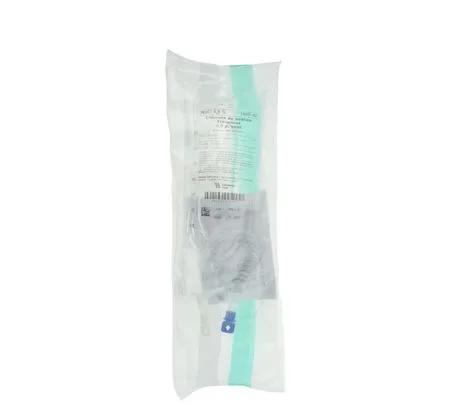
FRESENIUS SODIUM CHLORIDE 0,9 %, solution for infusion
Forms and presentations
Solution for infusion.
Clear and colourless solution.
Sodium: 154 mmol/L.
Chloride: 154 mmol/L.
Osmolality: 290 mosmol/kg.
Osmolarity: 308 mosmol/L.
pH = 4,5 at 7,0.>
Composition
Sodium chloride………………………………………………………………………………………9 g/L
1 ml contains 9 mg of sodium chloride.
Concentrated hydrochloric acid (for pH adjustment), sodium hydroxide (for pH adjustment), water for injections.
Indications
This medicine is indicated in the following situations:
• Treatment of sodium deficiencies;
• Treatment of isotonic extracellular dehydration;
• Treatment of hypovolaemia;
• Vehicle or diluent for compatible medicines administered parenterally
Dosage and administration
Intravenous route for infusion using sterile equipment and under aseptic conditions.
1 g of sodium chloride corresponds to 394 mg, i.e. 17,1 mEq or 17,1 mmol of sodium ion.
The recommended dosage for the treatment of isotonic extracellular dehydration and sodium deficiencies is:
• In adults: 500 mL to 3 litres/24 h.
• In neonates, infants and children: from 20 to 100 mL per 24 h per kg of body weight, depending on age and weight.
The rate depends on the clinical condition of the patient.
The recommended dosage for use of the product as a solvent or diluent is 50 to 250 mL per dose of medicine to be administered.
When the FRESENIUS SODIUM CHLORIDE 0,9 % solution is used as a diluent for injectable preparations, the dosage and rate will be dictated by the nature and dose of the prescribed medicine.
Contraindications
This product must not be administered in cases of sodium and water retention, in particular:
• Decompensated heart failure;
• Acute renal failure with oliguria or anuria.
In addition, when isotonic sodium chloride solution is used as a vehicle, the contraindications relating to the added medicinal product(s) must be taken into account.
Warnings and precautions
Warnings
• Before use, check the integrity of the container and the clarity of the solution;
• Discard any damaged or partially used container;
• Operate under aseptic conditions.
FRESENIUS SODIUM CHLORIDE 0,9 %, solution should be used with caution in patients suffering from hypertension, cardiac insufficiency, hepatocellular insufficiency with oedema and ascites, peripheral or pulmonary oedema, impaired renal function, pre-eclampsia, aldosteronism or any other condition or treatment associated with sodium retention.
Precautions for use
Administration must be carried out under regular and careful monitoring.
Clinical and biological parameters, in particular the electrolyte balance, must be monitored.
In newborns and premature infants, excess sodium retention may occur due to immature renal function. In these patients, repeated infusions of FRESENIUS SODIUM CHLORIDE 0,9 % must be carried out only after determination of plasma sodium.
It is the responsibility of the physician to judge the incompatibility of the medicinal product to be added to FRESENIUS SODIUM CHLORIDE 0,9 %, solution by checking for any change in colour and/or any formation of precipitate, insoluble complex or crystals.
Before adding a medicinal product, check whether the pH range within which it is effective corresponds to that of the sodium chloride 0,9 % solution (pH = 4,5 to 7,0).
Refer to the package leaflet of the added medicinal product.
When a medicinal product is added to FRESENIUS SODIUM CHLORIDE 0,9 %, solution, the resulting mixture must be administered immediately.
Precautions for use of bags
• Do not use an air inlet;
• Purge the infusion system so as not to allow air to pass;
• Do not connect in series; residual air from the first container may be carried along by the solution from the second container and cause a risk of gas embolism.
Fertility, pregnancy and breastfeeding
This product may be administered during pregnancy or breastfeeding if needed.
Adverse effects
Use of the isotonic solution of FRESENIUS SODIUM CHLORIDE 0,9 % may induce hypernatraemia and hyperchloraemia.
In the case of prolonged peripheral intravenous infusion, thrombophlebitis may occur.
Reporting of suspected adverse reactions
Reporting suspected adverse reactions after authorisation of the medicinal product is important. It allows continued monitoring of the benefit/risk balance of the medicinal product. Healthcare professionals are asked to report any suspected adverse reaction via the national reporting system: National Agency for the Safety of Medicines and Health Products (ANSM) and the network of Regional Centres of Pharmacovigilance - Website: www.signalement-sante.gouv.fr.
Overdose
In the event of accidental overdose of FRESENIUS SODIUM CHLORIDE 0,9 % administered intravenously, the general adverse effects are: nausea, vomiting, diarrhoea, abdominal cramps, thirst, insufficient salivary and lacrimal secretion, sweating, fever, tachycardia, hypertension, renal failure, pulmonary and peripheral oedema, respiratory arrest, headache, dizziness, nervousness, irritability, weakness, muscle rigidity, convulsions, coma and death.
Excessive intravenous administration of sodium chloride may lead to hypernatraemia, which must be treated in a specialised setting.
An excess of chloride ions in the blood may lead to loss of bicarbonate with an acidifying effect.
When FRESENIUS SODIUM CHLORIDE 0,9 %, solution for infusion is used as a diluent for parenteral administration of other medicinal products, the signs and symptoms of overdose will be related to the nature of the added products. In the case of accidental overdose, treatment must be stopped and the patient placed under observation to look for signs and symptoms related to the administered product. Appropriate treatment will be given.
Pharmacodynamics
Pharmacotherapeutic class: Plasma substitutes and infusion solutions / electrolyte solution / sodium chloride, ATC code: B05XA03
The pharmacodynamic properties of this solution are those of sodium and chloride ions in maintaining water and electrolyte balance. Ions such as sodium move across cell membranes through various transport mechanisms, among which the sodium pump (Na-K-ATPase). Sodium plays an important role in neurotransmission and cardiac electrophysiology, as well as in renal metabolism.
Pharmacokinetics
Sodium is mainly excreted by the kidney, but there is significant renal reabsorption.
Small amounts of sodium are excreted in faeces and sweat.
INCOMPATIBILITIES
Check for any possible change in colour and/or formation of a precipitate, insoluble complex or crystals.
Before adding a medicinal product, check whether the pH range for which it is effective corresponds to that of the 0,9 % sodium chloride solution (pH = 4,5 to 7,0).
When a medicinal product is added to this solution, the mixture must be administered immediately.
Shelf life
Glass vial:
Before opening: 5 years.
After opening: use immediately.
PERFUFLEX bags:
50 mL, before opening: 1 year.
100 mL, before opening: 18 months.
250 mL, 500 mL, 1000 mL and 2000 mL, before opening: 2 years.
After opening: use immediately.
Polypropylene/Styrene-ethylene-butadiene bags:
Before opening: 2 years.
After opening: use immediately.
Polyester-polyethylene copolymer-polypropylene/Styrene-ethylene-butadiene bags:
50 and 100 mL, before opening: 2 years.
250, 500 and 1000 mL, before opening: 3 years.
After opening: use immediately.
Bags (polypropylene/SIS- polypropylene/Styrene-ethylene-butadiene):
50 mL, 100 mL, 250 mL, 500 mL, 1000 mL, before opening: 2 years.
After opening: use immediately.
Bottles (polyethylene):
Before opening: 2 years.
After opening: use immediately.
Special storage precautions
Bottles (glass) and bottles (polyethylene): No special storage precautions.
Bags: Store at a temperature not exceeding 25°C.
SPECIAL PRECAUTIONS FOR DISPOSAL AND OTHER HANDLING
Use only if the solution is clear, free from particles and if the container is not damaged.
Discard any damaged or partially used container.
Precautions for use of the bags:
• Do not use an air inlet;
• Purge the infusion system so as not to allow air to pass;
• For single use only;
• Do not reconnect a partially used container.
Any unused medicinal product or waste material should be disposed of in accordance with local requirements.
Preparation instructions before administration - bags with vial adapter:
For single-dose powder or liquid medicinal product vials only (up to 10 mL) with closures of 20 mm.
Use aseptic technique
|
ASSEMBLY |
|
|
• Remove the cap from the vial a) Remove the cap from the vial b) Disinfect the stopper |
|
|
• Tilt and pull the vial adapter cap to remove it c) Gently tilt the adapter cap back and forth to break the seals and dislodge it from its place d) Once dislodged, pull the adapter cap to remove it e) Check that the vial adapter does not contain moisture. Discard it if you find moisture |
|
|
• Push the vial adapter down into the top of the vial f) Hold the vial firmly in an upright position g) Push the adapter into the vial until it clicks into place. DO NOT TWIST h) Pull lightly on the vial to make sure it is securely attached i) Squeeze the bag and check that the vial is still dry j) Use only if the vial is securely attached and dry |
|
|
RECONSTITUTION |
|
|
• Turn the vial to the right to open it k) Turn the vial to the right until the yellow indicator is in the OPEN position |
|
|
• For a powder medication vial, squeeze the bag until the vial is half filled with solution Note: For liquid medication vials, skip step 5 and go directly to step 6. l) Hold the bag while keeping the vial in an upright position m) Squeeze the bag until the vial is at half full with solution n) Shake the vial to suspend the medication in the solution |
|
|
• With the vial upside down, squeeze and release the bag to drain the solution from the vial o) Turn the bag so that the vial is upside down p) Squeeze the bag to let air into the vial q) Release the bag to drain the suspended medication from the vial into the bag r) Repeat steps 5 and 6 until the vial is empty of medication and the solution is well mixed. Make sure the medication is completely dissolved. Do not remove the medication vial |
|
|
• Turn the vial to the left to close it s) Turn the vial to the left until the yellow indicator is in the CLOSE position to prevent any backflow |
|
Prescription, supply and reimbursement
| Marketing authorisation (AMM) |
|
| Price: |
|
Not reimbursed by social security (Luer bag/50ml, Luer bag/100ml, Luer bag/250ml, Luer bag/500ml, Luer bag/1000ml).
Collect (Overwrap pouch/500ml, Overwrap pouch/1000ml, Overwrap pouch/50ml, Overwrap pouch/250ml, Luer pouch/50ml, Luer pouch/100ml, Luer pouch/250ml, Luer pouch/500ml, Luer pouch/1000ml).
5 PLACE DU MARIVEL
92316 SEVRES
Tel: 01 41 14 26 00 internet.fkf@fresenius-kabi.com
http://www.fresenius-kabi.fr/
Source: VIDAL · Updated on 10/11/2026. This information does not replace advice from a healthcare professional.