
Medicines
SmPC of 03/12/2025
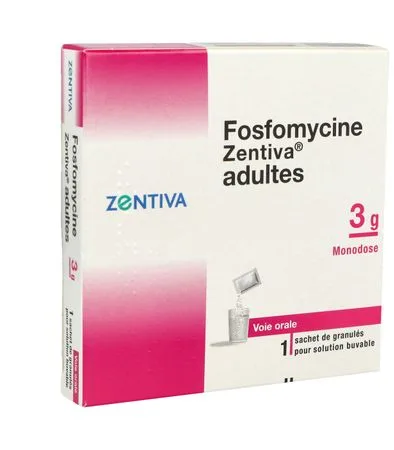
FOSFOMYCINE ZENTIVA ADULTS 3 g, granules for oral solution in sachet
Composition
Fosfomycin tromethamine............................................................................................................................5,631 g
Quantity corresponding to fosfomycin....................................................................................................3,000 g
Per sachet.
Excipient with known effect: sucrose (1,923 g per sachet).
Orange flavour, sodium saccharin, sucrose, calcium hydroxide.
Indications
FOSFOMYCINE ZENTIVA ADULTS 3 g, granules for oral solution in sachet is indicated in (see section Pharmacodynamics) :
• the treatment of uncomplicated acute cystitis in women and adolescent girls
Official recommendations concerning the appropriate use of antibacterial agents should be taken into account.
Dosage and administration
Dosage
Uncomplicated acute cystitis in adult women and adolescent girls (> 12 years)
Single administration of 3 g of fosfomycin.
Renal impairment
The use of FOSFOMYCINE ZENTIVA is not recommended in patients with renal impairment (creatinine clearance < 10 ml/min, see section Pharmacokinetics).
Paediatric population
The safety and efficacy of FOSFOMYCINE ZENTIVA in children under the age of 12 years have not been established.
Method of administration
Oral use.
In the indication of uncomplicated acute cystitis in adult women and adolescent girls, the medicine should be taken fasting (approximately 2 to 3 hours before or 2 to 3 hours after a meal), preferably at bedtime and after emptying the bladder.
The dose should be dissolved in a glass of water and taken immediately after its preparation.
Contraindications
Hypersensitivity to the active substance or to any of the excipients listed in section Composition.
Warnings and precautions
Hypersensitivity reactions
Serious and sometimes fatal hypersensitivity reactions, including anaphylaxis and anaphylactic shock, may occur during treatment with fosfomycin (see sections Contraindications and Adverse effects). If such reactions occur, treatment with fosfomycin must be stopped immediately and appropriate emergency measures must be initiated.
Diarrhoea associated with Clostridioides difficile
Cases of colitis associated with Clostridioides difficile and pseudomembranous colitis have been reported with fosfomycin, and their severity ranged from mild to life-threatening (see section Adverse effects). Therefore, it is important to consider this diagnosis in patients who present with diarrhoea during or following administration of fosfomycin. Discontinuation of fosfomycin treatment and administration of specific treatment against Clostridioides difficile. Medicinal products that inhibit peristalsis must not be administered.
Paediatric population
The efficacy and safety of FOSFOMYCINE ZENTIVA have not been established in children under the age of 12 years. Therefore, this medicine must not be used in this age group (see section Dosage and administration).
Persistent infections and male patients
In cases of persistent infections, a thorough examination and re-evaluation of the diagnosis is recommended, as this is often due to complicated urinary tract infections or the prevalence of resistant pathogens (e.g., Staphylococcus saprophyticus, see section Pharmacodynamics). In general, urinary tract infections in male patients should be considered complicated urinary tract infections for which this medicinal product is not indicated (see section Indications).
Excipient
This medicine contains 1,923 g of sucrose per sachet. Its use is not recommended in patients with fructose intolerance, glucose-galactose malabsorption syndrome or sucrase/isomaltase insufficiency.
Interactions
Metoclopramide
Concomitant administration of metoclopramide has been shown to decrease serum and urinary concentrations of fosfomycin and should be avoided.
Other medicinal products that increase gastrointestinal motility may produce similar effects.
Effect of food
Food may delay the absorption of fosfomycin, resulting in a slight decrease in maximum plasma levels and urinary concentrations. It is therefore preferable to take the medicinal product on an empty stomach or approximately 2 to 3 hours after meals.
Specific problems relating to changes in INR. Numerous cases of increased activity of oral anticoagulants have been reported in patients receiving antibiotic treatment. Risk factors include severe infection or inflammation, age and poor general health. In these circumstances, it is difficult to determine whether the change in INR is due to the infectious disease or to its treatment. However, certain classes of antibiotics are more often implicated, in particular: fluoroquinolones, macrolides, cyclines, cotrimoxazole and certain cephalosporins.
Paediatric population
Interaction studies have only been performed in adults.
Fertility, pregnancy and breastfeeding
Pregnancy
The available data on the safety of fosfomycin treatment during the 1st trimester of pregnancy (n = 152) are limited. These data have not revealed any safety signal regarding teratogenicity to date. Fosfomycin crosses the placenta.
Animal studies have not shown any direct or indirect harmful effects on reproduction (see section Preclinical safety).
FOSFOMYCINE ZENTIVA should be used during pregnancy only if clearly necessary.
Breast-feeding
Fosfomycin is excreted in small amounts in human breast milk. If clearly necessary, a single oral dose of fosfomycin may be used during breastfeeding.
Fertility
No data are available in humans. In male and female rats, oral administration of fosfomycin up to 1 000 mg/kg/day did not impair fertility.
Driving and using machines
No specific studies have been performed, but patients should be informed that cases of dizziness have been reported. These symptoms may affect the ability of some patients to drive vehicles and use machines (see section Adverse effects).
Adverse effects
Summary of the safety profile
The most frequent adverse reactions following administration of a single dose of fosfomycin trometamol concern the gastrointestinal tract and are mainly diarrhoea. These effects are usually of short duration and resolve spontaneously.
Tabulated summary of adverse reactions
The following table presents the adverse effects that have been reported following use of fosfomycin trometamol during clinical trials or after marketing authorisation.
Adverse effects are listed by organ system and frequency using the following convention :
very common (≥ 1/10); common (≥ 1/100, < 1/10); uncommon (≥ 1/1000, < 1/100); rare (≥ 1/10 000, < 1/1000); very rare (< 1/10 000), frequency not known (cannot be estimated from the available data).
Within each frequency grouping, adverse reactions are presented in order of decreasing seriousness.
|
System organ class |
Adverse effects Frequency category |
||
|
Common
|
Uncommon
|
Frequency not known |
|
|
Infections and infestations |
Vulvovaginitis |
|
|
|
Immune system disorders |
|
|
Anaphylactic reactions including anaphylactic and hypersensitivity shock (see section Warnings and precautions) |
|
Nervous system disorders |
Headache, dizziness |
|
|
|
Gastrointestinal disorders |
Diarrhoea, nausea, dyspepsia, abdominal pain |
Vomiting |
Antibiotic-associated colitis (see section Warnings and precautions) |
|
Skin and subcutaneous tissue disorders |
|
Rash, urticaria, pruritus |
Angioedema |
Reporting of suspected adverse reactions
Reporting suspected adverse effects after marketing authorization of the medicine is important. It allows continuous monitoring of the benefit/risk balance of the medicine. Health professionals report any suspected adverse effect via the national reporting system: National Agency for the Safety of Medicines and Health Products (ANSM) and network of Regional Pharmacovigilance Centers - Website : https://signalement.social-sante.gouv.fr/.
Overdose
Experience with cases of overdose with oral fosfomycin is limited. Cases of hypotonia, drowsiness, electrolyte disturbances, thrombocytopenia and hypoprothrombinaemia have been reported with parenterally administered fosfomycin.
In case of overdose, the patient should be monitored (particularly plasma/serum electrolyte levels) and receive symptomatic and supportive treatment. Rehydration is recommended to promote urinary elimination of the active substance. Fosfomycin is effectively eliminated from the body by haemodialysis, with an average elimination half-life of approximately 4 hours.
Pharmacodynamics
Pharmacotherapeutic class: Antibacterials for systemic use; other antibacterials, ATC code: J01XX01
Mechanism of action
Fosfomycin exerts a bactericidal effect on proliferating pathogens by preventing enzymatic synthesis of the bacterial cell wall. Fosfomycin inhibits the first step of intracellular bacterial cell wall synthesis by blocking peptidoglycan synthesis.
Fosfomycin is actively transported into the bacterial cell via two different transport systems (the hexose-6 and sn-glycerol-3-phosphate transport systems).
Pharmacokinetic/pharmacodynamic relationships
Limited data indicate that fosfomycin most probably acts in a time-dependent manner.
Resistance mechanism
The main resistance mechanism is a chromosomal mutation leading to an alteration of the bacterial transport systems for fosfomycin. Other resistance mechanisms, which are transmitted by plasmids or transposons, result in enzymatic inactivation of fosfomycin via binding of the molecule to glutathione or via cleavage of the carbon-phosphorus bond in the fosfomycin molecule, respectively.
Cross-resistance
There is no known cross-resistance between fosfomycin and other classes of antibiotics.
Critical concentrations
The critical concentrations or breakpoints of minimum inhibitory concentrations (MIC) by which the susceptibility of the bacterial strain is interpreted are established by the European Committee on Antimicrobial Susceptibility Testing (EUCAST) for fosfomycin and are as follows:
https://www.ema.europa.eu/documents/other/minimum-inhibitory-concentration-mic-breakpoints_en.xlsx
Prevalence of acquired resistance
The prevalence of acquired resistance of individual species may vary depending on geography and time. Information on local resistance is therefore needed, particularly to ensure appropriate treatment of severe infections.
The following table is based on data from surveillance programmes and studies. It includes the species relevant to the approved indications:
|
Commonly susceptible species Aerobic Gram-negative microorganisms Escherichia coli |
|
Species for which acquired resistance may be a problem Aerobic Gram-positive microorganisms Enterococcus faecalis |
|
Aerobic Gram-negative microorganisms Klebsiella pneumonia Proteus mirabilis |
|
Naturally resistant species Aerobic Gram-positive microorganisms Staphylococcus saprophyticus |
Pharmacokinetics
Absorption
After oral administration of a single dose, fosfomycin trometamol has an absolute bioavailability of approximately 33 % to 53 %. The rate and extent of absorption are reduced by food intake, but the total amount of active substance excreted in urine over time is the same. Mean urinary concentrations of fosfomycin are maintained above the MIC threshold of 128 µg/ml for at least 24 hours after administration of an oral dose of 3 g fasting or after a meal, but the time to reach maximum concentrations in urine is delayed by 4 h. Fosfomycin trometamol undergoes enterohepatic circulation.
Distribution
Fosfomycin does not appear to be metabolised. Fosfomycin is distributed into tissues, including the kidneys and bladder wall. Fosfomycin does not bind to plasma proteins and crosses the placental barrier.
Elimination
Fosfomycin is excreted unchanged, mainly by the kidneys via glomerular filtration (40% to 50% of the dose is recovered in urine) with an elimination half-life of approximately 4 hours after oral intake, and to a lesser extent in faeces (18 - 28% of the dose). Even when food delays absorption of the medicine, the total amount of medicine excreted in urine over time is the same.
Special populations
In patients with impaired renal function, the elimination half-life is increased in proportion to the degree of renal impairment. Urinary concentrations of fosfomycin in patients with impaired renal function remain effective for 48 hours after a usual dose if creatinine clearance is greater than 10 ml/min.
In elderly individuals, the clearance of fosfomycin is reduced due to the decline in renal function associated with age.
Preclinical safety
Non-clinical data from conventional studies of safety pharmacology, repeated-dose toxicity, genotoxicity and reproductive function did not reveal any particular risk for humans.
No carcinogenicity data are available for fosfomycin.
Prescription, supply and reimbursement
| Marketing authorisation (AMM) |
|
| Price: |
|
Collection.
35 RUE DU VAL DE MARNE CS 91439
75214 PARIS CEDEX 13
Tel: 0 800 089 219 https://www.zentiva.com/
Source: VIDAL · Updated on 10/11/2026. This information does not replace advice from a healthcare professional.