
Medicines
SmPC of 05/05/2025
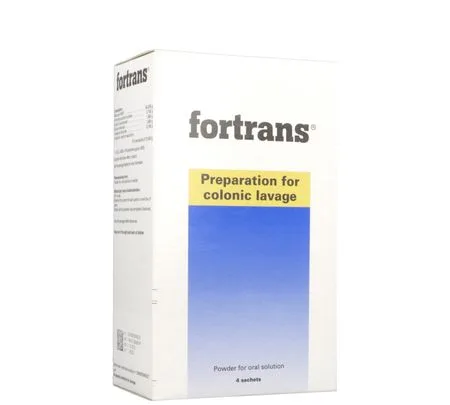
FORTRANS, powder for oral solution in sachet
Forms and presentations
Powder (white to off-white colour) for oral solution.
Sachet containing 73,69 g of powder. Box of 4.
Composition
For one sachet of 73,690 g:
Macrogol 4000*: 64,000 g
Anhydrous sodium sulfate: 5,700 g
Sodium bicarbonate: 1,680 g
Sodium chloride: 1,460 g
Potassium chloride: 0,750 g
* = P.E.G. 4000 = Polyethylene glycol 4000
Excipient with known effect: each sachet contains 2,890 g of sodium.
Sodium saccharin.
Indications
Colonic lavage ensuring the preparation of patients beforehand:
- for endoscopic or radiological examinations,
- for colonic surgery.
FORTRANS is indicated in adults only.
Dosage and administration
Dosage
RESERVED FOR ADULTS.
Oral use.
Dissolve the contents of the sachet in one litre of water.
Stir until the powder is completely dissolved.
The dosage is approximately 1 litre of solution for 15 to 20 kg of body weight, which corresponds to an average dose of 3 to 4 litres.
Method of administration
The preparation may be ingested as a single dose or in divided doses according to two dosage schemes, provided that the entire prepared solution is always ingested (on average 3 to 4 litres of solution depending on the patient's body weight):
- in divided doses: either 2 litres ingested the evening before and 1 to 2 litres the morning of the examination, ingesting the last glass 3 to 4 hours before the examination, or 3 litres ingested the evening before and 1 litre the morning of the examination, ingesting the last glass 3 to 4 hours before the examination.
- in a single dose: 3 to 4 litres the evening before, possibly with a one-hour pause after the first 2 litres.
The recommended rate of ingestion is 1 to 1,5 litre per hour (i.e. 250 ml every 10 to 15 minutes). The physician may adapt the recommended rate according to the patient's clinical condition and any comorbidities.
- Patient with renal insufficiency
For this patient population, data are insufficient (see section Warnings and precautions).
- Paediatric population
The tolerability and efficacy of FORTRANS in children aged under 18 years have not been studied.
Contraindications
- Hypersensitivity to the active substances or to any of the excipients listed in section Composition ;
- Severe heart failure;
- Severe impairment of general condition such as dehydration;
- Advanced carcinoma or any other colonic pathology resulting in excessive mucosal fragility;
- Severe acute phases of inflammation of the intestinal tract including Crohn's disease and haemorrhagic proctocolitis;
- Gastrointestinal perforation or risk of perforation;
- Toxic colitis or toxic megacolon;
- Patients who are at risk of or who already have ileus;
- Patients who are at risk of or who already have gastrointestinal obstruction or stenosis;
- Disorders of gastric emptying (e.g. gastroparesis, gastric stasis);
- Children and adolescents aged under 18 years.
Warnings and precautions
In elderly patients in a precarious general condition, it is recommended that the product be administered only under medical supervision.
Diarrhea resulting from the use of this medicine may considerably disrupt the absorption of medicines administered simultaneously (see section Interactions).
This medicine contains macrogol (polyethylene glycol or PEG).
Allergic-type reactions have been described with macrogol-based medicinal products: anaphylactic shock, rash, urticaria, angioedema (see section Adverse effects).
Although not expected given the isotonic composition of the product, cases of fluid and electrolyte disturbances have exceptionally been reported in patients at risk. Pre-existing electrolyte disturbances in some patients must be corrected before administering the colonic lavage solution. Therefore, the product should be used with caution in these patients or in patients treated with medicines that may increase the risk of fluid and electrolyte disturbances including hyponatraemia and hypokalaemia, or that may increase the risk of potential complications (such as patients with impaired renal function, heart failure, or those concomitantly treated with diuretics). In such cases, patients must be appropriately monitored.
The product must be administered with caution and under close supervision in patients prone to regurgitation, bedridden patients, or patients with impaired neurological function and/or motor disorders, due to the risk of inhalation. In these patients, the product should be given in a sitting position, possibly via a gastric tube.
In patients with heart failure and/or renal failure, there is a risk of acute pulmonary oedema due to fluid overload.
This medicine contains sodium. This medicine contains 2,890 g of sodium per sachet. To be taken into account in patients following a strict low-sodium diet.
Ischaemic colitis:
Pharmacovigilance has shown that cases of ischemic colitis, some of them serious, have been reported in patients treated with macrogol as part of bowel preparation. Macrogol should be used with caution in patients with known risk factors for ischemic colitis or when stimulant laxatives (such as bisacodyl or sodium picosulfate) are used concomitantly. Patients presenting with sudden abdominal pain, rectal bleeding or other symptoms of ischemic colitis should undergo prompt evaluation.
Interactions
The prescriber must be informed of all other medicines taken by the patient orally. Orally taken treatments may not be absorbed due to the intestinal emptying induced by the preparation and must be administered more than 2 hours before ingestion of the enema. Avoid taking other oral treatments during and after ingestion of the laxative, and until the examination is performed. For medicines with a narrow therapeutic margin or short half-life, such as digoxin, antiepileptics, coumarins and immunosuppressants, efficacy may be particularly affected.
Fertility, pregnancy and breastfeeding
Pregnancy
There are few or no data on the use of FORTRANS in pregnant women. Animal studies are insufficient to draw conclusions regarding toxicity to reproductive function. FORTRANS should be used only if necessary.
Breast-feeding
There are few or no data on the use of FORTRANS in breastfeeding women. There are no data on the excretion of FORTRANS in human milk. A risk to the newborn/infant during use cannot be excluded. Animal studies are insufficient to draw conclusions regarding toxicity to reproductive function. FORTRANS should be used only if necessary.
Fertility
There are no data documenting effects on fertility with the use of FORTRANS
Driving and using machines
No study on the effects of FORTRANS on the ability to drive vehicles and use machines has been performed.
Adverse effects
Diarrhoea is an expected effect resulting from the use of FORTRANS. Nausea and vomiting have been reported at the start of administration, generally subsiding with continued intake.
The table below lists the adverse effects reported during clinical studies, and the adverse effects observed since marketing. The frequency of adverse effects is classified as follows: Very common (≥ 1/10), common (≥ 1/100 to < 1/10), uncommon (≥ 1/1 000 to < 1/100), rare (≥ 1/10 000 to < 1/1 000), very rare (< 1/10 000), frequency not known (cannot be estimated from the available data).
|
System organ class |
Frequency |
Adverse reaction |
|
Gastrointestinal disorders |
Very common: |
Nausea, abdominal pain, abdominal distension |
|
Common: |
Vomiting |
|
|
Immune system disorders |
Not known |
Hypersensitivity (such as anaphylactic shock, angioedema, urticaria, rash, pruritus). |
Reporting of suspected adverse reactions
Reporting suspected adverse reactions after marketing authorisation of the medicinal product is important. It allows continuous monitoring of the benefit/risk balance of the medicinal product. Healthcare professionals report any suspected adverse reaction via the national reporting system: National Agency for the Safety of Medicines and Health Products (ANSM) and network of Regional Pharmacovigilance Centres - Website https://signalement.social-sante.gouv.fr.
Overdose
Intentional or accidental ingestion of a dose greater than the recommended dose of FORTRANS powder for oral solution may cause severe diarrhoea and electrolyte imbalance, including hyponatraemia and hypokalaemia, as well as dehydration and hypovolaemia with associated signs and symptoms.
In this case, the patient should be monitored and abundant quantities of fluids, including fruit juices, should be given. In the rare cases of overdose causing severe metabolic imbalance, intravenous rehydration may be carried out.
Pharmacodynamics
Pharmacotherapeutic class: OSMOTIC LAXATIVE, ATC code: A06AD65 (A: alimentary tract and metabolism)
High molecular weight macrogols (4000) are long linear polymers to which water molecules are retained by hydrogen bonds. Administered orally, they cause an increase in the volume of intestinal fluids.
The volume of unabsorbed intestinal fluid is responsible for the laxative properties of the solution.
Pharmacokinetics
The electrolyte content of the reconstituted solution is such that electrolyte exchanges between intestine and plasma can be considered nil.
Pharmacokinetic data confirm the absence of digestive absorption and biotransformation of macrogol 4000 after oral ingestion.
Preclinical safety
Preclinical data from acute and repeated-dose toxicity studies and genotoxicity studies performed with macrogol 4000 did not reveal any particular risk for humans. Given the short duration of use of the product, no carcinogenicity study was performed.
SPECIAL PRECAUTIONS FOR DISPOSAL AND OTHER HANDLING
Any unused medicinal product or waste material should be disposed of in accordance with local requirements.
Prescription, supply and reimbursement
| Marketing authorisation (AMM) |
|
| Price: |
|
MAYOLY PHARMA FRANCE
3, Renault Square. 92500 Rueil-Malmaison
Medical information:
Tel: 01 58 33 51 16
Source: VIDAL · Updated on 10/11/2026. This information does not replace advice from a healthcare professional.