
Medicines
Update of 13/10/2023
FOLINORAL®
calcium folinate
Forms and presentations
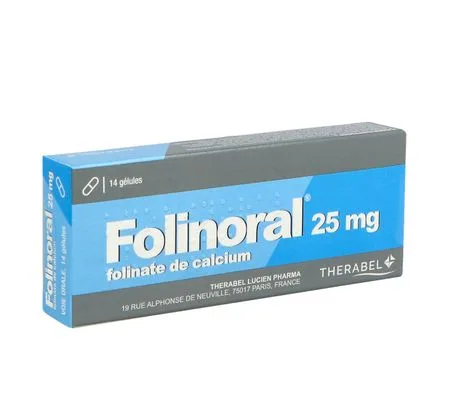
Capsule at 5 mg (yellow): Box of 28, under blisters.Capsule at 25 mg (yellow): Box of 14, in thermoformed blister packs.
Composition
| per capsule | |
| Calcium folinate expressed as folinic acid
|
5 mg |
| or | 25 mg |
| (in the form of calcium folinate: 5,402 mg/cap at 5 mg; 27,012 mg/cap at 25 mg) | |
Excipient with known effect: lactose.
Indications
- Correction of haematotoxicity induced by treatment with trimethoprim or sulfasalazine.
Note: during long-term treatment with trimethoprim as prophylaxis of pneumonia caused by Pneumocystis carinii, preventive administration of folinic acid is not recommended. - Prevention and correction of haematotoxicity induced by long-term or high-dose treatment with pyrimethamine.
- Prevention and correction of toxic effects caused by trimetrexate in the treatment of moderate to severe pneumonia caused by Pneumocystis carinii moderate to severe pneumonia in patients with acquired immunodeficiency syndrome.
- Prevention and correction of toxic accidents caused by methotrexate in the treatment of leukemias and malignant tumors.
Dosage and administration
Dosage
Oral use.
- Correction of hematotoxicity induced by treatment with trimethoprim or sulfasalazine:
- In adults: the daily dose of 5 mg of folinic acid (dl) during the duration of administration of the agent responsible for the hematotoxicity is usually sufficient.
- In children: the dosage is 5 mg of folinic acid (dl) every 2 to 4 days.
- In adults: the daily dose of 5 mg of folinic acid (dl) during the duration of administration of the agent responsible for the hematotoxicity is usually sufficient.
- Prevention and correction of hematotoxicity induced by long-term or high-dose pyrimethamine: dosage regimens depend on the doses of pyrimethamine administered.
- In adults:
In case of high doses of pyrimethamine: the dose of folinic acid (dl) to be administered is usually between 10 and 25 mg/day, more rarely 50 mg/day.
In case of low doses of pyrimethamine administered long-term: the dose of folinic acid (dl) to be administered is between 30 and 75 mg as a weekly cumulative dose. - In children: the dosage of folinic acid (dl) is 5 to 10 mg every 2 to 4 days.
- In adults:
- Prevention and correction of toxic effects caused by trimetrexate in the treatment of moderate to severe pneumonia caused by Pneumocystis carinii moderate to severe pneumonia in patients with acquired immunodeficiency syndrome.
Folinic acid (dl) must be administered every day during treatment with trimetrexate and for 72 hours following administration of the last dose of trimetrexate given in four equally spaced doses (see table below).
The recommended duration of treatment is 21 days of trimetrexate and 24 days of folinic acid (dl).
Doses of trimetrexate and folinic acid should be adjusted according to hematological toxicity (see table below). This dose-adjustment scheme is based on empirical data from clinical trials using initial doses of 45 mg/m2 per day of trimetrexate and 20 mg/m2 4 times per day of folinic acid (dl).
(1) If grade 4 haematological toxicity occurs before day 10, trimetrexate treatment must be interrupted. Folinic acid (dl) 40 mg/m2, 4 times a day, must be administered for an additional 72 hours. If grade 4 toxicity occurs on day 10 or later, trimetrexate administration must be interrupted for 96 hours until the blood count returns to a normal value.Level of toxicity Neutrophils Blister packs Recommended dosages Trimetrexate Folinic acid (dl) 1 > 1000/mm3 > 75 000/mm3 45 mg/m2 once per day 20 mg/m2 every 6 hours 2 750 to 1000/mm3 50 000 to 75 000/mm3 45 mg/m2 once per day 40 mg/m2 every 6 hours 3 500 to 749/mm3 25 000 to 50 000/mm3 22 mg/m2 once a day 40 mg/m2 every 6 hours 4 < 500/mm3 < 25 000/mm3 Day 1 to 9, stop
Day 10 to 21, interrupt treatment for 96 hours(1)40 mg/m2 every 6 hours
If the blood count returns to grade 3 within 96 hours, trimetrexate must be administered at a dose of 22 mg/m2 and folinic acid (dl) treatment may be maintained at 40 mg/m2 four times a day.
If the patient returns to grade 2 toxicity, the trimetrexate dose may be increased to 45 mg/m2 but the folinic acid (dl) dose must be maintained at 40 mg/m2 throughout the treatment period and administered for 72 hours after the last trimetrexate dose.
If grade 4 toxicity persists, trimetrexate treatment must be interrupted.
- Prevention and correction of toxic accidents caused by methotrexate in the treatment of leukaemias and malignant tumours: dosage schedules depend on the methotrexate doses administered, infusion protocols and renal function. Maintenance of adequate alkaline diuresis must always be ensured and renal function monitored.
For reference:
- Intermediate doses (i.e. ≤ 1,5 g/m2 of methotrexate in patients with normal renal function): administration of 25 mg/m2 of folinic acid (dl) every 6 hours, for a minimum duration of 48 hours.
- High doses (i.e. > 1,5 g/m2 of methotrexate in patients with normal creatinine clearance): the folinic acid administration schedule is determined by the pharmacokinetics of methotrexate at 24 hours and beyond. Folinic acid (dl) doses may range between 25 and 50 mg/m2 until the plasma concentration of methotrexate is below 10-7 M. To reach this threshold, in case of concentration at the 24e hour above 10-6 M, it is necessary to continue alkalinisation and folinic acid administration beyond 72 hours.
- In subjects with impaired renal function, and for methotrexate doses above 0,5 g/m2 : administration of 25 to 50 mg/m2 of folinic acid (dl) every 6 hours until circulating methotrexate has disappeared.
- At the end of the methotrexate infusion, if it is administered over 24 hours or more.
- At the latest 24 hours after the end of the methotrexate infusion, if it is administered over 3 hours.
Contraindications
Hypersensitivity to the active substance or to any of the excipients listed in section Composition.Calcium folinate must not be used for the treatment of pernicious anaemia or other anaemias due to a vitamin B12 deficiency.
Warnings and precautions
Many inhibitors of DNA synthesis can cause macrocytosis that is not related to treatment with folinic acid.
In elderly subjects or subjects with impaired renal function, the benefit-risk ratio of methotrexate administration must be reassessed regularly. Monitoring of methotrexate elimination by pharmacokinetic parameters is essential.
As part of the prevention of toxic accidents caused by methotrexate, the occurrence of vomiting must imperatively prompt resumption of hydration and parenteral administration of folinic acid.
As this medicinal product is an antagonist of methotrexate, it must not be administered at the same time, except in the case of specific protocols.
This medicinal product contains lactose. Its use is not recommended in patients with galactose intolerance, Lapp lactase deficiency or glucose-galactose malabsorption syndrome (rare hereditary disorders).
Interactions
Drug interactionsRequiring precautions for use:
- Phenobarbital and primidone, phenytoin: decreased plasma levels of enzyme-inducing anticonvulsants, due to increased hepatic metabolism of which folates are one of the cofactors.
To be taken into account:
- 5 fluorouracil: potentiation of both the cytostatic and undesirable effects of 5 fluorouracil.
Fertility, pregnancy and breastfeeding
Use with caution in pregnant or breastfeeding women, due to a lack of usable clinical data.
Adverse effects
The following undesirable effects have been observed very rarely:- urticaria,
- Quincke's oedema,
- anaphylactic shock.
Reporting suspected adverse reactions after authorisation of the medicinal product is important. It allows continuous monitoring of the benefit/risk balance of the medicinal product. Healthcare professionals should report any suspected adverse reaction via the national reporting system: National Agency for the Safety of Medicines and Health Products (ANSM) and the network of Regional Pharmacovigilance Centres. Website: https://signalement.social-sante.gouv.fr.
Overdose
Folinic acid is non-toxic: no overdose has been observed, including with the administration of very high doses. Indeed, only the dose needed by the body is used, and the excess is eliminated.
Pharmacodynamics
Pharmacotherapeutic class: Detoxifying agents for cytostatic treatment (ATC code: V03AF03; V: Various).
Folinic acid is the reduced or tetrahydrogenated state of folic acid. It is the cofactor of thymidylate synthetase, a key enzyme in DNA synthesis.
It is a biochemical antagonist of antifolate agents such as methotrexate (of which it is the specific inhibitor), but also of pyrimethamine and, to a lesser extent, of sulfasalazine and trimethoprim.
Pharmacokinetics
Folinic acid is almost entirely absorbed in the gastrointestinal tract, where it is already metabolised to 5-methyl-tetrahydrofolate, the active metabolite. The liver then continues the metabolism of the unbiotransformed folinic acid in the intestinal lumen, and the first-pass hepatic effect is estimated at 90%.
Plasma concentrations, expressed as total folates, are equivalent between the oral and parenteral routes, as long as doses are low. Above 50 mg of folinic acid, digestive absorption decreases, as a consequence of saturation of the active folate transport mechanism: the absolute bioavailability is then approximately 70 to 75%.
The maximum plasma concentration of 5-methyl-tetrahydrofolate is reached 2 to 3 hours after oral intake. Its elimination half-life is 6 to 7 hours and excretion is renal, in the form of the inactive metabolites 5 and 10 formyl-tetrahydrofolates.
Storage conditions
- Shelf life of the 5 mg capsule:
- 2 years.
- Shelf life of the 25 mg capsule:
- 3 years.
This medicine does not require any particular storage precautions.
HANDLING/DISPOSAL INSTRUCTIONS
No special requirements.
Prescription, supply and reimbursement
| Marketing authorisation (AMM) | 3400933073770 (1988, RCP rev 08.07.2021) capsule 5 mg. |
| 3400933672966 (1993, RCP rev 08.07.2021) capsule 25 mg. |
| Price: | 7,96 euros (28 capsules at 5 mg). |
| 12,21 euros (14 capsules at 25 mg). | |
|
Social Security reimbursement at 65 % (only in the indications for correction of haematotoxicity induced by treatment with trimethoprim, for prevention and correction of haematotoxicity induced by long-term or high-dose treatment with pyrimethamine, and for prevention and correction of toxic accidents caused by methotrexate in the treatment of leukaemias and malignant tumours). Collection. |
|
Marketing authorisation holder: THERABEL LUCIEN PHARMA, 18 rue Camille Pelletan, 92300 Levallois-Perret.
CSP
76-78, avenue du Midi. CS 30077
63808 Cournon d'Auvergne cdx
Tel: 04 73 69 28 28. Fax: 04 73 69 93 15
Medical information and pharmacovigilance: Tel: 01 47 04 80 46
Source: VIDAL · Updated on 10/11/2026. This information does not replace advice from a healthcare professional.