
Medicines
Update of the 07/10/2021
FLUOSTEROL®
fluorine, cholecalciferol
Forms and presentations
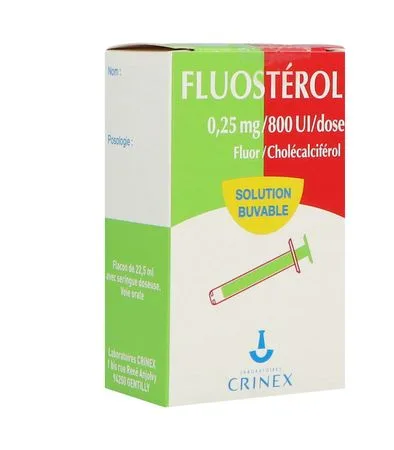
Oral solution at 0,25 mg/800 IU/dose: Bottle of 22,5 ml fitted with a child-safety cap with syringe for oral administration.Composition
| per dose | |
| Fluorine
|
0,25 mg |
| (as sodium fluoride: 0,553 mg) | |
| Cholecalciferol (INN) or vitamin D3
|
800 IU |
| (as cholecalciferol concentrate, powder form: 0,02 mg) | |
Excipients with known effect: polyoxyethylated hydrogenated castor oil, maltitol, sodium propyl parahydroxybenzoate, sodium methyl parahydroxybenzoate.
Indications
In infants aged 6 to 18 months, administration of fluorine and vitamin D as part of combined prophylaxis:- of dental caries in children particularly exposed to this risk and when total fluorine intake is less than 0,3 mg/day;
- as well as vitamin D deficiency states, when using a milk supplemented with vitamin D.
Dosage and administration
DosageInfants aged 6 to 18 months: one dose (¼ ml) per day, i.e. 0,553 mg of sodium fluoride (0,25 mg of fluorine) and 800 IU of vitamin D3.
Method of administration:
Oral use.
The product may be swallowed with a little water or fruit juice.
A dosing syringe facilitates the prescription and oral administration of Fluostérol.
- To deliver one dose of product (0,25 ml), gently pull the plunger to the stop so that the 1 dose line coincides with the stop of the oral administration syringe.
- If the stop is exceeded, the plunger no longer draws up the product, thus avoiding overdosing.
- After use, rinse with clear water and wipe the oral administration syringe; do not sterilise it.
Contraindications
- Known hypersensitivity to one of the constituents.
- Hypercalcaemia, hypercalciuria, calcium lithiasis.
- In regions where the fluoride content in the tap water is greater than 0,3 mg/l. In France, 85 % of the population lives in regions where the fluoride content is less than or equal to 0,3 mg/l. In case of doubt, it is advised to inquire with the town hall or the DDASS about the local fluoride level in the tap water.
Warnings and precautions
This medicinal product contains castor oil and may cause digestive disorders (mild laxative effect, diarrhoea).
This medicine contains maltitol. Its use is not recommended in patients with fructose intolerance.
This medicine contains sodium methyl parahydroxybenzoate and sodium propyl parahydroxybenzoate and may cause allergic reactions (possibly delayed).
Drug-based fluoride supplementation in infants older than 6 months must be adapted to age and to other potential sources: fluoridated salt, tap or mineral waters, fluoridated toothpastes.
Fluoride supplementation does not replace good oral and dietary hygiene: limitation of sugars, particularly in the form of snacking and sweetened drinks between meals, early education in tooth brushing after each meal with a fluoridated toothpaste suited to age, and regular visits to the dentist.
Uncontrolled fluoride intake over several months or years can cause fluorosis. To avoid cumulative intake, it is essential to establish a personalised assessment of fluoride intake (tap and mineral waters, fluoridated salt, medicines in the form of tablets, drops, chewing gums or fluoridated toothpastes) before any fluoride prescription.
The fluoride content of bottled waters must be carefully taken into account. Mineral waters with a fluoride content greater than 0,3 mg/l must not be used for preparing baby bottles in combination with fluoride supplementation.
To avoid any overdose, take into account the total doses of vitamin D when several treatments already containing this vitamin are combined.
In case of calcium intake, regular monitoring of urinary calcium excretion is essential.
Interactions
Drug interactionsCertain minerals such as calcium, magnesium or iron may chelate fluoride ions and reduce their absorption.
Simultaneous ingestion of milk or dairy products, as well as antacids based on magnesium or aluminium salts, should be avoided.
Adverse effects
Reporting of suspected adverse reactions:Reporting suspected adverse reactions after authorisation of the medicinal product is important. It allows continuous monitoring of the benefit/risk balance of the medicinal product. Healthcare professionals should report any suspected adverse reaction via the national reporting system: National Agency for the Safety of Medicines and Health Products (ANSM) and the network of Regional Pharmacovigilance Centres. Website: www.signalement-sante.gouv.fr.
Overdose
- Acute poisoning:
In adults or children, the toxic dose is 5 mg of fluoride/kg (minimum dose that may induce symptoms of poisoning).
It manifests as digestive disorders: vomiting, diarrhoea, abdominal pain, and may exceptionally lead to death.
In case of significant accidental ingestion, immediate treatment consists of gastric lavage or induced vomiting, ingestion of calcium (large quantity of milk), and medical monitoring for several hours. - Chronic poisoning (fluorosis):
Mottled or speckled appearance of the dental enamel may appear from a daily intake of a fluoride dose greater than 1,5 mg/day (0,10 mg of fluoride/kg/day in children up to 6 years) over several months or years depending on the extent of the overdose. It is accompanied by enamel fragility in severe forms.
Skeletal fluorosis is only observed with high chronic intakes (greater than 8 mg/day).
- Clinical signs:
-
- headache, asthenia, anorexia, weight loss, growth arrest;
- nausea, vomiting;
- polyuria, polydipsia, dehydration;
- arterial hypertension;
- calcium lithiasis, tissue calcifications, particularly renal and vascular;
- renal insufficiency.
- headache, asthenia, anorexia, weight loss, growth arrest;
- Biological signs:
- Hypercalcaemia, hypercalciuria, hyperphosphataemia, hyperphosphaturia.
- Action to be taken:
- Stop administration of vitamin D, reduce calcium intake, increase diuresis, abundant drinks.
Pharmacodynamics
Other mineral supplements (ATC code: A12CD51; A: alimentary tract and metabolism).
Fluorides play an essential role in the prevention of dental caries.
They exert a systemic effect during the period of tooth mineralisation, complemented by a topical effect after tooth eruption.
These two pathways are interdependent and complementary. Indeed, when a fluoridated product is ingested, fluoride is in contact with the tooth surfaces as it passes through the oral cavity, thus exerting a topical action.
Conversely, topical fluoride may be partially ingested and then becomes part of the systemic pathway.
The effects of fluoride are of three types:- a bactericidal effect on the germs of dental plaque. The consequences are an inhibition of bacterial proliferation in dental plaque and an inhibition of the formation of cariogenic acids;
- a decrease in the solubility threshold of enamel in an acidic medium;
- remineralisation of initial carious lesions of the enamel.
(Fluoride alone should not, however, be sufficient for the elimination of bacterial plaque or the treatment of caries.)
The essential role of vitamin D is exerted on the intestine, whose capacity to absorb calcium and phosphates it increases, and on the skeleton, whose mineralisation it promotes (through its direct actions on bone being formed and its indirect actions involving the intestine, the parathyroid glands and already mineralised bone).
Pharmacokinetics
Fluorides are well absorbed at the gastrointestinal level.
The peak concentration is reached between 30 minutes and one hour after intake. Fluoride ions concentrate in the hard tissues of the body: teeth and bones. They are eliminated via the urine.
Vitamin D is absorbed passively in the small intestine, then joins the general circulation via the lymphatic route, incorporated into chylomicrons.
After absorption, it binds to a specific carrier protein and is transported to the liver where it is converted into 25-hydroxyvitamin D. The latter in turn binds to the same carrier protein and is transported to the kidneys where it is transformed into its active form, 1,25-dihydroxyvitamin D.
Its essential storage sites are adipose tissue, muscles, but also blood. 25-hydroxyvitamin D bound to its carrier protein is the major circulating reserve form of vitamin D. Its half-life in the blood is 15 to 40 days.
Elimination of vitamin D and its metabolites occurs via the faeces, in untransformed form or in water-soluble form (calcitroic acid, glucuroconjugated derivatives).
Storage conditions
- Shelf life
- 2 years.
Store at a temperature not exceeding + 25 °C.
HANDLING/DISPOSAL INSTRUCTIONS
No special requirements.
Prescription, supply and reimbursement
| Marketing authorisation (AMM) | 3400935718495 (2001, SmPC rev 07.02.2017). |
| Price: | 2,54 euros (1 vial + 1 syringe). |
| Social Security reimbursement at 30%. Collect. | |
Laboratoires CRINEX
1 bis, rue René-Anjolvy. 94250 Gentilly
Tel: 01 42 53 28 51
Source: VIDAL · Updated on 10/11/2026. This information does not replace advice from a healthcare professional.