Medicines
SmPC of 26/01/2023
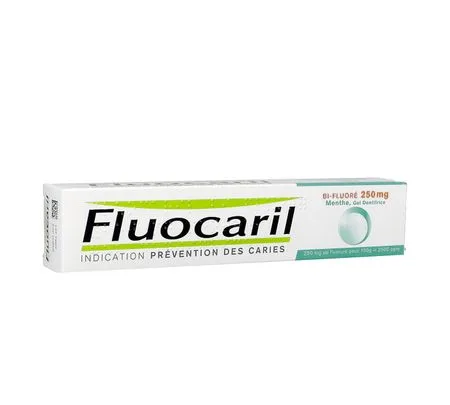
FLUOCARIL BI-FLUORIDE 250 mg MINT, toothpaste gel
Composition
Sodium monofluorophosphate .............................................................................................................0,7600 g
Sodium fluoride .....................................................................................................................................0,3315 g
Per 100 g.
100 g of toothpaste gel contains 250 mg or 2500 ppm of fluoride.
Excipients with known effect: sodium benzoate (E211), methyl parahydroxybenzoate (E218), propyl parahydroxybenzoate (E216).
Sodium benzoate (E211), sodium lauryl sulfate, sodium hexametaphosphate, disodium phosphate, dental silica (E551), sodium carmellose, macrogol 400, sorbitol at 70 % non-crystallisable (E420), sodium saccharin (E954), peppermint essential oil (Italo-Mitcham), mint flavour*, star anise essential oil, levomenthol, phenol, eugenol, Ceylon cinnamon essential oil, quinoline yellow, patent blue V, methyl parahydroxybenzoate (E218), propyl parahydroxybenzoate (E216), purified water.
*Composition of the mint flavour: mixture of rectified natural mint essences of various origins and eugenol.
Dosage and administration
Dosage
Reserved for adults and children over 10 years.
This medicine may be used in children over 10 years after a medical consultation.
Method of administration
For bucco-dental use only. Do not swallow.
Perform a careful brushing daily, 3 times per day, after each meal, in the vertical direction from the gum to the tip of the tooth.
A careful brushing lasts approximately 3 minutes.
Contraindications
This medicine MUST NEVER BE USED:
- In case of hypersensitivity to sodium fluoride, to sodium monofluorophosphate or to any of the excipients mentioned in the section Composition.
Warnings and precautions
- The local use of fluoridated toothpastes or fluoridated mouthwashes is compatible with the intake of fluoride by the general route; it reinforces the protection of the tooth against caries.
- However, the multiplication of potential sources of fluoride may be the origin of fluorosis. In order to avoid accumulations, it is essential to establish a personalised assessment of intakes (tap and mineral waters, fluoridated salt, medicines in the form of tablets, drops, chewing gums or fluoridated toothpastes) before any fluoridated prescription.
- In the overall calculations of the recommended intake of fluoride ion (0,05 mg of fluoride/kg/day all fluoridated intakes combined and without exceeding 1 mg/day), account must be taken of the possible doses of toothpaste ingestion (60 to 30% between 3 and 7 years), which will vary according to age and the concentration of the gel used.
- The maximum recommended content for a toothpaste in children under 6 years is 500 ppm of fluoride (50 mg/100 g). The quantity to be used must be the size of a pea and children must spit out the toothpaste well.
- This medicine contains methyl parahydroxybenzoate (E218) and may cause allergic reactions (possibly delayed).
- Due to the presence of sodium benzoate (E211), this medicine may cause irritation of the skin, eyes and mucous membranes.
From 6 years of age, children may use toothpastes dosed at 1000 to 1500 ppm (100 to 150 mg/100 g).
Have the teeth checked regularly by a dental surgeon.
Fertility, pregnancy and breastfeeding
Pregnancy
Data on the use of sodium fluoride in pregnant women are limited. Animal data do not indicate direct or indirect deleterious effects with regard to reproductive toxicity.
Systemic exposure to fluoride ions being low for FLUOCARIL Bi-Fluoré 250 mg, this medicine may be used during pregnancy.
Breastfeeding
Systemic exposure to fluoride ions being low for dentifrice gels, this medicine may be used during breastfeeding.
Fertility
Reproductive system abnormalities have been observed in animals at high doses and with chronic daily administration (see section Preclinical safety). However, at the doses to which treated patients are exposed, no effect on fertility is expected
Adverse effects
The adverse reactions listed below are classified by frequency and by system organ class (SOC). The frequency groups are defined according to the following convention: very common (≥ 1/10), common (≥ 1/100, < 1/10), uncommon (≥ 1/1000, < 1/100), rare (≥1/10 000, <1/1 000), and very rare (<1/10 000), frequency not known (cannot be estimated from the available data).
The expected side effects are mainly due to the presence of methyl parahydroxybenzoate, propyl parahydroxybenzoate and sodium benzoate.
|
Very rare |
Immune system disorders |
Symptoms of hypersensitivity reactions, including symptoms of bronchospasm and urticaria in exceptional cases |
|
Gastrointestinal disorders |
Oral irritation |
|
|
Skin and subcutaneous tissue disorders |
Hypersensitivity reactions, including contact dermatitis, and urticaria in exceptional cases |
Reporting of suspected adverse reactions
Reporting of suspected adverse reactions after authorisation of the medicinal product is important. It allows continuous monitoring of the benefit/risk balance of the medicinal product. Healthcare professionals report any suspected adverse reaction via the national reporting system: Agence nationale de sécurité du médicament et des produits de santé (ANSM) and network of Regional Pharmacovigilance Centres - Website: www.signalement.social-sante.gouv.fr.
Overdose
Acute intoxication
In adults or children, the toxic dose is 5 mg of fluoride/kg (minimum dose that can induce symptoms of intoxication). It manifests as digestive disorders: vomiting, diarrhoea, abdominal pain and may exceptionally lead to death.
In the event of significant accidental ingestion, particularly in children, immediate treatment consists of gastric lavage or induced vomiting, ingestion of calcium (large quantity of milk) and medical monitoring for several hours.
Intoxication chronic: fluorosis
Mottled or speckled appearance of dental enamel that may appear following daily absorption of a dose of fluoride greater than 1.5 mg/day (0.10 mg of fluoride/kg/day in children up to 6 years), for several months or years depending on the extent of the overdose. It is accompanied by enamel fragility in severe forms.
Skeletal fluorosis is observed only with strong chronic absorptions (greater than 8 mg/day).
Pharmacodynamics
PROPHYLACTIC ANTICARIES MEDICINES
ATC Code: A01AA01.
Mechanism of action
Fluorides play an essential role in the prevention of dental caries.
They exert a systemic effect during the period of tooth mineralization, supplemented by a topical effect after tooth eruption.
These two routes are interdependent and complementary. Indeed, upon ingestion of a fluoridated product, the fluoride is in contact with the dental surfaces during its passage through the oral cavity, thereby exerting a topical action.
Conversely, topical fluoride can be partially ingested and then integrates into the systemic route.
The effects of fluoride are of three types:
- a bactericidal effect on the germs of dental plaque. The consequences are an inhibition of the bacterial proliferation of dental plaque and an inhibition of the formation of cariogenic acids,
- a decrease in the solubility threshold of enamel in an acidic medium,
- a remineralization of initial carious lesions of the enamel.
(However, fluoride would not suffice for the elimination of bacterial plaque or for the treatment of caries).
This medicine is an association of two fluoride salts: sodium fluoride and sodium monofluorophosphate with a high fluoride concentration. The latter is released rapidly from sodium fluoride and with a delayed effect from sodium monofluorophosphates after enzymatic hydrolysis of bacterial or salivary origin. As with all fluoridated salts, the carioprotective action is dependent on the fluoride concentration.
Preclinical safety
Fluorides administered orally have shown genotoxic effects at high doses (approximately 20 mg/kg or more) and toxic effects on reproductive functions and on the fetus have been observed in the mouse, rat and rabbit, only at very high doses.
An equivocal carcinogenic effect was observed in the male rat but not in the female rat or in the male and female mouse.
Prescription, supply and reimbursement
| MA |
|
20 RUE DES DEUX GARES CS 90056
92842 RUEIL-MALMAISON CEDEX
Tel: 01 41 96 62 00 Tel (toll-free number): 0800 800 690
u.labs@sofip-sa.fr
www.fluocarilgamme.fr - https://www.sofip-sa.fr/
Source: VIDAL · Updated on 10/11/2026. This information does not replace advice from a healthcare professional.