
Medicines
SmPC of the 20/02/2026
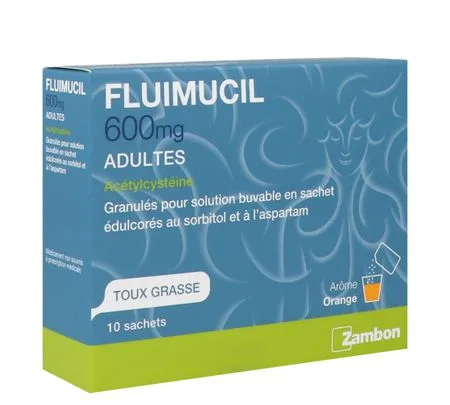
FLUIMUCIL 600 mg ADULTS, granules for oral solution in sachet sweetened with sorbitol and aspartame
Forms and presentations
Granules (white) for oral solution.
Sachet containing 3 g of granules. Box of 10.
Composition
For one sachet:
Acetylcysteine: 600 mg
Excipients with known effect :
- 75 mg of aspartame (E 951)
- 2 025 mg of sorbitol (E 420)
- 300 mg of orange flavouring (contains glucose and lactose)
Aspartame (E 951), sorbitol (E 420), orange flavouring (contains glucose and lactose).
Indications
FLUIMUCIL is indicated in adults for the treatment of bronchial conditions in which a reduction in the viscosity of bronchial secretions is necessary to facilitate expectoration, particularly during episodes of acute bronchitis.
Dosage and administration
Dosage
Adults
600 mg of acetylcysteine (1 sachet) once a day.
The maximum daily dose must not exceed 600 mg.
Paediatric population
FLUIMUCIL is not indicated in children under 18 years of age.
FLUIMUCIL is contraindicated in children under 2 years of age (see section Contraindications) and is not suitable for children and adolescents.
Method of administration
Oral use.
Dissolve one sachet in a small volume of water. The resulting solution is opalescent and gives off a characteristic orange odour associated with a slight sulphur odour.
After complete dissolution of the medicine, the solution should be drunk immediately.
FLUIMUCIL must not be dissolved with other medicines.
The solution may be taken during or outside meals.
Acetylcysteine is used as symptomatic treatment and must not be administered for more than 6 to 10 days without medical advice.
Patients with a reduced cough reflex (elderly or weakened patients) should take FLUIMUCIL in the morning.
Contraindications
Hypersensitivity to the active substance or to any of the excipients listed in section Composition.
Children under 2 years.
Children and pregnant women with phenylketonuria (see section Fertility, pregnancy and breastfeeding).
Warnings and precautions
Caution is recommended in patients with a gastroduodenal ulcer or a history of gastroduodenal ulcer, particularly in case of concomitant administration of other medicines known to irritate the gastric mucosa (see section Adverse effects).
Cases of bronchospasm have been reported with acetylcysteine, particularly in patients with bronchial asthma. In case of bronchospasm, intake of acetylcysteine must be stopped immediately and the patient must consult a doctor.
In very rare cases, severe skin reactions such as Stevens-Johnson syndrome and Lyell's syndrome have been reported during use of acetylcysteine. In most cases, these reactions could be explained by the patient's underlying disease and/or concomitant treatment with another medicine. If new skin or mucosal lesions appear, the patient must immediately consult a doctor and treatment with acetylcysteine must be discontinued as a precaution.
Administration of acetylcysteine, especially at the start of treatment, may liquefy bronchial secretions and increase their volume. If the patient is unable to expectorate effectively, postural drainage and bronchial aspiration must be performed.
Acetylcysteine must not be administered concomitantly with another antitussive (see section Interactions).
As acetylcysteine may moderately influence histamine metabolism, caution is required when the medicine is administered as part of long-term treatment in patients with histamine intolerance, as intolerance symptoms may occur (headache, vasomotor rhinitis, itching).
The presence of a slight sulphur odour does not indicate deterioration of the product, but is characteristic of the active substance.
Important information about certain of the components
FLUIMUCIL contains:
- 75 mg of aspartame per sachet. On oral ingestion, aspartame is hydrolysed in the digestive tract. One of the main products of hydrolysis is phenylalanine.
- glucose and lactose (from orange flavouring): patients with rare hereditary problems of galactose intolerance, total lactase deficiency or glucose-galactose malabsorption must not take this medicine.
- sorbitol: the additive effect of taking products containing sorbitol (or fructose) and dietary intake of sorbitol (or fructose) must be taken into account. The sorbitol content of oral medicines may affect the bioavailability of other oral medicines administered concomitantly.
Paediatric population
In children under 2 years, mucolytics may cause bronchial congestion. Due to the physiological characteristics of the airways in this age group, the ability to expectorate may be limited. Mucolytics should therefore not be used in children under 2 years (see section Contraindications).
Interactions
Drug interactions
Antitussives and mucolytics such as acetylcysteine must not be administered concomitantly, as reduction of the cough reflex could lead to accumulation of bronchial secretions.
Activated charcoal may reduce the effect of acetylcysteine.
Reports of inactivation of antibiotics resulting from acetylcysteine so far concern only tests in vitro in which the substances concerned were directly mixed. However, if it is necessary to administer other oral medicines or antibiotics, it is advised to give them at an interval of 2 hours from acetylcysteine. This does not apply to loracarbef.
Concomitant administration of nitroglycerin and acetylcysteine resulted in significant hypotension and increased dilatation of the temporal artery. If concomitant treatment with nitroglycerin and acetylcysteine is necessary, patients must be monitored for any potentially severe hypotension and warned of the possible risk of headache.
Changes to laboratory tests
Acetylcysteine may interfere with the colorimetric determination of salicylates.
Acetylcysteine may interfere with the determination of urinary ketone bodies.
Paediatric population
Interaction studies have only been performed in adults.
Fertility, pregnancy and breastfeeding
Pregnancy
Because of its aspartame content, FLUIMUCIL is contraindicated in pregnant women with phenylketonuria.
Data on the use of acetylcysteine in pregnant women are limited. Animal studies have not shown reproductive toxicity (see section Preclinical safety). Acetylcysteine crosses the placental barrier. Available data have not shown a risk to the child. If necessary, use of FLUIMUCIL may be considered during pregnancy.
Breast-feeding
It is not known whether acetylcysteine passes into breast milk, but at therapeutic doses, no effect of acetylcysteine is expected in the infant. FLUIMUCIL may be used during breastfeeding.
Fertility
Available preclinical data do not reveal any effect of acetylcysteine on fertility (see section Preclinical safety).
Driving and using machines
Acetylcysteine has no known effect on the ability to drive vehicles and use machines.
Adverse effects
Summary of the safety profile
The most frequent adverse effects associated with oral administration of acetylcysteine are gastrointestinal effects. Hypersensitivity reactions (including anaphylactic shock, anaphylactic/anaphylactoid reactions, bronchospasm, dyspnoea, Quincke's oedema, tachycardia, urticaria, skin rash and pruritus) have been reported less frequently.
Tabulated list of adverse reactions
In the table below, adverse effects are classified by system organ class and by frequency (very common [≥ 1/10], common [≥ /100, < 1/10], uncommon [≥ 1/1 000, < 1/100], rare [≥ 1/10 000, < 1/1 000], very rare [< 1/10 000]) and frequency not known [cannot be estimated from the available data]).
Within each frequency category, adverse reactions are presented in order of decreasing seriousness.
|
System organ class |
Adverse effects |
|||
|
Uncommon
|
Rare
|
Very rare
|
Frequency not known |
|
|
Immune system disorders |
Hypersensitivity |
Anaphylactic shock
|
||
|
Nervous system disorders |
Headache |
|||
|
Ear and labyrinth disorders |
Tinnitus |
|||
|
Cardiac disorders |
Tachycardia |
|||
|
Vascular disorders |
Haemorrhage |
|||
|
Respiratory, thoracic and mediastinal disorders |
Bronchospasm,
|
Bronchial obstruction |
||
|
Gastrointestinal disorders |
Vomiting,
|
Dyspepsia |
||
|
Skin and subcutaneous tissue disorders |
Urticaria, skin rash, Quincke's edema, pruritus |
Facial oedema |
||
|
General disorders and administration site conditions |
Fever |
|||
|
Investigations |
Decrease in blood pressure* |
Decrease in platelet aggregation§ |
||
* see section Interactions Interactions with other medicinal products and other forms of interaction
§ see Description of selected adverse reactions.
Description of selected adverse reactions
A decrease in platelet aggregation in the presence of acetylcysteine has been confirmed in several studies. The clinical significance has not yet been established.
Acetylcysteine may have an adverse effect on the gastric mucosa of patients with a gastroduodenal ulcer or a history of gastroduodenal ulcer (see section Warnings and precautions).
Very rare cases of severe skin reactions temporally associated with the administration of acetylcysteine have been reported, including Stevens-Johnson syndrome and Lyell's syndrome.
Although in most cases at least one other medicinal product was identified as very likely involved in the occurrence of these mucocutaneous syndromes, should such syndromes occur, patients must consult a doctor and immediately discontinue treatment with N-acetylcysteine.
Reporting of suspected adverse reactions
Reporting suspected adverse reactions after authorisation of the medicinal product is important. It allows continued monitoring of the benefit/risk balance of the medicinal product. Healthcare professionals are asked to report any suspected adverse reactions via the national reporting system: National Agency for the Safety of Medicines and Health Products (ANSM) and the network of Regional Pharmacovigilance Centres - Website: https://signalement.social-sante.gouv.fr/.
Overdose
No cases of toxic overdose have been reported with oral pharmaceutical forms of acetylcysteine.
Healthy volunteers received 11,6 g of acetylcysteine per day for three months without experiencing serious adverse effects. Oral doses up to 500 mg of acetylcysteine/kg body weight were tolerated without any symptoms of intoxication.
Symptoms
An overdose may cause gastrointestinal symptoms such as nausea, vomiting and diarrhoea.
Treatment
There is no specific antidote for acetylcysteine; treatment is symptomatic.
Pharmacodynamics
Pharmacotherapeutic group: Cough and cold preparations; Mucolytics, ATC code: R05CB01.
Mechanism of action and pharmacodynamic effects
Acetylcysteine, the active substance of FLUIMUCIL, exerts an intense mucolytic and liquefying action on mucous and mucopurulent secretions. It depolymerises the mucoprotein complexes and nucleic acids that confer viscosity on the clear and purulent components of sputum and other secretions.
The structure of the molecule allows it to easily cross cell membranes. Inside the cell, acetylcysteine is deacetylated, forming L-cysteine, which plays an essential role in the synthesis of glutathione (GSH).
These activities make FLUIMUCIL particularly suitable for the treatment of acute and chronic respiratory tract infections characterised by thick, viscous and mucopurulent secretions.
Pharmacokinetics
Studies in humans with labelled acetylcysteine have shown good absorption of the drug after oral administration. In terms of radioactivity, plasma peaks are reached in 2 to 3 hours. Measurements performed in the lung, 5 hours after administration, reveal the presence of significant concentrations of acetylcysteine.
Acetylcysteine is mainly deacetylated to cysteine in the liver. This cysteine is mainly used in amino acid metabolism. It also forms reversible disulfide compounds with amino acids and proteins containing free sulfhydryl groups.
Finally, high doses are largely transformed into inorganic sulfate, which is excreted in the urine.
Preclinical safety
Non-clinical data from conventional safety pharmacology, repeated-dose toxicity, genotoxicity and reproductive function studies did not reveal any particular risk of acetylcysteine for humans.
No study has been carried out on the carcinogenic potential of acetylcysteine.
Shelf life
Granules for oral solution in sachet: 3 years.
The prepared solution must be used immediately after reconstitution.
Prescription, supply and reimbursement
| Marketing authorisation (AMM) |
|
ZAMBON FRANCE
13, rue René-Jacques
92138 Issy-les-Moulineaux cdx
Tel: 01 58 04 41 41. Fax: 01 58 04 41 00
Website: www.zambon.fr
Source: VIDAL · Updated on 11/11/2026. This information does not replace advice from a healthcare professional.