
Medicines
SmPC of 25/03/2021
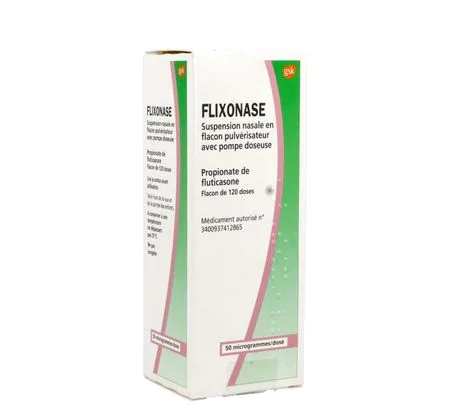
FLIXONASE 50 micrograms/dose, nasal suspension in pump spray bottle with metering pump
Composition
Per dose:
Fluticasone propionate: 50,00 micrograms
Excipient with known effect: benzalkonium chloride.
Anhydrous glucose, microcrystalline cellulose and sodium carboxymethylcellulose (AVICEL RC 591), phenylethyl alcohol, benzalkonium chloride, polysorbate 80, diluted hydrochloric acid, purified water.
Indications
Seasonal allergic rhinitis in adults and children over 4 years of age.
Perennial allergic rhinitis in adults and children over 12 years of age.
Symptomatic treatment of nasal polyposis in adults.
Dosage and administration
Regular use is essential to obtain maximum therapeutic benefit. Advise the patient that a delay of 3 to 4 days of treatment may be necessary before effects on allergic rhinitis symptoms are observed.
Contact with the eyes should be avoided.
Dosage
- Allergic rhinitis:
Adults and children over 12 years of age (seasonal and perennial allergic rhinitis): 200 μg as a single intake per day, i.e. 2 sprays of 50 μg in each nostril 1 times daily in the morning. It may be reduced to 100 μg per day once symptom improvement has been obtained.
Children aged 4 years to 12 years (seasonal allergic rhinitis): 100 μg as a single intake per day, i.e. one spray of 50 μg in each nostril 1 time daily in the morning.
The maximum dosage is 2 intakes per day of 200 μg in adults and adolescents aged 12 years and over, or 2 intakes per day of 100 μg in children aged 4 to 12 years.
Initiation and duration of treatment depend on allergen exposure.
- Nasal polyposis:
Adults:
Attack treatment: 400 μg per day, i.e. 2 sprays of 50 μg in each nostril 2 times per day, morning and evening.
Once symptom control is obtained (generally, after 1 to 2 months), maintenance treatment: 200 μg per day, i.e. 2 sprays of 50 μg in each nostril, once per day in the morning.
The tolerability and efficacy of fluticasone propionate in the treatment of nasal polyposis in children have not been evaluated.
Method of administration
Nasal use.
Contraindications
- Hypersensitivity to the active substance or to any of the excipients listed in section Composition.
- Haemostasis disorders, in particular epistaxis.
- Oro-buccal-nasal and ophthalmic infection by herpes simplex virus.
- Children under 4 years in the absence of clinical data.
Warnings and precautions
Infections of the nasal passages must be treated appropriately, but they do not constitute a contraindication to treatment with fluticasone propionate.
Systemic effects may occur during long-term treatment with high doses of intranasal corticosteroids. The risk of systemic repercussions nevertheless remains lower than with oral corticosteroids and may vary depending on individual susceptibility and the composition of the corticosteroid product used. Possible systemic effects are: Cushing's syndrome or Cushingoid symptoms, skin thinning, subcutaneous bruising, adrenal insufficiency, growth retardation in children and adolescents, decreased bone density, and more rarely, psychological and behavioural disorders, including psychomotor hyperactivity, sleep disorders, anxiety, depression or aggressiveness (particularly in children).
Concomitant administration of intranasal corticosteroids in patients on long-term oral corticosteroid therapy does not dispense with the necessary precautions when reducing oral corticosteroid doses. These will be reduced very gradually and withdrawal must be carried out under careful medical supervision (watching for signs of acute or subacute adrenal insufficiency), continuing beyond the discontinuation of systemic corticosteroid therapy.
The risk of systemic effects of corticoadrenal suppression and of repercussions on growth is increased in case of concomitant administration of inhaled or a fortiori systemic corticosteroid therapy.
Growth retardation has been reported in children receiving intranasal corticosteroids. Therefore, children should receive the minimum dose of corticosteroids allowing symptom control to be maintained.
It is recommended to regularly measure children's height during prolonged treatment with intranasal corticosteroids and to consider consulting a paediatrician if necessary.
Treatment with intranasal corticosteroids at doses higher than the recommended doses may lead to clinically significant adrenal insufficiency. If it proves necessary to use doses higher than the recommended doses, systemic corticosteroid supplementation should be considered during periods of stress or when a surgical procedure is planned (see section Pharmacodynamics for data on fluticasone propionate).
Local intranasal administration of corticosteroids is not recommended in patients who have recently had an ulceration of the nasal septum, or who have undergone surgery or trauma to the nose, until healing is complete.
Advise the patient that this is regular and continuous treatment. In allergic rhinitis, several days of treatment may be necessary before effects on allergic rhinitis symptoms are observed; in nasal polyposis, this delay may be several weeks.
Fluticasone propionate treatment may not be sufficient to treat seasonal allergic rhinitis symptoms in the case of particularly high exposure to summer pollens, and another treatment should be associated.
Nasal patency should be ensured to allow optimal distribution of the product. Advise the patient to dry the nasal passages by blowing the nose before instillation.
In case of major nasal obstruction, a detailed examination of the ENT area should be performed.
In cases of pulmonary tuberculosis or pulmonary fungal infection, the institution of close monitoring and appropriate treatment is required.
In the case of prolonged treatment, detailed examinations of the nasal mucosa are required.
Ritonavir may considerably increase plasma concentrations of fluticasone propionate. Therefore, unless the expected benefit for the patient outweighs the risk of systemic corticosteroid effects, concomitant administration should be avoided. The risk of systemic corticosteroid effects is also increased with concomitant administration of fluticasone propionate with other potent inhibitors of cytochrome P450 3A4 (see section Interactions).
Visual disturbances may occur with systemic or local corticosteroid therapy. In case of blurred vision or the appearance of any other visual symptom during corticosteroid therapy, an ophthalmological examination is required to look for cataract, glaucoma, or rarer lesions such as central serous chorioretinopathy, as described with systemic or local administration of corticosteroids.
Athletes should be made aware that this product contains an active substance that may induce a positive reaction in tests carried out during anti-doping controls.
FLIXONASE 50 micrograms, nasal suspension in a spray bottle with metering pump contains 0,02 mg of benzalkonium chloride per dose.
Benzalkonium chloride may cause irritation or swelling inside the nose, especially if used over a long period.
Interactions
Under normal conditions of use, plasma concentrations of fluticasone propionate reached after nasal administration are very low due to a significant presystemic first-pass effect (hepatic and intestinal) and high plasma clearance through extensive metabolism mediated by cytochrome P450 3A4. Consequently, the risk of clinically significant interactions with fluticasone propionate appears low.
Nevertheless, an interaction study in healthy volunteers receiving nasal fluticasone propionate showed that ritonavir (a very potent inhibitor of cytochrome P450 3A4) at a dose of 100 mg twice daily increased plasma concentrations of fluticasone propionate several hundred-fold, resulting in a marked decrease in plasma cortisol concentrations. There is no data documenting the interaction with inhaled fluticasone propionate, but a significant increase in plasma concentrations is expected; cases of Cushing's syndrome and adrenal function inhibition have been reported. Concomitant administration of fluticasone propionate and ritonavir should therefore be avoided, unless the benefit outweighs the increased risk of systemic corticosteroid effects.
A small study in healthy volunteers showed that ketoconazole, a somewhat less potent inhibitor of cytochrome P450 3A4, increased the systemic exposure to a dose of inhaled fluticasone propionate by 150%. The reduction in plasma cortisol was greater than that observed after administration of fluticasone propionate alone.
Concomitant administration of CYP3A inhibitors, including products containing cobicistat or itraconazole, is expected to increase the risk of systemic side effects. The combination should be avoided unless the benefits outweigh the increased risk of systemic corticosteroid side effects; in this case, patients should be monitored for possible systemic corticosteroid side effects.
Fertility, pregnancy and breastfeeding
As with other medicines, the benefits of using nasal fluticasone propionate during pregnancy or breastfeeding should be weighed against the potential risks associated with the product or with other treatments.
Pregnancy
The systemic passage of intranasally administered corticosteroid is low.
In animals, experimentation shows a teratogenic effect that varies according to species.
In humans, epidemiological studies have not detected any malformation risk related to corticosteroid use during the first trimester.
In chronic diseases requiring treatment throughout pregnancy, a slight intrauterine growth retardation is possible.
Neonatal adrenal insufficiency has exceptionally been observed after systemic corticosteroid therapy at high doses. It seems justified to observe a period of clinical and biological monitoring of the newborn.
Breast-feeding
The passage of fluticasone propionate into milk has not been studied. Nevertheless, other corticosteroids are excreted into milk.
Therefore, although systemic passage after nasal administration is low, as a precaution, as with all corticosteroids, prescription during breastfeeding should only be considered if necessary.
Driving and using machines
No studies to date have evaluated the effects of FLIXONASE on the ability to drive vehicles or use machines. FLIXONASE is unlikely to have an effect on the ability to drive vehicles or use machines.
Adverse effects
Undesirable effects are listed below by organ class and by frequency.
Frequencies are defined as: very common (≥ 1/10), common (≥ 1/100 and < 1/10), uncommon (≥ 1/1 000 and < 1/100), very rare (< 1/10 000), including isolated reports, and not known (cannot be estimated from the available data). Very common, common and uncommon effects were described in clinical trials. The corresponding incidence in the placebo arm was not taken into account since it was generally comparable to the incidence observed in the active substance arm.
"Very rare" undesirable effects are derived from spontaneous reports after marketing.
|
Organ class |
Adverse effects |
Frequency |
|
Immune system disorders |
Hypersensitivity reactions,
|
Very rare |
|
Nervous system disorders |
Headache, unpleasant taste and smell* |
Common |
|
Eye disorders |
Glaucoma, increased intraocular pressure, cataract |
Very rare |
|
Blurred vision |
Frequency not determined (see section Warnings and precautions) |
|
|
Respiratory, thoracic and mediastinal disorders |
Epistaxis |
Very common |
|
Nasal dryness, nasal irritation, dryness and irritation of the throat* |
Common |
|
|
Perforation of the nasal septum** |
Very rare |
|
|
Nasal ulcerations |
Frequency not known |
* As reported with other nasal sprays
** Perforation of the nasal septum has been reported after use of other nasal corticosteroids
Cases of infections caused by Candida albicans nasal and pharyngeal infections have also been described with local corticosteroid treatment. In such cases, nasal corticosteroid therapy should be discontinued and appropriate treatment considered.
The risk of systemic effects related to fluticasone propionate administered nasally cannot be excluded. (See section Warnings and precautions).
This risk is increased with concomitant administration of inhaled corticosteroids or, even more so, systemic corticosteroids.
The risk of latent corticotropic insufficiency after prolonged administration should therefore be considered in cases of intercurrent infection, accident or surgical intervention.
Reporting of suspected adverse reactions
Reporting suspected adverse reactions after authorisation of the medicinal product is important. It allows continued monitoring of the benefit/risk balance of the medicinal product. Healthcare professionals are asked to report any suspected adverse reactions via the national reporting system: National Agency for the Safety of Medicines and Health Products (ANSM) and the network of Regional Pharmacovigilance Centres - Website: https://signalement.social-sante.gouv.fr.
Overdose
Signs and symptoms
No data are available on the effects of acute or chronic overdose with nasal fluticasone propionate. In healthy volunteers, administration of 2 mg of nasal fluticasone propionate 2 times daily for 7 days showed no effect on the hypothalamic-pituitary-adrenal (HPA) axis function.
Treatment
Administration of doses above the recommended doses over a long period may lead to temporary inhibition of adrenal function. In these patients, fluticasone propionate treatment should be continued at a dose sufficient to control symptoms. Adrenal function recovers normally within a few days and will be monitored by measuring plasma cortisol levels.
Pharmacodynamics
Pharmacotherapeutic class: Topical glucocorticoid (R: Respiratory System), ATC code: R01AD08.
Fluticasone propionate administered by nasal instillation has potent local anti-inflammatory activity on the nasal mucosa.
Fluticasone propionate has very little or no suppressive effect on the hypothalamic-pituitary-adrenal axis after oral, intranasal or topical administration.
A 1-year randomised, double-blind, placebo-controlled, parallel-group study evaluating growth in children aged 3 to 9 years (56 patients receiving 200 mg of nasal fluticasone propionate and 52 receiving placebo) showed no statistically significant difference in growth velocity. The estimated growth velocity after 1 year of treatment was 6,20 cm/year (standard deviation = 0,23) in the placebo group and 5,99 cm/year (standard deviation = 0,23) in the fluticasone propionate group. The mean difference in growth velocity after 1 year between treatments was 0,21 cm/year (standard deviation = 0,28, CI 95% [-0,35; 0,76]). No clinically relevant change was observed in hypothalamic-pituitary-adrenal axis function or bone mineral density.
Pharmacokinetics
After nasal instillation, part of the dose is swallowed but contributes only minimally to systemic exposure due to low aqueous solubility and extensive first-pass metabolism. Oral bioavailability is thus close to 0.
Systemic exposure increases linearly with increasing instilled dose.
After administration of 200 μg/day of nasal fluticasone propionate for 4 days in 12 healthy volunteers, no significant change in serum cortisol (area under the curve over 24 hours) was demonstrated compared with placebo (ratio 1,01; 90% CI 0,9-1,14).}
After administration of 2 400 μg (800 μg/day 3 times daily) of fluticasone propionate by nasal route in pressurised form for 4 days in 12 healthy volunteers, a significant decrease in the areas under the plasma cortisol curve of about 25 % compared with placebo was observed, accompanied by a significant decrease in urinary cortisol.
After oral administration of fluticasone propionate, 95 % of the dose is excreted in faeces, 70 % unchanged and 20 % as the main metabolite.
After intravenous administration, plasma clearance is rapid (1 150 ml/min) suggesting a very strong hepatic first-pass effect. The plasma half-life is approximately 3 hours. The volume of distribution is approximately 260 litres.
Plasma protein binding is 91 %.
Fluticasone propionate is eliminated very rapidly from the systemic circulation. The product is mainly metabolised to an inactive carboxylic acid derivative, by the isoenzyme CYP3A4 of cytochrome P450. Other unidentified metabolites are also found in faeces.
The renal clearance of fluticasone propionate is negligible. Less than 5 % of the dose is excreted in urine, mainly as metabolites. The majority of the dose is eliminated in faeces as metabolites and as unchanged substance.
The terminal half-life is approximately 8 hours.
Prescription, supply and reimbursement
| Marketing authorisation (AMM) |
|
| Price: |
|
GlaxoSmithKline Laboratories
23, rue François-Jacob. 92500 Rueil-Malmaison
Tel: 01 39 17 80 00
Medical information:
Tel: 01 39 17 84 44. Fax: 01 39 17 84 45
Website: www.fr.gsk.com
Source: VIDAL · Updated on 10/11/2026. This information does not replace advice from a healthcare professional.