
Medicines
SmPC of 05/03/2026
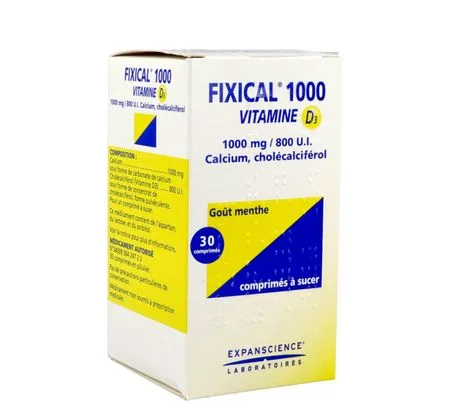
FIXICAL VITAMIN D3 1000 mg/800 IU, chewable tablet
Composition
Calcium ..................................................................................................................................... 1 000 mg
In the form of calcium carbonate
Cholecalciferol (Vitamin D3) ......................................................................................................... 800 IU
As cholecalciferol concentrate, powder form
For one chewable tablet.
Excipients with known effect: aspartame, lactose, sorbitol.
Xylitol, povidone excipient K30, aspartame (E951), levomenthol, mint flavouring (containing in particular sorbitol), talc, magnesium stearate, lactose monohydrate.
Indications
- Correction of vitamin and calcium deficiencies in elderly subjects.
- Vitamin and calcium supplementation associated with specific treatments of osteoporosis, in patients who are deficient or at high risk of vitamin D and calcium deficiency.
This medicine is indicated in adults.
Dosage and administration
Dosage
1 tablet per day.
Method of administration
Oral use.
Chewable tablet, then drink a glass of water.
Contraindications
- Hypercalcaemia, hypercalciuria, calcium lithiasis.
- Prolonged immobilisation accompanied by hypercalciuria and/or hypercalcaemia: vitamin-calcium treatment should only be used when mobilisation resumes.
- Hypersensitivity to the active substances or to any of the excipients listed in section Composition.
- Phenylketonuria, due to the presence of aspartame.
- Children under 15 years of age.
Warnings and precautions
During long-term treatment, it is justified to monitor urinary calcium excretion and to reduce or temporarily interrupt treatment if it exceeds 7,5 mmol/24 h (300 mg/24 h).
Take into account the dose of vitamin D per intake unit (800 IU) and any other prescription of vitamin D. As this medicine already contains vitamin D, the additional administration of vitamin D or calcium must be carried out under strict medical supervision, with weekly monitoring of serum calcium and urinary calcium.
This medicine should be prescribed with caution in patients with sarcoidosis due to a possible increase in the metabolism of vitamin D to its active form. In these patients, serum calcium and urinary calcium should be monitored.
This medicine should be used with caution in patients with renal impairment, with monitoring of the calcium-phosphorus balance.
This medicine contains 16 mg of aspartame per tablet. Aspartame contains a source of phenylalanine and may be harmful to people with phenylketonuria.
This medicine contains lactose. Patients with galactose intolerance, total lactase deficiency or glucose-galactose malabsorption syndrome (rare hereditary diseases) must not take this medicine.
This medicine contains 0,67 mg of sorbitol per tablet.
Interactions
Associations requiring precautions for use
+ Digitalis glycosides
Oral administration of calcium combined with vitamin D increases the toxicity of digitalis (risk of rhythm disorders). Strict clinical monitoring and, if appropriate, monitoring of the ECG and blood calcium levels are necessary.
+ Bisphosphonates
It is advised to observe a minimum interval of two hours before taking calcium (risk of reduced digestive absorption of bisphosphonates).
+ Oral cyclines
It is recommended to delay calcium intake by at least two hours (possible reduction in cycline absorption).
+ Oral iron salts
It is recommended to take iron away from meals and in the absence of calcium (reduced digestive absorption of iron salts).
+ Estramustine
Take calcium salts away from estramustine (more than 2 hours, if possible) (reduced digestive absorption of estramustine).
+ Thyroid hormones
Take calcium salts away from thyroid hormones (more than 2 hours, if possible) (reduced absorption of thyroid hormones).
+ Strontium
Take strontium away from calcium salts (more than 2 hours, if possible) (reduced digestive absorption of strontium).
+ Zinc
Take calcium salts away from zinc (more than 2 hours if possible) (reduced digestive absorption of zinc by calcium).
+ Enzyme-inducing anticonvulsants
Decrease in vitamin D concentrations more marked than in the absence of an inducer.
Measurement of vitamin D concentrations and supplementation if necessary.
+ Rifampicin
Decrease in vitamin D concentrations more marked than in the absence of treatment with rifampicin.
Measurement of vitamin D concentrations and supplementation if necessary.
Associations to be taken into account
+ Thiazide diuretics and related agents
Risk of hypercalcemia due to decreased urinary elimination of calcium.
+ Orlistat
Decreased absorption of vitamin D.
+ Food
Possibility of interactions with foods (for example those containing oxalic acid, phosphates or phytic acid).
Fertility, pregnancy and breastfeeding
Pregnancy
Due to the high dosage of vitamin D3, this product is not indicated during pregnancy.
During pregnancy, overdosage with cholecalciferol should be avoided:
- overdoses of vitamin D during gestation have had teratogenic effects in animals.
- in pregnant women, vitamin D overdoses must be avoided because permanent hypercalcaemia may lead to physical and mental retardation, supravalvular aortic stenosis or retinopathy in the child. However, several children were born without malformation after administration of very high doses of vitamin D3 for maternal hypoparathyroidism.
Breast-feeding
Due to the high dosage of vitamin D3, this product is not indicated during breastfeeding.
Vitamin D and its metabolites pass into breast milk.
Fertility
Not applicable.
Adverse effects
Adverse effects are listed below, by System Organ Class and by frequency. Frequencies are defined as follows: uncommon (≥ 1/1 000 ; < 1/100), rare (≥ 1/10 000 ; < 1/1 000), frequency not known (cannot be estimated from the available data).
Skin and subcutaneous tissue disorders:
Rare: Pruritus, skin rash, urticaria.
Immune system disorders:
Frequency not known: Angioedema or laryngeal oedema.
Gastrointestinal disorders:
Rare: Constipation, flatulence, nausea, epigastric pain, diarrhoea.
Metabolism and nutrition disorders:
Uncommon: Hypercalciuria and exceptionally hypercalcaemia in case of prolonged treatment at high doses.
Special populations:
In patients with a medical history of renal insufficiency: risk of occurrence of adverse effects such as hyperphosphataemia, nephrolithiasis, nephrocalcinosis.
Reporting of suspected adverse reactions
Reporting suspected adverse reactions after authorisation of the medicinal product is important. It allows continued monitoring of the benefit/risk balance of the medicinal product. Healthcare professionals are asked to report any suspected adverse reactions via the national reporting system: National Agency for the Safety of Medicines and Health Products (ANSM) and the network of Regional Pharmacovigilance Centres - Website: https://signalement.social-sante.gouv.fr
Overdose
Overdose results in hypercalciuria and hypercalcemia, the symptoms of which are as follows: nausea, vomiting, polydipsia, polyuria, constipation.
Chronic overdose of vitamin D3 may cause vascular and tissue calcifications due to hypercalcaemia.
Treatment
Stop all calcium and vitamin D intake, rehydration.
Pharmacodynamics
Pharmacotherapeutic class: CALCIUM IN COMBINATION WITH OTHER SUBSTANCES, ATC code: A12AX.
Vitamin D corrects inadequate vitamin D intake.
It increases intestinal absorption of calcium and its fixation on osteoid tissue.
Calcium supplementation corrects dietary calcium deficiency.
Calcium requirements in elderly people are estimated at 1 500 mg/day and vitamin D requirements at 500-1 000 IU/day.
Vitamin D and calcium correct secondary senile hyperparathyroidism.
In a double-blind, placebo-controlled study lasting 18 months, 3 270 elderly women aged 84 ± 6 years, with a diet poor in calcium and living in care centres, received an additional intake of vitamin D (800 IU/day) and calcium (1,2 g/day). A significant decrease in PTH secretion was observed. After 18 months, the results of the intention-to-treat analysis revealed 80 hip fractures (5,7%) in the calcium-vitamin D group and 110 hip fractures (7,9%) in the placebo group (p = 0,004). Thus, under the conditions of this study, treatment of 1 387 women prevented 30 hip fractures. After 36 months of follow-up, 137 women had at least one hip fracture (11,6%) in the calcium-vitamin D group (n = 1 176) and 178 (15,8%) in the placebo group (n = 1 127) (p ≤ 0,02).
Pharmacokinetics
Calcium carbonate
Absorption
During dissolution, the calcium salt contained in FIXICAL VITAMIN D3 1 000 mg/800 IU is converted into calcium citrate.
Calcium citrate is well absorbed, on the order of 30% to 40% of the ingested dose.
Elimination
Calcium is eliminated in the urine, feces and sweat secretions.
Vitamin D3
Absorption
Vitamin D3 is absorbed in the intestine.
Distribution - Biotransformation
Vitamin D3 is transported bound to proteins in the blood to the liver (first hydroxylation) and then to the kidney (second hydroxylation).
Vitamin D3 non-hydroxylated is stored in reserve compartments such as adipose and muscle tissues.
Elimination
The plasma half-life of vitamin D3 is on the order of a few days. It is eliminated in the faeces and urine.
SPECIAL PRECAUTIONS FOR DISPOSAL AND OTHER HANDLING
No special requirements for disposal.
Any unused medicinal product or waste material should be disposed of in accordance with local requirements.
Prescription, supply and reimbursement
| Marketing authorisation (AMM) |
|
| Price: |
|
Collect (Pilul/30).
26 AVENUE TONY GARNIER
69007 LYON
Tel: 04 72 72 60 72 Tel (toll-free): 0811 65 27 76
contact@laboratoire-arrow.com
http://www.laboratoire-arrow.com/
Source: VIDAL · Updated on 10/11/2026. This information does not replace advice from a healthcare professional.